Sucre is a small city in the middle of Bolivia with a vibrant colonial old town. Exploring Sucre is the perfect way to spend a few days chilling out before getting on the road again.
Exploring Sucre: Treasures
“I’d like to go to Australia so I could visit Coober Pedy”, the smiling middle-aged woman in the gift shop shares on hearing Michelle is Australian. It’s one of the stranger places to want to go in Australia. Sydney, Uluru, Barrier Reef, yes. But an underground town in the middle of the South Australian desert doesn’t usually crack a mention on tourist lists.
We’re in the Museo del Tesoro (Treasure Museum) in Sucre where a wide range of Bolivian gems and precious metals are on display. So it’s not that surprising that the woman in the gift shop is explaining how she loves mining and would like to see the huge underground opal mines of Australia.
We are guided around the small museum at a rapid pace to learn about the mining of silver and gems in Bolivia. It’s a long and somewhat sordid history for this country, which is a veritable treasure trove of precious materials. What started with the indigenous people trading with other tribes, led to the Bolivian town of Potosí becoming one of the largest and wealthiest cities in the world under Spanish rule, and then a huge uprising against shocking working conditions.


It doesn’t rate a mention in the museum, but we can’t help but think about the most recent precious material that’s being drawn from the earth here at a rapid clip: lithium. It seems history may be repeating as the wealth quickly moves out of the country.
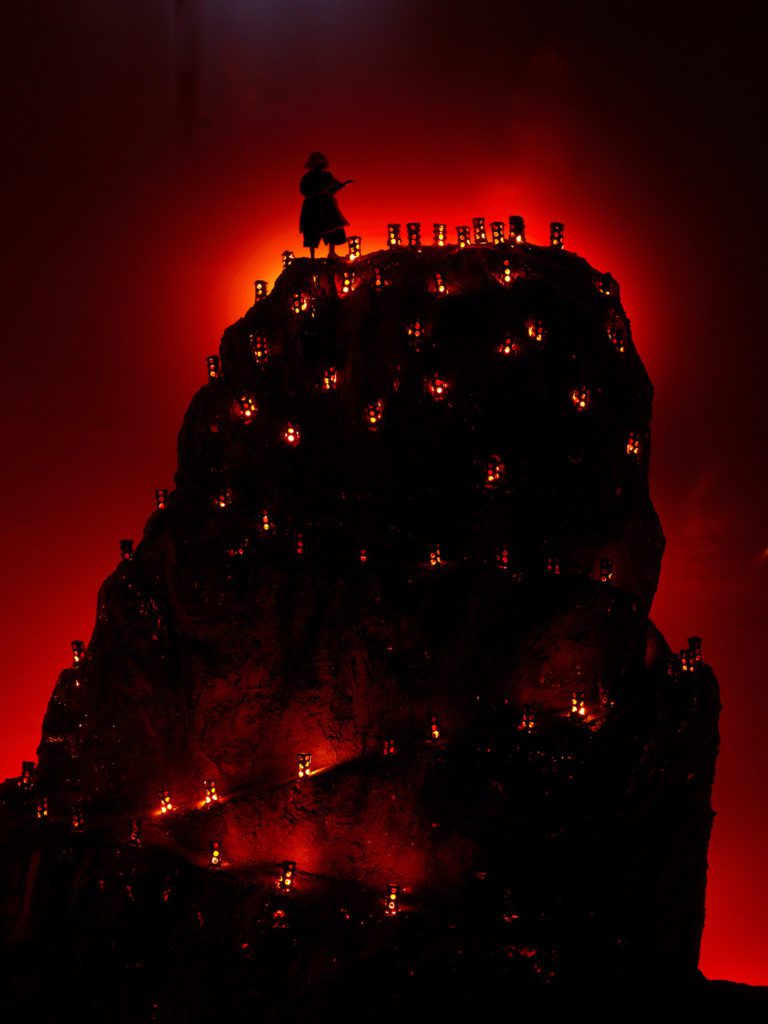
One of the more fascinating parts is a display showing how the indigenous people used small clay chimneys about 60cm high to smelt silver. They set these miniature smelters up in a spiral around the ridges of a specific mountain so that the prevailing nightly wind could accelerate the burning of llama dung and help reach the temperatures needed for melting the silver. The shape and basic technology is remarkably similar to what is still used today (minus the llama dung).
Bolivia is also home to a host of quartz-based crystals of all colours and sizes. One of the interesting crystals is Bolivianita, a gem that forms amatrine, as a combination of purple amethyst and yellow citrine together. It’s only found here in Bolivia, where it’s formed in large bubbles in the volcanic rock from crystals, under the Amazon jungle near the border with Brazil.

We may have bought a couple of things at the gift shop. Our first souvenirs in 4 months.

Faces of Independence
Bolivia. As we stand in front of large portraits of the people credited with establishing Bolivia we feel a little foolish that we’re only just now realizing the source of the country’s name. You can’t really travel anywhere in South America without learning about the legend that is Simón Bolívar. He was a Venezuelan who is credited with securing independence for Colombia, Venezuela, Ecuador, Peru, Panama and Bolivia from the Spanish Empire. Bolívar, Bolivia.
The museum guide at the Casa de la Libertad tells us that Simón Bolívar in fact wanted the country named after Juana Azurduy, who is celebrated as the heroine of HIgh Peru (the original name of Bolivia). Inspired by the poor conditions of the indigenous people, she fought for 15 years against the Spanish rule, first as a general in the army and later as a guerrilla. She is credited with playing a key part in the independence of both Bolivia and Argentina. In recognition, a statue of Christopher Columbus was somewhat controversially replaced with a statue of Azurduy outside the Government House in Buenos Aires for a short time. She had to make do with a Province named after her instead.


As it stands today, Bolivia is quite progressive as it is actually a collection of 37 nations, representing many of the original indigenous groups from the region.
Exploring Sucre: The White City
When nearby Potosí was in its heyday in the 1700’s, many of the elite chose to live in Sucre. It has a much warmer climate and an easier altitude at ‘just’ 2,800m above sea level. Al can sympathise as he’s feeling much better than he was at 4,000m in Uyuni.
As a result, the old town is a pretty colonial mélange of churches, city buildings, convents and large old houses. Many of these are painted white with coloured features and have large internal patios that have been converted to cafes. Despite this charm, it doesn’t feel overwhelmed with tourists. Instead there are high school and University students wandering around and locals sitting in the main square. At one point the streets are closed so one of the local high schools can march through with their band in celebration of the anniversary of their founding.


There’s not a huge number of tourist attractions, but that’s part of the charm. We can immediately see the allure of studying Spanish here, which is apparently quite a popular option.
Big City Tastes
We discovered some very good restaurants in Sucre, and even some good Bolivian high altitude wine. Dare we say, the Bolivian high altitude wine is more balanced and less bitingly acidic than the Argentinean equivalent. We had delicious homemade pasta at Cafe Monterossa where you have to knock on the door of a family home to be allowed in. Inside it feels wonderfully warm and as though you’re in their home. We also had an excellent steak meal at the French restaurant La Taverne.


Sucre In a Nutshell
Catching the Bus to Sucre:
It’s about six hours by bus from Uyuni to Sucre. A popular option seems to be to take the night bus, which leaves at 9:30pm.
To us this reeks of madness.
Let’s do the math. 6 hours leaving at 9:30 gets you in to Sucre at 3:30 in the morning. The only welcoming you’re getting at that time in the morning is from one of the packs of wild dogs roaming the streets. And to add to your misery, you’re not checking in to your accommodation until 2 in the afternoon. So you’ll be roaming the streets of Sucre for ten hours, probably foaming at the mouth after catching rabies from the dog bites you’ve sustained. (To be fair, the packs of wild dogs seem to be limited to Uyuni)
No. A much more sensible option is to catch a bus from Uyuni to Potosi first thing in the morning. Buses leave at various times in the morning – just walk up and down the street where all the buses leave from and ask what time their bus goes. We caught a 9am bus which arrived in Potosí right on time four hours later, at 1pm, at the old bus station.
From Potosí you have a choice. You could spend a couple of hours here (or even the night) exploring the town. The Museum of Money (the old Mint) is supposed to be excellent (although when we were there it didn’t open until 2:30, and we didn’t want to hang around). You could do a tour of the mine (popular, if a little controversial). Michelle being more than a little claustrophobic has ruled this out anyway, but from what we’d read we weren’t going to do the mine tour.
Whatever you decide, to catch a bus to Sucre you’ll need to make your way to the new bus station (Nuevo Terminal). It’s about 2.5km from the old terminal, 15Bob by taxi for two people.
Buses leave the station regularly – like, every hour all day long. The journey takes three hours.
We took the 2pm bus and had time for a quick lunch beforehand. If we did it again, I’d suggest going into the old town for a quick look around and a bite to eat before heading to the bus station. Leaving Potosi at 4pm still gets you in to Sucre at a very respectable 7pm.
The airport is quite a long drive from the city but roadworks we saw indicate this could change soon. We flew with BOA from Sucre on to La Paz. It is a budget airline but they were very efficient and it was a nice plane.
Like most places in Bolivia, and South America, give yourself extra time in Sucre. it can be hard to find opening times and guided tour information online. You need to check in once you’re there and possibly return the next day for the scheduled times. We tried three times to find a way up to the rooftop of the Iglesia de San Felipe Neri only to finally discover you have to knock on the door between 2:30pm and 5:30pm.
Guided tours do give a much richer experience as there is very little English signage in Bolivia.