
This post is part of ‘The Big Loop’ series, which chronicles our summer road trip from Ontario out to the West Coast of Canada and back via the northern US states.
After two weeks enjoying the wonders of Alberta and British Columbia with Michelle’s family, we’re now turning our back to the sea and heading east. For something a little different we’ve decided to drop down into the northern states of the US – from Oregon, through the Wild West of Idaho, Wyoming, and North Dakota and then on to Illinois, stopping off on the way at some ‘wish list’ places like Yellowstone and Grand Teton National Parks.
Well Hello Oregon, We like You Already
“What are you doing in St Paul?” the couple at the bar ask us, in a state of shock to find tourists in their town of just 440 people, well off the main highway.
Good question.
It was a story of serendipity that’s landed us here in the Harvester Taphouse in the tiny town of St Paul, Oregon on a warm July evening. A band is playing under huge redwood trees in the beer garden, the place is packed with large groups of locals, and there’s a general feeling that life is good. And as it turns out, next to us at the bar is a couple on their first date.
We had started the day in Vancouver BC, with the plan to drive the 6 hours south to the Willamette Valley, a region well known for excellent Pinot Noir and home to one of our favourite wines, Sokol Blosser. Unfortunately a few thousand other travellers got in the way and by the time we pulled into Dundee township it was well past usual wine tasting time. We headed to the hopefully named ‘After Hours Bar’ only to discover it was closed for a private event. After 9 hours on the road the disappointment was palpable.
In a last ditch effort we headed over to Archer Vineyard Tasting Room, which Google assured us was open until 8pm. As we pulled in a group of pre-teen t-ball players were running around out the front and it didn’t look very hopeful. But, it turned out to be a perfect antidote to 9 hours in the car. A low-key, family run place with a nice selection of easy drinking wine.
As we explained our story of woe, Sarah took pity on us and plied us with a range of their wines (a nice Rosé, and the 2017 Hopewell Pinot Noir was very good) and chatted to us for about 45 minutes about her career outside the wine industry and the story of their family winery. They keep the tasting room / bar open later than the surrounding wineries so that people staying in their RV park can stop in for a drink. Hence the t-ball players. We approve.

As the crowd thinned we found ourselves sitting with Sarah’s dad, the founder of the winery, who was having a drink with friends. He’d called us over and grilled us about who we were, where we were from and where we were going. One of his drinking buddies was a laid back, middle-aged guy who was introduced as the best local craft brewer in the area, Paul Long. Paul is a chemical engineer who decided to start a craft brewery in regional Oregon in his retirement. He provided us with several options for dinner, and the one high on his list just happens to have four of his beers on tap.
And so here we are at the Harvester Taphouse talking to a guy with a penguin on his t-shirt and his date. We explain how we ended up here and they both say in unison, “Oh, I know Paul”. Of course you do.

Around the Bend
We’d added a stop to our trip in the central Oregon town of Bend solely to catch up with our friends Kristen and Mike. We had absolutely no idea how awesome it is.
Just minutes after we arrive, Mike has us on mountain bikes and taking the trail into town to the local craft brewery. It didn’t take long for us to figure out we were going to like this place.
We spend the next three days in the summer sunshine cycling all over town to Mike and Kristen’s favourite cafés and restaurants, checking out some local art, golfing and hiking.


As we stand on a restaurant rooftop patio on the outskirts of town Mike points out the buttes and peaks of the Cascade mountains that surround his hometown. Even though he hasn’t lived here for years it’s obvious he loves it. It has that laid-back mountain town feel with a ton of outdoor fun, lots of great locally owned galleries and stores. It’s right on the edge of the rain shadow of the mountains, so is surrounded by forest but still enjoys 300 days of sunshine. What’s not to like?
What we didn’t know, but wished we’d planned for, was the awesome line up of bands that play at the Bend outdoor amphitheatre every summer. In the days before and after our visit they had Beck, Stone Temple Pilots, Smashing Pumpkins and Cake. In the same week! And we missed ’em all.
Into the Wild West
“Be prepared for a mind-numbingly boring drive. And make sure you fill your fuel tank.” That was the warning from practically every person we met in our three days in Bend. They were talking about the next leg of our trip, the drive east from Bend toward Idaho.
Our drive from the Oregon coast to Bend earlier this week had been exactly as we had pictured Oregon, roads winding through forests of tall fir trees, large lakes and mountains. Trees as far as the eye could see.
Apparently, that is all about to change. We’re entering the ‘high desert’ formed over 30 million of years ago by huge volcanoes. Almost as soon as we leave Bend the trees disappear and we’re surrounded by flat, hot, dry landscape with not a single tree in sight.
It turns out the Bend locals were right. We drive over 300km and see very little sign of human life. And take not a single picture.
If we’d had more time, and hadn’t already driven over 4,000km in the last 4 weeks, we might have taken the alternative route through John Day which looks quite spectacular.
Ah, the Smell of Manure in the Morning
Sorry Idaho, but the only lasting memory we have of you is the smell of manure. A very strong smell of manure. It’s hot the day we drive across Idaho and each time we get out of the car, we open the door and are immediately hit by a strong, dry wind carrying an overwhelming smell of manure. Idaho is famous for its potatoes but apparently they have a healthy number of cows too.
As we get closer to Wyoming the landscape starts to change from flat, dusty plains as the road winds through high canyons of red rock. Welcome back to the Rockies. We’d spent a week in the Canadian section of the Rockies a couple of weeks ago and now we’re crossing back over them once again.

Grand Teton National Park: Oh Niño!
The sign at the ranger station was not encouraging. Severe Weather Alert: Flood warning for the next 48 hours.
Our two-month road trip across Canada and then back through the US was roughly based on a few ‘wish list’ places to visit. For Michelle one of these was the Grand Teton National Park, home to amazing multi-day hiking through the mountains. We were planning on a four-day hike through the Painted Canyon and Cascade Canyon loop.
Sadly, the start of El Niño had other plans. As we drove across the Wyoming border the beautiful blue skies we’d been enjoying for the last week were suddenly replaced by big black clouds. It had rained all afternoon and when we arrive at the park, the ranger explains they’re not recommending setting out on a hike for the next two days.
Turns out 2023 is shaping up to be the wettest summer on record for this area. We’ve been incredibly lucky with hiking weather during our travels in the last 18 months so we can’t really complain. We hunker down in the tent and wait for the storm.


Alas, a visit to Yellowstone would have to suffice.

A Day in Yellowstone National Park
Old Geezers

We’ve been standing in the warm drizzling rain for about 20 minutes. More and more people have gathered as we get closer to the estimated time. We’re all focused on a shallow mound of yellow-orange rock about 60m across as a column of white steam gently flows out. There’s an excited murmur at one point when a gush of water comes up out of the centre of the mound.
We’re at the star attraction of Yellowstone National Park: Old Faithful.

The Yellowstone Caldera is the enormous crater of one of the largest ‘super volcanoes’ in the world (the largest is in Indonesia). An eruption 1.3 million years ago left a shallow underground chamber of magma estimated to be 60km by 29km. The result is a collection of the largest number of active geysers in the world, including the one we’re standing in front of: Old Faithful.
It’s not the biggest or highest geyser, but due to its isolation from other geysers it is very predictable. Every 94 minutes (give or take 10 minutes).
At 11:46am, exactly on cue, the steam gathers pace and suddenly a huge gush of boiling water spurts 40m straight up into the air. This lasts for several minutes until it gradually simmers back down.

All the hype and the hundred or so people here doesn’t detract from the wonder. Nature is cool.
Hot Spots
150 year-old Yellowstone was the first national park in the US, and some say in the world (*not fact-checked*). At 2.2 million acres it’s huge and on a warm day in mid-summer its rammed with visitors. It has so many visitors every year that the National Parks services are actively encouraging people to visit the many other amazing US National Parks instead.
It’s a little different to our usual national park experiences of wilderness and quiet, but there’s a reason so many people flock here.
After wandering the boardwalks of the Upper Geyser Basin hot springs, mud pots and geysers, oohing and ahhing at the cool effects, we drive about 40 minutes further through the park to the tantalisingly named Grand Prismatic Hot Springs. As we walk over the bridge entry we see boiling water rushing over the red-stained rocks and down into the river.

Grand Prismatic Hot Spring is the largest hot spring in the park, at over 100m wide and almost 40m deep. But that’s not the main reason for the attraction. It’s the bacteria.
We follow the boardwalk several hundred meters over the moonscape of rock formed by the boiling water flowing from the spring down to the river. We can see a large cloud of steam rising from the spring but it’s not until we get close that we see the rainbow of colours reflected in the steam. The crystal clear, ice blue centre is surrounded by a green and then a yellow ring and then further out are hundreds of small shallow pools like tiny rice paddies that are various hues of orange and red. The colours are different species of heat-loving bacteria, the only living things that can survive in this water.

We take lots of cool photos but don’t have time to walk up to the high point where on a sunny day you get a better idea of the rainbow effect.
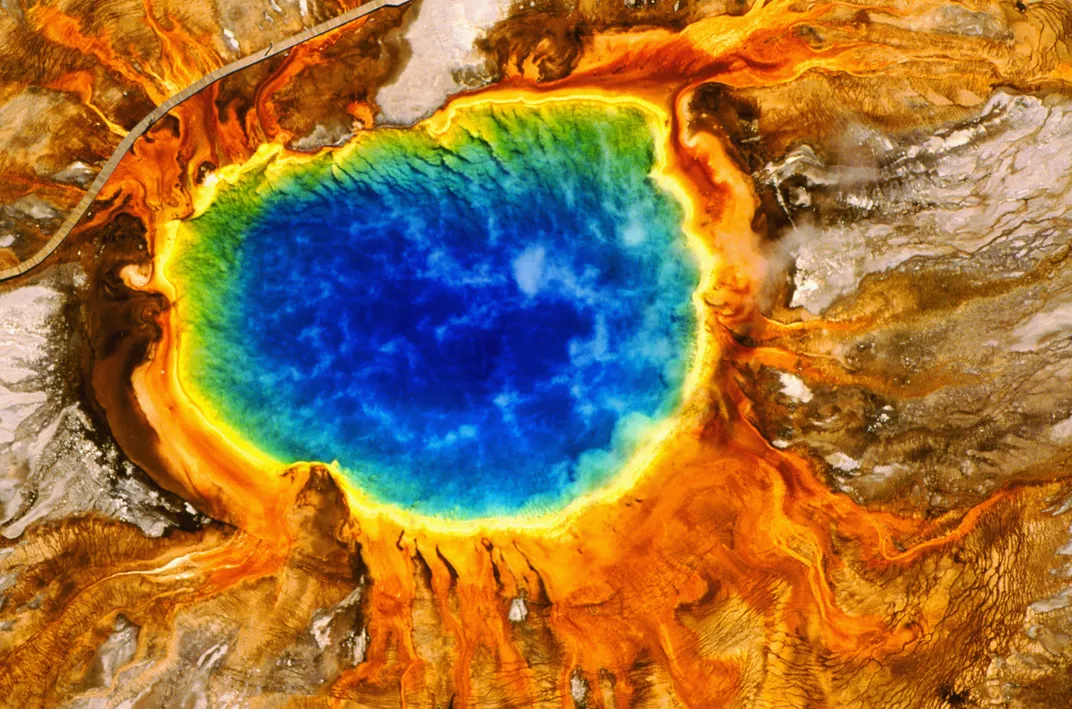
Photo courtesy smithsonianmag.com
Deep Cuts
Following the ring road through the park, the landscape changes from the harsh crater of the volcano to lush pine forest with lots of people fly fishing in the rushing river. Our last stop in the park is the Grand Canyon of Yellowstone. Figuring that this was most likely a marketing ploy we chuckle at this reference.
But as we wander down from the parking lot, we stop at scenic spots that are progressively more and more spectacular until we reach the appropriately named Artist Point. And we retract our scoffing. We are standing on an outcropping looking up the canyon with its 300m walls of yellow rock towards two spectacular waterfalls. The first is 90m high and the second 30m.


That is the last attraction on our whistle-stop day through Yellowstone National Park so we take the road east. The rest of the week is going to be filled with very long days of driving across the wide plains of this huge country.
After leaving the park’s eastern gates, the drive is spectacular enough to be an attraction of its own. We wind our way through steep red rock faces that dwarf the cars. There are several campgrounds dotted along, including one called Clearwater that looks quite cool.

In the small town of Greybull we stay in the very cute Sage Motel where the young family have gone to a lot of effort to liven up the rooms with retro decor. We dry out soaked camping gear and head back out on the road. On our way out of town we pass by a range of disconcerting billboards such as one stating ‘4.3 million children in America have access to a loaded and unsecured firearm’. In this land of sweeping plains it does feel like a very long way from where federal laws and regulations are decided.
Just over an hour south of Greybull, the flat plains are suddenly interrupted by steep cliffs on either side of the road. We’re in Ten Sleep, a climbing mecca and a town with a fun name being the half-way point (exactly ten sleeps) from two Sioux Indian reserves.

El Niño continues to thrash us as we drive East from Wyoming and into South Dakota. While the thrashing rain slows us down we feel a lot better than the 500,000 motorbike riders heading to the massive annual Sturgis Motorbike Rally near our next stop.
As we drive through true cowboy country we stop in Sundance so Feathers can have a picture taken with ‘The Kid.’

Mountain Goats and Giant Jackalopes
The Badlands
“What I saw gave me an indescribable sense of mysterious elsewhere – a distant architecture, ethereal” Frank Lloyd Wright, 1935
On every continent in the world (except Antarctica) there are Badlands, areas of land where sedimentary rock has eroded to reveal wild shaped formations. The famous White River Badlands of South Dakota happen to be right off the main East-West highway that cuts through the Midwest, so they get a lot of attention.
As we drive into the park, ahead of us the sky is dark with large black clouds, broken by bright lightning strikes. Luckily, as we pull into the Pinnacles Overlook parking area the rain stops but the thunder is still rumbling all around and lightning can’t be far away. In front of us the view spreads out with pools of rain sparkling in between the tall ridges of sandstone as the late afternoon sun breaks through the dark clouds. In such a harsh, dry landscape the rain is a sharp contrast.

There are a few brave (or stupid?) souls out on the the viewing outlooks and we figure they might act as lighting rod alternatives to us. So we venture out to take a closer look. But after just a few minutes, sense prevails over bravado and we retreat to the Faraday cage of the car.

As we drive the Sage Creek Rim Road we spot some bison munching on the wild grasslands and we realise we’re on top of a butte the wall of which falls away to our left into the valleys of pinnacles all around.

We head back into the nearby town of Wall. For the last 200km of highway leading into the area there have been small billboards with old-fashioned humour advertising something called Wall Drug Store. Turns out it’s an old-fashioned tourist trap with a large complex of tacky ‘Wild West’ tourist shops.


More fun than the Wall Drug Store is the nearby ‘Carvers of the Hills’, otherwise known as home of the self-proclaimed World’s Largest Jackalope Sculpture. In the spirit of the Big Prawn in NSW, this roadside attraction takes things to another level.

It’s actually quite amazing as it stands 12 metres high and made with 3,000 pieces of woods of different types. The best part is you can walk inside, up a wooden staircase carved with 71 ‘wood spirits’ up to the second-floor balcony. Refreshingly in this age of all things computer generated, this was designed with just a pencil and paper and constructed in 2022.
The Jackalope, a mythical creature of a jack rabbit with antelope horns, actually originated in neighbouring Wyoming. Some early entrepreneurs managed to sell a stuffed rabbit with some horns stuck on it to a local shopkeeper. Hence was born the legend.
Apparently the Wyoming Government has even considered making the jackalope the mythical icon of the state. Not as ridiculous as it might sound given Scotland’s national animal is the unicorn. Seriously.
Like all good chainsaw art stores there’s a good collection of Bigfoot sculptures.

Sands of Time
The next day we drive the length of the Badlands Park from west to east as it winds through the pinnacles of sandstone. We walk the Notch Trail out to a view that gives a good sense of how this area suddenly stops and gives way to flat prairies all the way to the horizon. Some fellow hikers suggest we take the alternate route and we’re rewarded with an even better view.


Tonight our dart-board style trip planning lands us in the lesser known Jackson, Minnesota, where we spend an evening with the locals at Bridget’s BuckSnorts Brew Ha-Ha & Grill.

From here it’s an easy 800km hop-skip and jump to Chicago tomorrow. (Which tells you how wide this country is, when 800km feels like an easy day…)
Visiting Grand Teton, Yellowstone and The Badlands In A Nutshell:
If you’re thinking of visiting these three parks in the heartland of America, rest assured you’re not alone. Thousands of thousands of visitors flock here every summer, especially Yellowstone.
A visit to Yellowstone is mainly going to be driving around the park and stopping at a series of sites, with generally quite short and very accessible hikes of an hour or less. It’s busy all through the summer months, but still quite a cool place and worth a visit, especially for those with young kids or those of us with less mobility.
Grand Teton is much more about multi-day hikes through quite rugged landscapes. Some people stay near Yellowstone and do a day drive down to Teton, but this is a pretty long drive and probably not worth it. Better to plan to stay a couple of days camping and get out there for a longer hike or three.
Similar to Yellowstone, the Badlands is about the scenery, most of which you can capture from the viewpoints or with a short hike. Even in bad weather the Badlands have something to offer.

…or follow us on Instagram…