
Gros Morne Park South
Neither of us knew much about Gros Morne before we got to Newfoundland. We knew it was a National Park and a UNESCO World Heritage Site, and figured it would have to have some cool hikes. And we knew that it was the site of some pretty spectacular fjords (similar, but even more majestic than what we saw in Saguenay, Quebec). What we weren’t expecting was for the whole park to be so fascinating. Or that the fjords wouldn’t even be the star attraction. Or that rocks – yes, rocks – could be so interesting.
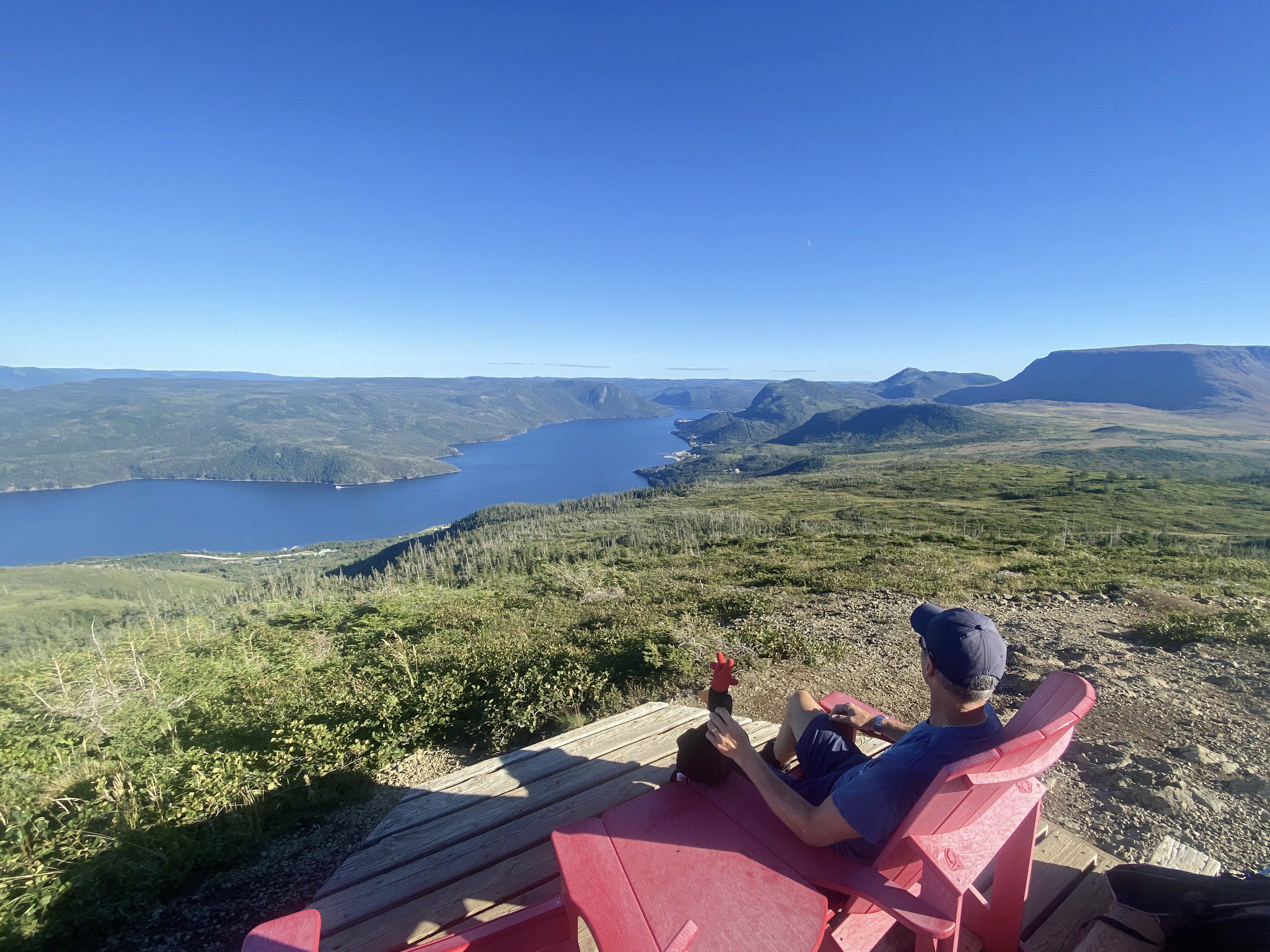
South Gros Morne: Lookout Trail
As an island on the edge of the Atlantic, Newfoundland gets its fair share of harsh weather. So when you’re lucky enough to have days of beautiful sunshine you want so make the most of every minute. Even when this means rolling onto town at 4pm and starting a hike. Luckily the Lookout trail was perfect for this as it’s is a perfect short hike with big impact. This was our first taste of hiking in the park. Its a great, short trail to do as an introduction to the park as from the top you get to see the different settlements dotted around the fjord. You get up high quickly and it gives you spectacular views of the park. The trail leaves from the Discovery Centre parking lot.

Tablelands Off-Trail Loop
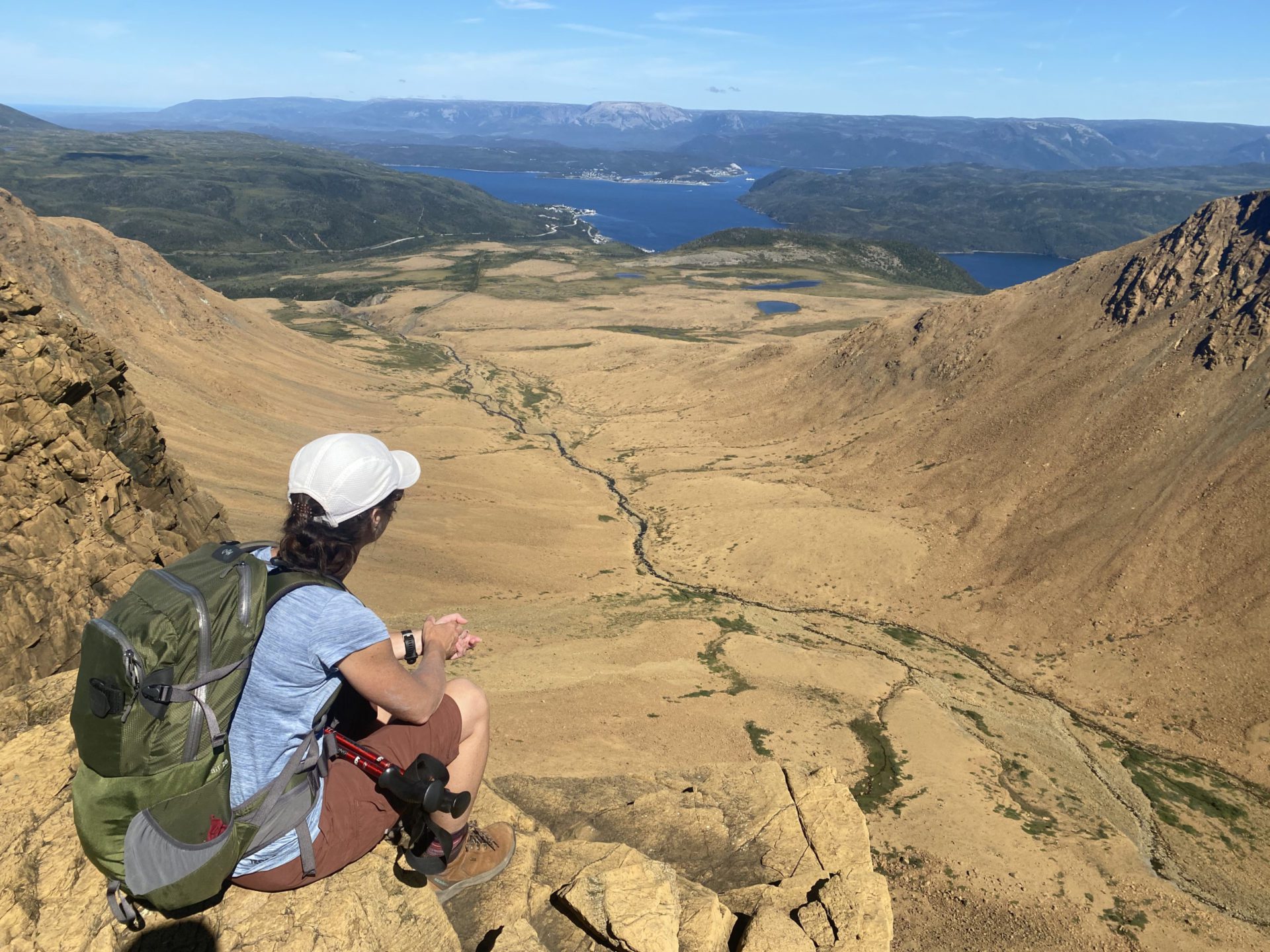
The Tablelands off trail hike was easily our top day hike in Gros Morne and in fact in all of Newfoundland.
It’s easy to see where the name of this area came from, with its freakishly flat top. But it’s not its shape that makes Tablelands so special. Terms like ‘bizarre’ and ‘otherworldly’ are regularly used to describe this landscape, and the Discovery Centre does an amazing job of describing the phenomenon that created this part of the Long Range mountain range, and why it was declared a UNESCO World Heritage Site. We’ll try and do it justice, but really, you should come and check it out yourself.
What you immediately notice about the Tablelands is how different they are from the other mountains around them. They are stark, largely devoid of vegetation, and have a reddish hue which many have compared to the surface of Mars. Even on Google Maps you can quickly see that they are completely unlike anything around them.
It was this uniqueness that drew Hank Williams, a Canadian geologist, to study the geological makeup of the Tablelands back in the late 60’s. His PhD supervisor, John Tuzo Wilson, had famously published a paper in 1966 that made some bold assertions about the formation and later destruction of an ancient ocean, the Iapetus.
The paper laid out the theory of plate tectonics which, although accepted today, at the time was controversial at best and quackery at worst, especially as the evidence to prove the theory had not yet been discovered. It was Williams’ work at the Tablelands which provided this evidence, by demonstrating that the rocks making up the terrain here were in fact ancient (500+ million years old) exposed parts of the earth’s mantle, an extremely rare phenomenon caused by one tectonic plate ‘bulldozing’ the surface of another plate as they were pushed together. This provided the proof for Wilson’s Plate Tectonics theory, and led to Gros Morne being recognized as a UNESCO site in 1987. It continues to bring scientists to the area to study its unique geology.
And, it offers a spectacular and extremely challenging hike. It’s called the ‘Off trail loop’, with a heavy emphasis on ‘off trail’ – in fact it should probably be called ‘No trail loop’. It’s a 14km round trip and took us about 7 hours to complete.
We started our hike by tagging along with the National Park’s daily guided walk along the main trail. The guide gave us all sorts of useful intel about the formation of the park, as well as the (lack of) flora and fauna, and the rockology of the place. It’s free and worth tagging along if the timing works for you.
We walked in an anti-clockwise loop, starting by following the creek and then the steep incline up the face of the cliff. Once on top you are rewarded with spectacular views as you follow the edge of edge of the cliff around do a wide canyon. Going in this direction means you finish your day with a long haul out over the rocky base of canyon. In hindsight, we’d recommend going clockwise starting the off-trail from the end of the official trail. This is not a trail for the faint of heart; take plenty of water and start early.
Green Gardens Trail
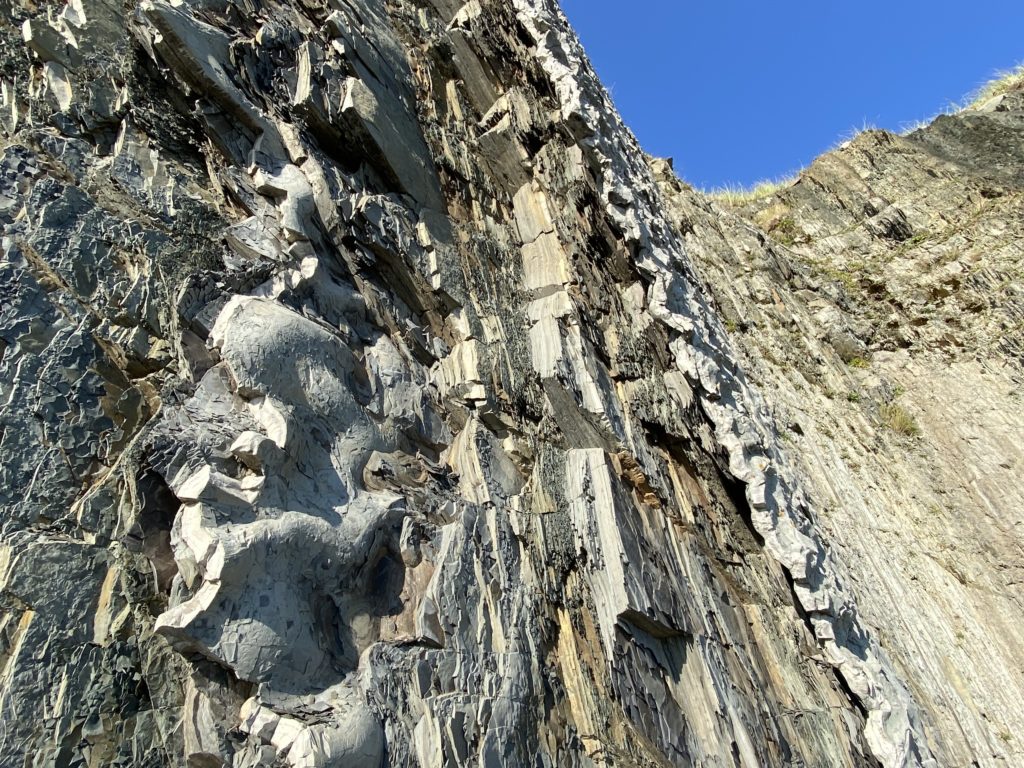
The Green Gardens Trail is the opposite of the Tablelands in some ways. It’s a walk through dense, low trees down from the high cliffs to the shore of Western Newfoundland on the Gulf of St Lawrence. Here the geology lesson continues as you see a more ‘traditional’ example of the mantle being exposed to us humans up here. They were formed when an underwater fissure was spitting out globules of magma which formed these telltale sphere shapes. The ocean later retreated, leaving the globs behind.
Where to Stay
By chance, and because we couldn’t get the accommodation we wanted for a full week, we split up our week in the park with a few days in the South followed by several more days in the North. Given it’s over an hour to drive between one side and the other this ended up being a great decision. We’d definitely recommend doing the same.
1 thought on “Hiking Gros Morne South”
Comments are closed.