An extended stay in a world-class city like Buenos Aires is an absolute luxury. We have lazy mornings and then wander out for some sightseeing and lunch. On the other hand, our utter lack of pre-planning and corresponding lack of urgency to try and ‘see it all’ means our two weeks in Buenos Aires is a little… unstructured. But that’s OK too.
Argentinians and Porteños
“Fernet and cola is the national drink and is like the Argentine people – it takes a while to get used to,” our walking tour guide says with a chuckle.
Argentinians, it seems, are well aware of their reputation in Latin America. Way back when we first arrived in Argentina, we had been bracing ourselves for a heavy dose of arrogance and machismo, based on everything we’d been told in Colombia and Chile. But from the moment we arrived in Mendoza we discovered the polar opposite: a warm and friendly people, outgoing and always happy to say hello, ask how you are and offer their help. Proud of their country, yes, but after having spent six weeks in this wonderful country, we can understand why.
And the Porteños (Buenos Aires natives)? Well, if you believe what the other Argentinians say about Buenos Aires, prepare for super-sized attitudes. An example: Porteños have a unique way of pronouncing the double-L sound found in words like ‘pollo‘ (chicken). Literally everywhere else in the Latin world pronounces the double L as a j or a y – so ‘pojo‘ or ‘poyo‘. But Porteños pronounce it as ‘posho‘. And when they travel to other parts of Argentina, they will correct people who mispronounce it.
Porteño: ‘El posho, por favor.’
Waiter: ‘Ah, el pojo, bueno. ¿Nada mas?’
Porteño: ‘No, no, no – POSHO.’
Hahaha. Maybe we’ve been in South America too long, but that’s uproariously funny to us.
But then, when you live in a city that houses almost a third of all Argentinians, and where everything is on a bigger and grander scale, it’s perhaps not surprising to find personalities that are a little bigger, and a larger sense of pride in their city and their country. Being from (near) Toronto, Al sees a similar attitude to that of someone from Toronto – ‘Well, if it weren’t for us, the rest of you wouldn’t be here…’ In the nicest possible way, of course.
But even in a city of 17 million people, when you walk down the street people still greet you with a cheerful ‘buon dia’ as you pass. Imagine that in a place like Toronto or New York (Al cannot).
Two Weeks in Buenos Aires: The Paris of South America
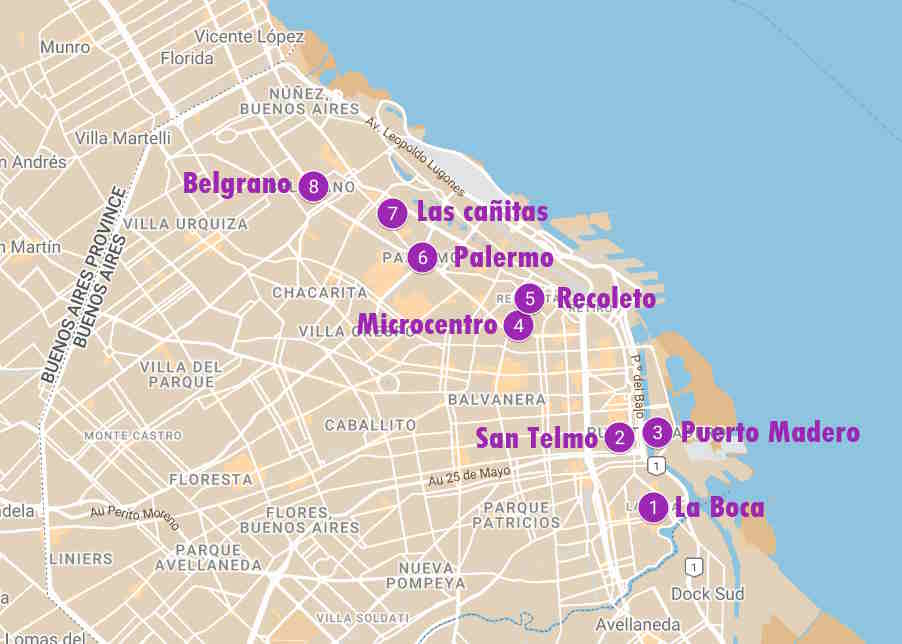
Buenos Aires, or BA for the hip and cool, can be a little hard to get a handle on. Despite the fact that it sits on the edge of a huge bay, the city itself has ‘turned its back on the water’. and doesn’t have a seashore or riverbank to orient yourself around. Instead, Buenos Aires is a patchwork of four dozen neighbourhoods or barrios, each with its own personality. In the two weeks we’ve got here, we’re going to do our best to explore some of these barrios and hopefully start to understand why it’s known as the ‘Paris of South America’.
BA feels like the kind of city you could just keep wandering around in and discover new buildings and places all the time. Each time we catch a city bus home it seems to take a slightly different route, past beautiful huge old colonial buildings. The main tourist highlights are in the neighbourhoods that follow the curve of the coastline from the old port of La Boca in the south, through the Microcentro and then on to the hip area of Palermo further north west.
We’re staying in Las Cañitas, just a little north of the hipster Palermo. It’s a low-key area, quiet at night, close to parks and with easy access to transport. It’s about a 45 minute drive from here to the other end of the tourist sights along the wide avenues and through the winding backstreets. Rather than give you a blow-by-blow of every day of our two weeks in Buenos Aires, we’ll try to condense it into a ‘best of’ for each of the neighbourhoods. But with so much to see and do, this is a bit of a monster post and to quote Blaise Pascal, a French author of the 17th century, “I have not had time to make it shorter”. So perhaps go mix yourself a fernet and cola, sit back and enjoy as we start our tour in the south, in La Boca, and work our way up.
La Boca
We almost didn’t visit La Boca. Dangerous, touristy, and tacky were the most common descriptions we’d heard of the port, the oldest part of the colonial town. It turned out to be one of our favourite days in the city.
‘La Boca’ means mouth in Spanish, probably referring to the natural widening of the Matanza River here, and making it an ideal location for ship building, meat packing, and other gritty industries that dominated the working-class culture of the barrio in the 1800’s. When the main port for BA moved further north to Puerto Madero at the end of the 19th Century, La Boca entered a period of decline and poverty that wouldn’t improve for 50 years.
Our cab driver reiterates the same message we’d heard before: “Don’t walk beyond the main streets of the tourist area. It’s a very poor neighbourhood and as tourists you’re targets for pickpockets and muggings.” Even Feathers opted not to come (much to his later chagrin).
Benito Quinquela Martín Museum
As we get out of the cab several minibuses disgorge tourists who make their way down the crowded streets of coloured houses that are the main draw card of this area. We walk the other way to start our day at the Benito Quinquela Martín Museum, the museum dedicated to the man largely responsible for La Boca’s revival in the 1950s, and whose legacy is the reason so many tourists come here today.

The building itself was Martín’s home and studio, and was later donated to become the museum and school of art, still active today. The collection showcases works by the artist (one of the most influential in Argentina) and others from the early 20th century. We wander through the collection, enjoying the eclectic mix of pieces. There’s a room dedicated to ship figureheads: exquisite art in their own right from anonymous artisans with names now lost to the mists of time. There are a variety of works by artists from the 1880’s, when they first started to define what exactly ‘is’ Argentinian art. There’s an excellent collection of paintings capturing parts of Argentina we’ve already seen, such as the vast steppes of Patagonia, and areas we’re looking forward to visiting, like the Northwest where the indigenous peoples more closely resemble Bolivians in appearance and dress.


But it’s the last painting on the second floor that strikes us both. At the far end of the room, a painting stands on its own. Vivid colours, broad strokes and simple curves render a typical Boca scene of the shipyard: men straining under the weight of carrying heavy loads to and from the giant ships; the reflection of the sun and sky in the water. The simplicity and the detail all at once are mesmerising. This was painted by Martín at the age of 78, and show an artist at the very peak of his talent. We go back to elsewhere in the museum and find two others by him from earlier periods, and we can clearly see the progression of his skills.
 In person, this was incredible. Pictures can’t do it justice.
Upstairs we discover more by Martín, including a room dedicated to ‘Fire’. As we stand in the room surrounded by these incredible paintings we can feel the intensity of the port: the steelworks belching out heat and smoke; the raw heat of the smelters; the terror of the huge fires that regularly broke out from the oil tanks; the back breaking work of ship building.
Martín was apparently a little bit of an eccentric, or maybe just had a good sense of fun. For many years he recognised local and international artists by awarding a prize called ‘The Screw’ which was an actual screw from a boat attached to a ribbon. He’d get dressed up in an Admirals uniform and give out the highly coveted prize.
The Caminito
We exit the gallery and stroll down the Caminito (little path), another of Martín’s legacies. In an effort to help revitalise the neighbourhood, he urged the government to turn the street into an open air museum, and he encouraged people to paint their homes in different bright colours to mimic the original settlement. This is the area people come to see (and the only part that is recommended as being safe), and while it’s a bit of a tourist trap, it’s not aggressively so. Shops selling all manner of Argentinian knick knacks line the streets.

Tango dancers are everywhere; on the streets and in the bars. The tango was born in Buenos Aires, and its cradle is right here in La Boca. Juan de Dios Filibrito’s ‘Caminito’ is one of Argentina’s best-known tangos, and this street is named in its honour. While we’re eating lunch a few of the patrons spontaneously start dancing a version of tango when a particularly fun song comes on.
This is one of the reasons why we love travelling in Latin America
Colon Fabrica
After lunch we head to the Colon Fabrica. What a great concept. The most prestigious theatre in Buenos Aires, Teatro Colon, has a set and costume design factory that makes sets, costumes and props for huge productions such as opera, ballet and theatre. They ship these enormous sets all over the world. Here in La Boca they have a huge warehouse where they have a number of the backgrounds set up for people to wander through and pretend they’re on stage.. It’s fun to see them up close and so much larger than you realise.


PROA
One of the other great spaces in La Boca is PROA, which is a large art museum housing contemporary exhibits. The exhibit on while we were there was Anthropocene, an excellent large-scale photography exhibition about the effect that man has had on the earth. We’d actually seen the exhibition a few years ago in Toronto so we didn’t go in, but if this is the quality of the exhibitions then it’s absolutely worth keeping an eye out for what’s on.
After a fun day we hop on the local bus which makes its way back to our Airbnb. The bus ride takes about an hour and costs about 40 cents each(!!). A taxi would have cost less than $10, but there wasn’t one around when we were leaving, and the city buses really are pretty great.
(For soccer, I mean, futbal fans, La Boca is also home to the Boca Juniors, one of the most famous clubs in Argentina. Maradona played one season for the Juniors early in his career, which is enough for them to declare him as one of their own. It’s one of the few places in the city where you’ll see his picture more often than Messi. And that’s saying a lot.)
 Over the top? Nah.
San Telmo
On Sunday, San Telmo is the place to be. The focus of activity is the Mercado (market) and the streets around it.
We’d arranged to meet our friends Elsa and Angele on one of the streets near the market. Together we walk to the entrance of the mercado;-from the street you have no idea what’s inside, but as you walk in, it opens up with artesanal stalls and people sitting at the bars and restaurants having lunch – everything from Asian fusion to (our choice for today) Asado.


Asado is everywhere in Buenos Aires (and Argentina). It’s both the technique and the event of barbecuing huge quantities of meat, with little to no salad or other accoutrements to distract from the glory of the protein. Anything from beef to pork to lamb to chicken are all fair game for an asado, but the classic is beef as thick as your arm. This is what we gorge ourselves on.

As we emerge back out into the sunshine, blinking a little after the sensory overload of the food hall area, we wander the streets for a while to make some space in our bellies, and then stop for coffee and a pastry because, you know, it’s been an hour or so since we last gorged ourselves.
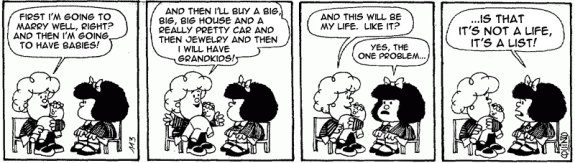
The street is lined with stalls selling this and that. There’s a massive line to have a photo with a small statue of a famous comic strip character named Mafalda. She’s a six-year old who’s wiser than her years and questions everything. Mafalda was an Argentinian comic strip in the 60’s and early 70’s but still remains hugely popular (and relevant) right across Latin America.

 We totally cheated – this statue’s in La Boca, where there’s no queue for a photo!
The only english example I could find
Puerto Madero
Just to the east of San Telmo lies Puerto Madero. Ironically, when the government moved the main port of BA from La Boca to here in the late 1880s, it would only last about ten years before it too was made obsolete by the size of the new cargo ships. The city’s main port moved once again (to Puerto Nuevo, still in use today) and much like La Boca, Puerto Madero fell into a steep decline that would take 100 years to recover from. In the late 1980s the city finally agreed on a revitalization plan, and today it’s filled with luxury hotels, warehouse conversions, restaurants, giant condos and a very pleasant waterside promenade facing a large ecological reserve to its east. It reminds us a little of Darling Harbour in Sydney, which has also taken a long long time to develop into something with some level of charm. Families picnic and stroll along the wide walkway, or lunch at one of the many restaurants or bars. We spend a pleasant hour before heading back home.


Microcentro
Although not an official barrio, Microcentro is the official centre of the city and ground zero for many of the main tourist destinations, especially for those on a much tighter time frame than us. We don our tourist capes and join a free walking tour. We’ve done quite a few of these in the big cities we’ve visited, and they’re always well worth it; this is no exception.
National Congress
We start at the National Congress, which houses both chambers of government (except, of course, when Argentina is ruled by a military dictatorship, that is). They’re not in session when we’re here: “You can tell when congress is in session because there are always demonstrations”. 2023 is the 40th anniversary of continuous democratic rule here, which in a country that has undergone as many coups as Argentina has, is reason to celebrate. It’s easy to take democracy for granted.

We continue down (actually, east) Avenida de Mayo, through a series of connected green spaces, at the end of which we find a copy of Rodin’s The Thinker. (An original copy, the tour guide is quick to point out). We continue east and all the while our tour guide regales us with fascinating stories of the history of Buenos Aires. There is a much stronger Italian influence here than we ever realized. Our tour guide asks us to name a few famous Argentinians. (Uh… the group shifts their feet uneasily. Messi? The Pope?) Exactly, she says – both Italian names (Pope Francis Bergoglio is the son of an Italian immigrant, and Messi is of Italian-Spanish descent).
Palacio de Bolero
A little further east down Avenida de Mayo brings us to the mighty Palacio de Bolero. Completed in 1934, it was the highest building in South America at the time. Conceived by Luis Barolo (another Italian immigrant!) as an homage to Dante’s Divine Comedy, it is filled with allusions to the great work. Its height is 100m tall (one metre for each canto), and the floors are divided into Hell (basement and ground floor), Purgatory (floors 1-14) and Heaven (floors 15-22). Ornamentation on the floors goes from extremely ornate in Hell (representing the sins of materialism and vice) to very austere in Heaven. Even getting to the upper floors is difficult, with the elevators stopping before reaching the top echelons of heaven, and those wishing to reach the very top forced to take steep winding stairs. Separate to our walking tour, we took a sunset tour of the building and we can say that it’s definitely vale la pena (worth the effort) to reach the lookout-cum-lighthouse at the tippy top. 360 degree views of the city and even with the thick hazy summer sun, we still get a magnificent sunset.
 View of the Palacio de Bolero and its lighthouse, still towering over the surrounding buildings


Back to the walking tour! – We continue east and cross the absolutely massive Avenida 9 de Julio, which our tour guide proudly proclaims is the widest avenue in the world. 7 lanes in either direction and flanked by a further four lanes of parallel streets on either side, you can’t possibly cross this avenue in one green walking person (From a liveability point of view, not sure this is something to brag about!). We stop for a breather halfway across, and our guide points out a building in the distance where a huge mural of Eva Peron has been mounted (more about Eva when we get to Recoleta).

Casa Rosada
Our tour ends at the Casa Rosada – literally the Pink House – which is the presidential palace. Aside from its colour, one of the unique things about this building is its non-symmetricity (?is that a word?) due to its evolution over the years. It started as a fort back in 1536 before morphing into Customs House, then the Postal Headquarters and finally the presidential palace that we see today, inaugurated in 1898.

Immediately before the palace is the Plaza de Mayo, named for the 1810 revolution that occurred here leading to Argentina’s independence. Today we see (yet another) sign reminding us that the Malvinas (Falkland Islands) are indeed Argentinian. On the ground around the plaza are painted giant white handkerchiefs, representing The Mothers of the Plaza de Mayo. For over thirty years, the Mothers have campaigned for information about the fate of their lost relatives who were ‘disappeared’ during the time of state terrorism / military rule from 1974 to 1983. Again, it’s easy to take democracy for granted.

If you were to continue east behind the palace you would quickly reach the northern end of Puerto Madero, but we’re going to continue heading north, to…
Recoleta
Like the Père Lachaise Cemetery in Paris (home of Jim Morrison), the Recoleta Cemetery houses a staggering collection of incredibly ornate vaults housing some of the most famous families in Buenos Aires’ and Argentina’s history. On the afternoon we walk through here it’s also staggeringly hot (mornings are recommended, we now see why!). The cemetery’s no longer free as of 2020, but it’s not absurdly expensive. We don’t find any human guides hanging around at the entrance, so we just wander the laneways and occasionally try to look up who all these people are / were. Just about all of the early presidents of Argentina are here. A surprising number of references to the Jockey Club can be found – obviously a pretty powerful club. (They do love their polo here.)

Inevitably we find ourselves in front of the grave of Eva Perón. Possibly the most famous person buried here, certainly the most controversial; Evita’s story is a complicated one. A young actress who married a powerful general in 1944, two years later her husband Juan Peron would become the president of Argentina. She would serve as First Lady until her death in 1952 at only 33 years old. Peronism as a political force remains as relevant – and divisive – today as it was 50 years ago, and Evita remains a powerful symbol within that sphere. To her supporters she is a model of feminism, suffragism, philanthropism and strength. To her detractors she is a symbol of the corruption, fascism and dictatorial rule endemic to Peronism.

Following her death, her husband (President Perón) began to construct a massive statue larger than the Statue of Liberty in her honour, where her embalmed remains would be displayed a la Lenin. While the statue was being constructed, he was overthrown in a military coup, and in the ensuing chaos her body disappeared. It wouldn’t reappear for another sixteen years, when in 1971 it was discovered in Milan, Italy (there’s that Italy connection again…). It was later moved to Spain where Perón had gone into exile with his third wife; they displayed the corpse in their dining room (because that’s totally normal). After he returned to Argentina to become president for a third time, Evita was eventually brought back home and finally interred in her family’s tomb (Duarte) in Recoleta. Did you follow all that? Probably best to watch the movie with Madonna if you want more info, I guess.
Following our wander through the cemetery we’re pretty parched, so we go across the street to a really cool brewery called Buller Brewing Co where, somewhat ironically, Michelle has a fantastic G&T while we watch a rare rainstorm roll through.
Museo Nacional de Bellas Artes
On another day we head to the Museo Nacional de Bellas Artes. There’s a lot of interesting stuff here, including more Rodin memorabilia. Just around the corner is a massive stainless steel sculpture of a flower, that opens and closes each morning and evening. Super cool, and the green space around it is a great place to sit and watch the sunset.

Plaza Francia Artesanal Market
There’s also a modest artesanal market here in Plaza Francia. It’s much lower key than some of the other markets but large, with all of the items actually made by the people manning the stalls. When Al buys a belt here, the guy actually cuts it down to size and re-rivets it while we wait. Fine Argentinian leather, at a bargain price. And faster than Amazon!

El Ateneo
Finally, (wow, there’s a lot in Recoleta!) another must-see thing is El Ateneo Grand Splendid Book Store (Yep, that’s its actual name). It’s a beautiful old theatre that’s been converted into a book store. The stage is now the cafe! Feathers has a good time here checking out some books on fish.


Palermo
Bordering the exclusive Recoleta is the hip and happening area of Palermo. It’s home to some beautiful gardens, as well as plenty of restaurants and bars. We venture out here a couple of times, but we probably need another month in BA to really capture the mojo of the place. The closest we get is an evening that starts at the Pain et Vin wine bar, followed by delicious flavoured pisco sours at the Thames Bar, some tasty ceviche, and finally a live show at the Be Bop Club – a local band called Funky Punky puts on a 1 hour show from 11 pm – midnight sharp, and then they kick us all out.

MALBA
One afternoon we also visit the MALBA, short for the Museo de Arte de Latin Americano de Buenos Aires. Yep, I’d be using an acronym for that too! Anyway it’s got some pretty interesting stuff in here, worth a visit I’d say.


Belgrano
Our last evening in BA we walk 15 minutes further north and into the neighbourhood of Belgrano. The Grand old European style buildings of the olde city give way to quiet streets lined with more modern condos.
Under the rail line there’s some cool new bars serving delicious craft gin cocktails and playing eclectic music. It feels like an area with a bit of a buzz and a heartbeat. This small area of a few blocks is the Chinatown of BA and we take the opportunity to indulge in some Japanese food.


After dinner we wander home through the park. Couples and small groups sit in the park enjoying the warm summer Saturday evening. The beautiful 19th century rotunda is packed with couples dancing the tango.

Farewell to the Paris of South America
Ah, Buenos Aires. We enjoyed our time here more than we expected! And still feel like we only scratched the surface. As to why it’s called the Paris of South America? Well, the architecture has something to do with it. Like many colonial cities, when it was first established the founders made a concerted effort to build big, solid, imposing buildings like the Congress building and the Bank of Argentina. But while there’s definitely a strong ‘European’ flavour to the architecture, it’s not necessarily French. The café lifestyle is thriving here, but that owes as much to Rome or Milan as it does to Paris. And with the heavy Italian influence here, it could just as easily have been called ‘The Rome of South America’ or ‘The Florence of South America’. But nothing is as romantic as Paris, is it?
Most likely, they just wanted to model themselves on Saskatoon, Canada, the ‘Paris of the Prairies.’
Two Weeks in Buenos Aires: In an Nutshell
- We talked about the challenges of Argentinian currency in our previous post on Mendoza. The main mall of Buenos Aires is where to go to change money using the informal exchange.
- Public buses are wonderful. Air conditioned, clean, incredibly inexpensive…. but… you need a SUBE card to ride them. And unfortunately for the past few years, you cannot buy a new SUBE card for love or money. Something about the chips in the cards being impossible to source by the city… blame supply chain issues, blame COVID, blame the rampant inflation… There are Facebook groups where people are pleading for spare cards, or selling them for outlandish amounts. We got lucky and were able to borrow a spare SUBE that our friends had. Without an ‘in’ like that, you’ll be stuck taking cabs. Luckily, cabs are everywhere and super cheap. And hopefully they sort things out soon with the SUBEs.
- While meat, pizza and pasta are seemingly everywhere, there are lots of vegetarian options and even vegan. we were pleasantly surprised to find a lot of delicious vegetables and healthier options on offer. Look and you will find.
- The famous Argentine drink of fernet and cola is an acquired taste. And not one that we’re willing to acquire. You’ve been warned.
- Here’s a list of notable / historical cafes if you want to enjoy some history while you sip your cortado.
- For non-Latin Americans, it can be hard to embrace eating dinner at 9 or 10 at night. Luckily here in BA, many restaurants open early, but just don’t get busy until 9pm. So you can eat at your ‘normal’ time (with all the other gringos). Although the Canadian penchant for eating dinner at 5:30 may still be a bridge too far.
- If all else fails just talk about the World Cup