The phrases ‘must-see’ and ‘bucket list’ get thrown around alot, but visiting Perito Moreno Glacier in the Southern Patagonian Ice Field is one of those locations you really should try to get to. It’s one of the most popular tourist locations in the region (for good reason) and yet, despite this popularity, still manages to exceed your expectations when you visit.
Visiting Perito Moreno Glacier: A Short Stay in El Calafate
If you’re planning on visiting Perito Moreno Glacier, you really have no choice but to stay in El Calafate for at least a night or two. And one or two nights is pretty much the max time we’d recommend.
If you’ve read our El Chaltén blog post, you’ll remember that we weren’t very enamored with El Calafate. With a population of 28,000, the town is almost 10 times the size of El Chaltén but, to us at least, lacks Chaltén’s charm. Why is that? Well, for starters, most of the restaurants we saw reminded us of ‘The Keg’. Nothing against The Keg, but it’s not somewhere I’m going to seek out. And expensive Kegs, at that.
Secondly, there doesn’t seem to be a lot else to do in Calafate aside from visiting the glacier. Unlike Chaltén where you have hiking trails at your doorstep and Fitz Roy is constantly looming at your shoulder, Calafate’s trails (if they’re there) are much better hidden.

It probably didn’t help our opinion of the town that our Airbnb, which had advertised that it was in the centre of El Calafate, turned out to be 2km outside of town, on a dirt road, with no easy way to get in and out of town aside from a 40 minute walk. So we were a little sour on the town to begin with. Regardless, for our money we’re very happy we spent the majority of our time in El Chaltén, and just a few days in Calafate.
And yet.
Even with all of that being said. Even being surrounded by expensive Keg clones. Even having no other activities to do except the glacier. Even having to walk into town every day. It’s still – STILL – all worth it for the chance of visiting Perito Moreno Glacier. It’s that good.
Visiting Perito Moreno Glacier: What’s This All About, Then?
What makes the Perito Moreno Glacier so cool? Let’s start by pulling up a map. If you open Google Maps and type in ‘Perito Merino Glacier‘, and then change to Satellite view, you’re going to see something like this:
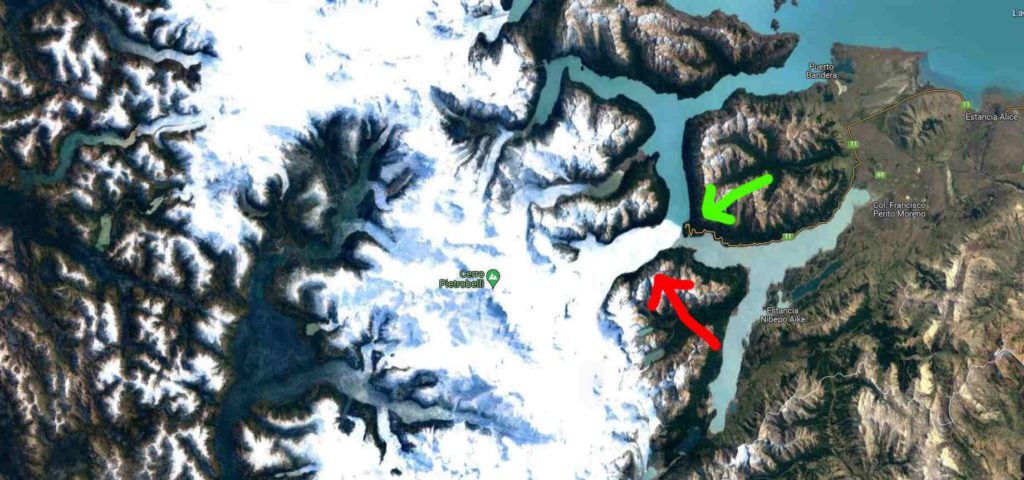
See that big white mass on the left side of the screen? That’s the Southern Patagonia Ice Field, one of the largest ice fields in the world. Extending out from the ice field like a big icy tongue is the Perito Merino Glacier – I’ve added a big red arrow pointing right at it. The glacier is about 30km long, and is one of the few glaciers in the world that isn’t retreating; it’s currently in a state of equilibrium year on year.
Which brings us to the first cool thing about the glacier. We had previously thought of glaciers as being sort of ‘static’. They might get a little bigger or (more likely) a little smaller each year, but other than that they don’t change too much. Oh how wrong we were! The Perito Moreno Glacier is constantly moving, pushing its way down the valley at a rate of 2 metres PER DAY – that’s over 700m per year!
Let’s go back to the map for a sec. See that big green arrow? It’s pointing at the peninsula opposite the glacier. And if you look reeeeaaally closely you can see that there’s a little tiny road that wiggles its way out to the end of the peninsula. It’s at the end of this road that the National Park Service has set up a whole stack of viewing platforms up and down the side of the hill facing the glacier. There are so many of these platforms snaking their way across the 2km expanse that they never really feel crowded. This despite there being dozens of tour buses disgorging thousands of tourists every day to the site. Our expectations of the day were super low, because we figured we’d be fighting through five or six rows of people just to get to the edge of the platform to sneak a picture before retreating to the back. The reality couldn’t be further from that. In some cases we had a platform completely to ourselves, and even in the most popular locations we could always find a space to take a photo or just enjoy the spectacle.
 Some of the platforms
I guess we’d better show you a couple of photos of this magnificent glacier before we go any further.


Another thing that we didn’t know about these valley glaciers (and the list is long!) is that despite what it might look like, they aren’t floating in the water. They’re sitting on the valley floor. The part of the glacier that you can see in the photos is about 50 or 70m high – which is hard to imagine, even when you’re standing right in front of it. But what’s even harder to fathom is that more than double that again is under the water. That’s right, there’s more than 120m of glacier that we can’t even see.
I mentioned that the glacier is moving 2m a day. So we’ve got a 170m-high glacier pushing its way over the granite down the valley. Over the short term the granite might seem like it’s way harder and would win that fight, but over the long term? Water wins every time.
Which brings me to a couple other really cool things about the glacier. Since the glacier’s moving forward at a rate of 2m, surely it’s going to push right into the land on the far side, isn’t it? Well, yes – that’s exactly what happens. Every few years, the glacier pushes its way all the way across the channel and blocks the water flow from the southern arm to the northern arm. Look at the map again, and you’ll see that the water in the lower channel is actually a different colour from the upper channel. That’s because when this satellite photo was taken, the glacier had just about completely closed off the flow of water from one side to another. This happens pretty regularly (if unpredictably) every few years, and when it does the water height differential from one side of the ice dam to the other can reach 20m or more. But, like I said before – water always wins. Eventually the water worms its way through the glacier, creating a small hole which eventually becomes a huge arched tunnel, before spectacularly crashing into the water below. And then the cycle starts anew. We didn’t get to see this state of affairs when we were there, but the Glaciarium museum in El Calafate has some spectacular videos from over the years – well worth a visit.
But even if you don’t get to see the ice dam, what I can guarantee you’ll see is regular calvings. Calving is when huge chunks of ice crack off the end of the glacier and crash into the water below, replete with massive thunder-like booms (causing everyone’s heads to whip around looking for the source). These were happening every ten or fifteen minutes while we were there, and were quite the spectacle.
 That big set of waves radiating out is where a massive chunk of ice fell in the water. Gotta have that camera ready!
It sounds corny, but the glacier felt like a living, breathing entity out there.
Visiting Perito Merino Glacier: The Mini-Trek
As if all of this wasn’t enough, we decided to add on a ‘Mini-Trek’ to our tour. This gave us the opportunity to spend about 90 minutes walking out on the glacier itself, as well as a short boat ride across the face of the glacier on the way to the start of the trek. The boat ride itself offers some spectacular close-ups on the way across!


The guides first strap you up with a set of crampons, and after a short briefing you and your group of about 10 set off on the trail. Again, despite there being lots of groups doing the exact same thing, it’s extremely well orchestrated and it doesn’t feel crowded or rushed. It’s also designed to be accessible to anyone from ‘5-65’, unlike the more technical ‘Big Ice’ trek which takes you a lot further onto the glacier. You have to be under 50 to that one – no exceptions. (Seriously?? That was a kick in the teeth…)


You’re given plenty of opportunities for great photos, though they do try to keep you on a fairly short leash so you don’t wander off into a crevasse. The mini-trek finishes with a shot of whisky, with glacier ice providing the ‘on the rocks’.


They then whisk you back over the channel on the boat, where your bus is waiting to take you back into El Calafate and concluding what is a long but hugely rewarding day.
Why are Glaciers Blue?
We mentioned that we visited the Glacarium Museum, which is just out of town (there’s a free shuttle that will take you out there – ask at the tourist office). It’s really well done, and provides a pile of information about glaciers in general, and the South Patagonia region in particular. There’s also a great movie with some spectacular footage that you definitely should sit down and watch. Unfortunately the ‘Ice Bar’ that they used to have is closed indefinitely as of Jan 2023.
One interesting piece of trivia we learned at the museum is why glaciers are blue. And interestingly, it’s not for the same reason that glacial lakes are blue.
Glacial lakes owe their brilliant turquoise blue to glacial flour. Rock flour, as it’s also known, forms when the huge forces of the glacier crush the rocks of the mountainside into fine dust even finer than sand. This dust is suspended in the lake, and when sun light bounces off the fine particles it creates the beautiful blue-green colour.
Glaciers, on the other hand, get their distinctive blue hue from the spectral properties of light. As you might remember from high school science, white light is made up of the colours of the rainbow. When light hits the snow and ice, the shorter wavelengths (Red, Orange, Yellow) are absorbed. Only the longer wavelengths (Blue and Indigo) are able to escape; hence the ice takes on its beautiful blue.
Visiting Perito Moreno Glacier and El Calafate: In a Nutshell
- El Calafate is extremely well serviced by bus and air, both within Argentina and from Chile.
- Our recommendation is to stay two nights in El Calafate, with your visit to the glacier taking up the full day.
- While you can visit the glacier platforms on your own to avoid the crowds (by renting a car, or taking a taxi out to the park), we didn’t think this was really necessary in the end – the platforms are so well set up that the crowds were a non-issue. And a self-visit means you can’t do the Mini-trek or Big Ice.
- Dress warmly, as the glacier can get windy/cold
- All tour companies charge the same price for the tour/Mini-trek, so shopping around when you arrive doesn’t really work. It’s better to book your tour/trek before you arrive on the internet, to ensure you are able to go on your one available day. We had to wait two days before there was a mini-trek available. You will pay slightly more to use a credit card, but in our opinion it’s worth the hassle.
- Despite its size, El Calafate does not have many/any ATMs, and the Western Unions often don’t have cash available and they have upper limits on amounts. So bring enough pesos with you for your time there. (That being said all the restaurants we went to took credit cards)
- This part of Argentina is much more expensive than other areas.