On either end of our Inca Trail trek we spent a few days in two Peruvian capital cities with quite different personalities: the modern coastal capital of Lima and the high altitude Inca capital of Cusco. This, then, is A Tale of Two (Peruvian) Cities…
A Tale of Two (Peruvian) Cities: Lima, The City Of Kings
The difference between Lima and Cusco is much more than just coastal vs mountain geography. With a population of 11 million and only 17% of people identifying as indigenous, Lima feels like a world away from Cusco.
Don’t Mention Bolívar, or the Chileans
“Simón Bolívar is NOT our hero”. Our Free Tour guide Jorge is emphatic on many points, but this one really gets a rise out of him. He waggles his finger at Al and says, “General San Martín is our hero here, not Bólivar”.
During our months travelling around South America we’ve heard a lot about Simón Bolívar, who liberated much of the northern South American continent from Spanish rule. So, when Jorge explains that San Martín is the liberator of Peru, Al is curious. He asks what he believes to be a reasonably innocuous question: how Bólivar and Martín perhaps worked together to liberate the area.
This, apparently, is a sore point.
Argentinian General José de San Martín, having liberated what is now Argentina and Chile, then moved on to liberate Lima. The Spanish made a hasty retreat to the Andes and holed up in Cusco so still had control of some of Peru. Official records get a little hazy at this point but ultimately San Martín withdrew from Lima, Bolívar came in and took the whole of Peru and was installed as Dictator for three years (while also taking on the side hustle of liberating Upper Peru which is later established as the new country of Bolivia).
Jorge uses air quotes for Bolívar’s name as he goes on to let us know what the locals think of him. “We lost Bolivia and the port of Guayaquil thanks to him.”
 A statue of the good guy, San Martín
Whew. That out of the way, we continue our tour and Jorge provides us with a very entertaining tour of the highlights of the historic centre. We wander the streets surrounding the main plazas where many grand old houses can be found from the ‘Golden Age of the Republic’ of Peru. Lima was a prosperous city for a short time in the 19th century. Not because of the precious metals of previous eras, but instead thanks to guano – a precursor of gunpowder and fertilizer.
 House of Parliament in the main square
Many of the buildings we walk past have ornate wooden covered balconies, in the mudejar style of architecture which we’d first seen in Andalucía in Spain. As well as the strong 16th century Spanish influence, there’s an eclectic mix of architecture as a result of the city being rebuilt after multiple earthquakes over the centuries. Even some buildings that look a little like Gaudí had a hand in their design.

Jorge explains that the golden age of the republic in Lima came to an abrupt halt when the Chileans invaded in 1881. It appears his disdain for Bolívar is only exceeded by his vitriol for the Chileans and their role in the War of the Pacific. Among other things, they took libraries full of important books and moved then to Chile and still haven’t returned them (Actually we fact-checked this and they did finally return them, in 2007. Never let the facts get in the way of a good finger-wagging, though).
 Apparently this is empty, if Jorge is to be believed
 A section of the old city wall, uncovered during recent building works
Cathedrals and Chifa
After the tour we meet up with our friends Natasha and Tony, who’ve just arrived from Toronto. We’re meeting at the place that’s credited with inventing the pisco sour, the Gran Hotel Bólivar.
The pisco sours here are served as ‘cathedrals‘ and true to their name they are very large and quite spectacular.
From here we walk to Barrio Chino (Chinatown) for some Chifa, the classic Peruvian-Cantonese cuisine so called as it means ‘eating rice’. Jorge has insisted we should try it, so we head to his top recommendation San Joy Lau. It may have been the cathedral pisco sours colouring our opinion but it tasted very good. But also a fairly typical example of westernised cantonese food, with fried rice, stir fried beef, sweet and sour and most of the other usual staples.
As we walk back to our hotel we see groups of people dancing in the park surrounding the central station. A local explains that they are here every night practicing their group routines for various events and parades that happen during the year.
Art through the Ages
With all the focus on the Incas, the human history of this area prior to the 13th century doesn’t get a lot of attention. This is a shame, as the coastal region of Peru is considered one of the cradles of civilization. In fact, the Norte Chico was the first civilization in the Americas, dating back to 3,500BC.
The Lima Art Museum (Museo de Arte de Lima), on the outskirts of Lima’s historic centre, turned out to be a great place to soak in some of this history. It was possibly the best museum of pre-Colombian art museum that we’ve been to in South America. It has excellent English explanations of the ceramics and textiles and how they relate to the culture and beliefs of the pre-Columbian people.

We’re not exactly ceramic-o-philes but we found this museum quite interesting given that these civilizations didn’t use written language, so the bottles, bowls and plates formed an important part of communication. There was an entire section devoted to narrative art on ceramics detailing some of the stories passed down. There are also some more up-to-date exhibits such as drone footage of the Nazca lines taken just a few years ago and fun video animations that bring to life the stories found on the ceramic bottles.
On another evening we have dinner at a restaurant overlooking the Huaca Pucllana, a pyramid built by the Lima Culture which was predominant between 200 and 700AD. Some of their agricultural and irrigation technologies would later be used by the Inca.

So, the site of Lima city had a rich human history before the Spanish conquistador Pizarro turned up and named it the ‘City of Kings’. Nevertheless, from this point Lima became Spain’s main city in Peru and the continent. The capital of the Viceroyalty of Peru, Lima was the administrative centre for all the Spanish colonies in South America for almost two centuries. Its importance began to wane with the establishment of two additional viceroyalties in Rio de La Plata (modern day Argentina) and New Granada (Colombia/ Venezuela). And then came independence (but not by Bolívar!!)
 Another Pacific Coast Highway, much like the one in LA…complete with intrepid surfers
A Tale of Two (Peruvian) Cities: Cusco, Land of Four Quarters
At first blush, Cusco looks like so many other colonial cities in South America. A large, green central square surrounded by churches, stately buildings, and old homes with ornate wooden balconies. But the Spanish influence here is only skin deep.

Locals are quick to point out that the colonial city we see today was built on the foundations of the once-mighty Inca capital. Cusco was quite literally the geographical ‘navel’ as well as the political and spiritual core of the Inca empire; the Land of the Four Quarters.
From here four roads radiated out to the four provinces of the Inca empire. Those ‘royal roads’ were part of a huge (40,000km!!) network covering a large swathe of the South American continent.
 A statue of Pachacuti, the mighty 9th emperor of the Inca empire, in the central square of Cusco
We arrive on the Saturday night of a local football game between the two local teams, Cusco and Deportivo. From our apartment on the hill we can see the stadium lit up and hear the roar of the crowd. The lights of the city twinkle all the way up the slopes of the surrounding mountains.
The next morning it’s overcast and drizzling, but not enough to dampen our spirits. With our friends Natasha and Tony we’ll be walking the Inca trail to Machu Picchu and we’re spending two days in Cusco acclimatizing to the high altitude of 3,400m, learning a little history, and eating some of the famous Peruvian food.
On Sunday, the streets around the main square are closed for a parade of local groups which we think may happen every Sunday, but can’t be sure. In the shadow of the Spanish colonial buildings, people dance in traditional costume and play pan pipes (Pan pipes, Di! Pan Pipes!). Unlike in Lima, Cusco province has one of the highest indigenous populations in the country, with 75% of people identifying as indigenous, compared to 25% in Peru overall.
 Those are actual baby llama foetuses that they wear for good luck…

While Spanish is used in the area, Quechua (the language of the Incas) is the first language of most people. We’ve heard Quechua spoken throughout the last few months in Bolivia and Ecuador, particularly in the rural areas, but here in the highlands of Peru it is much more common. It’s thought to be the most widely spoken indigenous language in the world with an estimated 10 million speakers. Having said that, the dialects vary wildly across central South America, to the point that a Quechua speaker from one region may or may not be able to understand a Quechua speaker from another. We stick to our broken Spanish.
An Incan Warm Up in Cusco
Similar to a trip through Egypt with its mummies, it’s hard to walk the area around Cusco without tripping over an Incan ruin or ten. On a hill just a 30 minute walk from the central square is the large Inca complex of Sacsayhuaman. It once formed part of the city wall, and was the ‘head’ of the puma shape of the city. (Oh, did we mention that back in the day, Cusco was shaped like a Puma?? How cool is that!!)

The Incan tradition was that the son of the emperor inherited the empire but none of his father’s goods. Every Incan emperor built their own temple structure and needed to conquer new lands. The 9th leader, Pachacuti, built his temple of Sacsayhuaman on the outskirts of Cusco in the 15th century.
Like many Inca buildings it had a range of functions. The complex was used to keep watch for attackers, to store goods and as a place of worship.
During our first afternoon in Cusco the weather has taken a turn for the worse. As we stand at Sacsayhuman the freezing winds sweep across the hill and we can imagine why the Incas worshipped gods who might help control this bitter weather. We’re each doing quiet prayers of our own to ask the sun to return before our trek to Machu Picchu in two days’ time.
What makes Sacsayhuaman extraordinary is its sheer size. Without the use of wheeled vehicles or horses and oxen, complexes like these were built solely with people power. With an empire of 8 million by the 15th century, they had the 20,000 people they needed to build this complex over 40 years. Each person was required to give two months of their time every year in manual labour as a form of taxation (Which actually sounds like a bargain, compared to the 5 months of work we provide our governments, but then again it’s not manual labour). As we look at the 5,000 huge limestone blocks, each up to 120 tonnes and 4m high that were quarried 2km away and transported here, it’s not hard to imagine why it took so long.
Without forged iron, the stones had to be broken and shaped by heating, cooling and then breaking with bronze chisels. They were then polished by hand with sand and harder stones. It could take months to prepare each stone. The Spanish couldn’t move these large stones which is why so much of the complex remains here today.
 Over 500m the walls form a zigzag pattern thought to appease the god of lightning and curve to fit the terrain of the hill.
Our Free Tour Guide Elvis does an amazing job of trying to stay upbeat in the cold and wet but after an hour we’re quite happy to make our way back down the hill and into town. (And our hands are frozen, so we take very few pics…)
Elvis tells us the Spanish did bring some important improvements such as the wheel, as well as horses and oxen for working the fields. But there’s no denying Spanish colonization of the area was devastating. They looted the gold, silver and gemstones that covered the walls of the temples, they destroyed temples and buildings and they brought diseases which decimated the local population. In just 300 years the indigenous population went from 10 million to only 3 million.
We walk through the La Blas district through narrow cobblestone streets with whitewashed walls and window frames painted blue. It used to house the middle class people of both the Inca and the Spanish and now hosts an array of shops, galleries and restaurants catering to tourists.
After a warming coffee we retreat to our Airbnb, which unfortunately on this wet and chilly day is not heated. As we pack for our 4 day trek through the mountains to Machu Picchu we start to worry we haven’t brought enough warm gear.

If you haven’t read about our Inca Trail trek to Machu Picchu, you really should. Then come back and read the rest of this post…
What a Difference a Day Makes
When we return to Cusco 5 days later, we’re on a high after our amazing hike to Machu Picchu, and the weather has turned. We spent two days in what feels like a completely different city. It’s sunny and warm and everyone seems to have a spring in their step. We head across the road from our hotel to visit the most important temple of the entire Inca empire, Qorikancha.
 Qorikancha. This terrace originally held statues of animals made from solid gold.
The Temples of Qorikancha, Cusco
We leave the bustling street and enter the Santo Dominican Convent, where a mass is going on in the church. Once inside the convent, we enter a large courtyard that looks like so many other colonial buildings. The difference is that beyond the limestone columns stand imposing walls of large grey stone – the temples of Qorikancha.
The Temple of the Sun found at Qorikancha formed the religious centre of Cusco and of the whole empire. It was from here that the priests and shamans determined the agricultural calendar and where they made sacrifices to the gods, including the most important of god of them all, Inti – the Sun God.
Today, Qurikancha is symbolic of how the indigenous culture survived the Spanish conquest while assimilating some of their Catholic beliefs and practices.
As with the other Inca temples in the city, Qurikancha was destroyed by the Spanish and the stones reused to build the Santo Domingo Convent. Unlike other sites, however, much of the foundations of the original temple can still be seen within the walls of the convent complex.

Perhaps also symbolically, the Incan foundations have survived three huge earthquakes thanks to their clever architecture, which places all walls at an incline of 13 degrees and all doors with the same angular sturdiness. (This distinctive ‘Incan trapezoid’ shape is seen throughout the many Inca structures we’ve visited).

One earthquake destroyed much of the catholic structure, but the Incan foundations remained and were restored for display. There’s a simple display that shows us for the first time just how some of the stones in the walls without mortar stayed together.
 Copper wire would be tightly wrapped in these inlays to hold two adjacent stones together
As we look at the large dark grey stones that form the thick temple walls we have to imagine what is was like in the times of the Inca, when every wall was covered in a layer of gold, some inlaid with gems, and the false windows displayed golden statues of various gods. All of this was looted with the arrival of the Spanish; not even a sliver of the original sparkle can be seen.
 No mortar required
We move to the exterior of the building and the outer wall of the original complex. Part of the curved wall of polished adenosite stone stands as a reminder of the huge, gold-covered wall that once surrounded the complex. In the 1950’s an earthquake destroyed the front section of the church that had been built on top of this wall. When it was rebuilt, they reduced the size of the church by a few metres to reveal the original underlying wall.
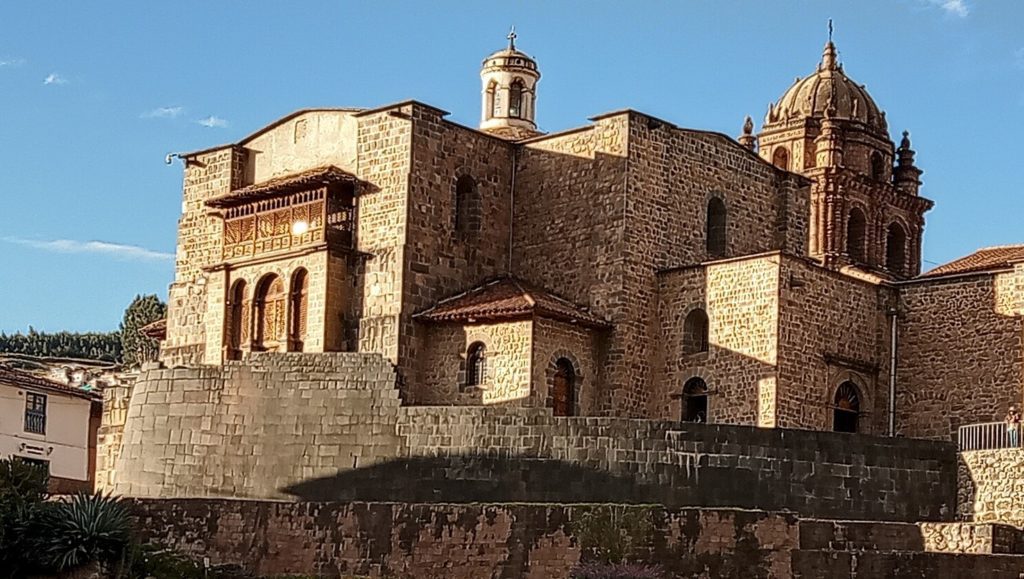
The higher curved wall on the left used to support the church, which toppled during an earthquake. (The Incan wall was fine.)
From this spot we look out over a terraced area covered in grass. Originally this space was filled with statues of various wildlife (alpacas and llamas, etc), most of them in solid gold or silver, as offerings to Inti, God of the Sun. Today the space is often used for local concerts and events.

We move back inside the main church complex. Our guide takes us through each of the small temples, for the moon, the rainbow, lightning, and the stars. The Sun temple was completely destroyed to build the church, where we can hear the mass in progress. He points out a window in the temple of the stars where, on the winter solstice, astrologers could view Orion’s belt which, depending on whether the area above below, or within the belt shone more brightly, would predict a dry season, a wet season or a good harvest.
Here we also hear how the Inca saw the night sky differently to the Europeans. As well as the stars, they saw and named shapes and forms in the dark areas. This different way of interpreting the world was confronting for the Spanish.
 A llama and a snake dominate the dark skies of the Inca milky way
What the Spanish found when they arrived was an Empire to rival their own in size and influence but with a completely different world view. The Inca controlled an area of 200,000 square km with 10 million people. They had a sophisticated agricultural system and architecture, but a way of looking at the world that was so completely different the Spanish just couldn’t fathom it.
Today, the indigenous culture is still struggling to gain recognition in Peru but at least in Cusco it’s possible to see some of the beliefs, ceremonies and crafts actively practiced.
Weaving Stories
It’s the vibrant colours that catch the attention first; bright green, red and blue splashed across a large wall of a modern art canvas. But closer inspection reveals the ancient stories brought to life as textured woven art.

We’re in the Maximo Laura Museum and Gallery, just off the main square of Cusco. Thanks to his spectacular art that showcases myths and legends of Peruvian culture, Maximo Laura is a UNESCO National Living Treasure of Peru. He has taken his traditional family profession of weaving in a different direction and creates spectacular weavings as a form of contemporary art.

In search of the more traditional weaving of the region, on our last morning Michelle takes a very quick look through the Traditional Textile Centre of Cusco for a crash course in the history and importance of weaving and woven goods in the region. Weaving has been part of the culture here since as early as 8,000BC and is central to the beliefs and identity of the indigenous people of the Andes. Woven goods made from alpaca wool, vicuña yarn, cotton and palm fronds are used for all kinds of day-to-day things like blankets, hats, bags and even rope. They are also an important part of ceremony like marriage and festivals. In the absence of written language for pre-columbian cultures, they formed a key part of communication.

The centre is a not-for-profit organization focused on retaining the weaving traditions of the area. Given a little more time Michelle may have been tempted to take one of their classes. But, we were headed back to the Pacific coast to Lima.
Look at the Flowers
Our final days in Peru, and our last in South America after more than 5 months of travel, are spent in the seaside Lima suburb of Miraflores. True to its name there are plenty of tropical flowers to see.
As soon as we step outside we can feel the salt spray of the Pacific ocean and the vibe of a well-to-do suburb. Al has his lower altitude mojo back and we walk for miles along the pacific coastline, eat some delicious ceviche and have our final pisco sours.


And with that, it’s over. We board a flight back to Toronto, with a stopover in Bogotá, where this all began five short months ago. Hasta Luego South America!
In A Nutshell: A Tale of Two (Peruvian) Cities
- There’s a lot more to Peru than just Machu Picchu and the Inca. We didn’t have much time on this trip (“But you had five months!!??”) but some other areas that were recommended were hiking in the northern Andes from Huarez and Caraz, a visit to the Amazon and the ancient civilizations around Trujillo. The Peru tourist site is quite good as a starting guide.
- Costs – We found Peru more expensive than other South American countries. Accommodation, food and travel all seem more pricey. US dollars are more widely accepted here than in other countries, and given all the tourists in Cusco there are a lot of money exchanges.
- Cusco:
There is a lot to see and do in Cusco city and surrounding areas, both Inca sites and naturally beautiful places. You could easily spend a number of days in the area. There’s a tourist ticket the you must purchase for some of the museums and ruins. There are also other worthwhile attractions not included on this ticket. We suggest you look at the ticket and use it to decide what to see. Some of our favourite meals in Cusco were at Kusykay, Cicciolina and Don Pancho Taberna as well as Oni Cochina Nikkei for a quick lunch. We also heard good things about Organika. The coffee and vibe at Cappuccino Cafe is also great, and you can’t beat the view of the square from this second story balcony. We’d recommend staying close to the historic area of Cusco; be careful to read the reviews of hotels as many near the plaza are very noisy apparently. We stayed close to Qorikancha at the LP Los Portales Hotel Cusco which was a good location and a wonderful hotel. Qorikancha was not included on the tourist ticket. It’s 15 soles per person plus 50 soles per group for guide. The guide is worthwhile as they give some extra insights, especially if you ask questions. You access it through the Santo Domingo church. There is a separate museum which was closed when we visited and doesn’t get great reviews. - Lima:
The historic area is not a particularly nice part of town to stay. We’d recommend staying in Miraflores and taking a cab into the historic area.