
Our picture certainly was not of a country with lush green mountain scenery, a fascinating history, delicious tropical fruit in abundance and one of the most ecologically diverse countries on the planet. Oh, and with a city where the temperature is in the mid-20s all year round. It’s also quite safe, as long as you’re not displaying your wealth like a peacock in mating season. Or, as they say here in Colombia: “Don’t give papaya.” But then you shouldn’t give papaya in Europe either.
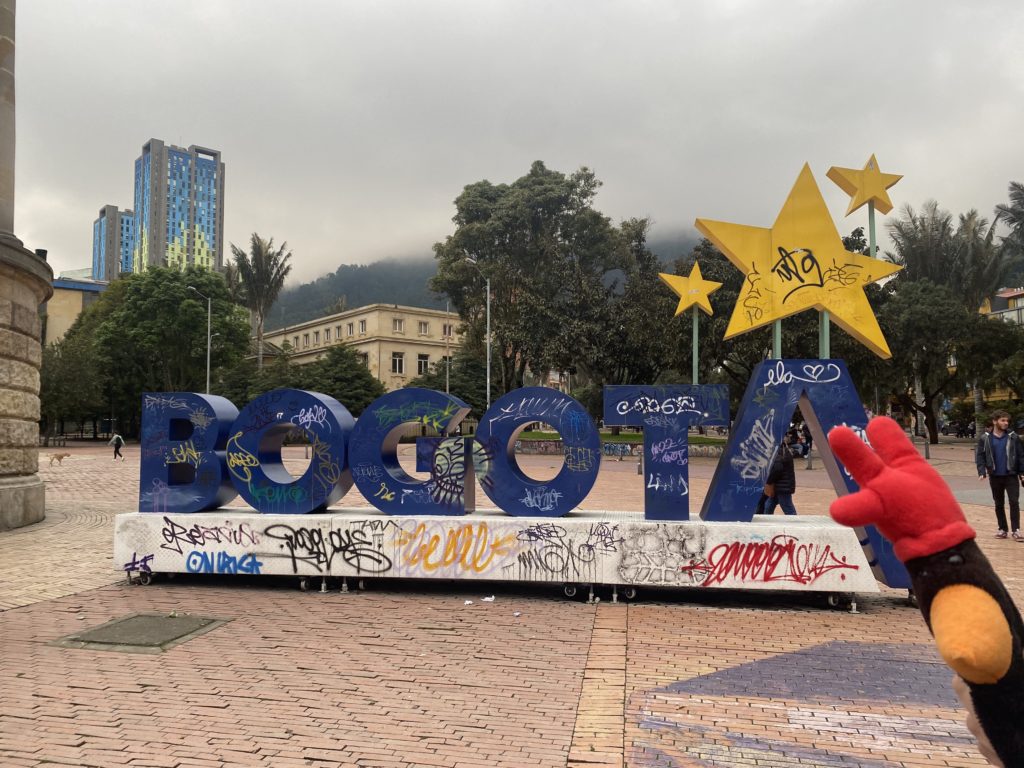
Biking through Bogotá
“Use your tongue wisely,” our guide Daniel said to us without a hint of sarcasm. So we did, using our tongue to grab all the sweet pulp of the giant yellow passion fruit without getting any of the white pith. Delicious and a little sweeter than the small purple variety we’re used to; we were in a market laneway in central Bogotá trying tropical fruit we’d never seen before.
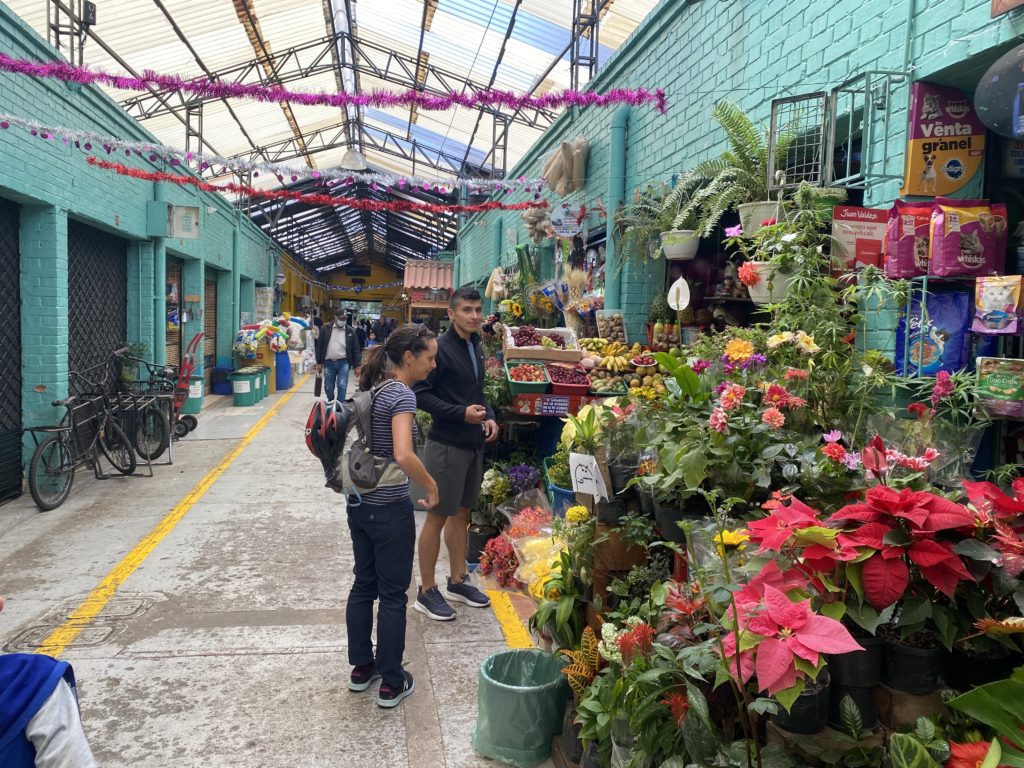
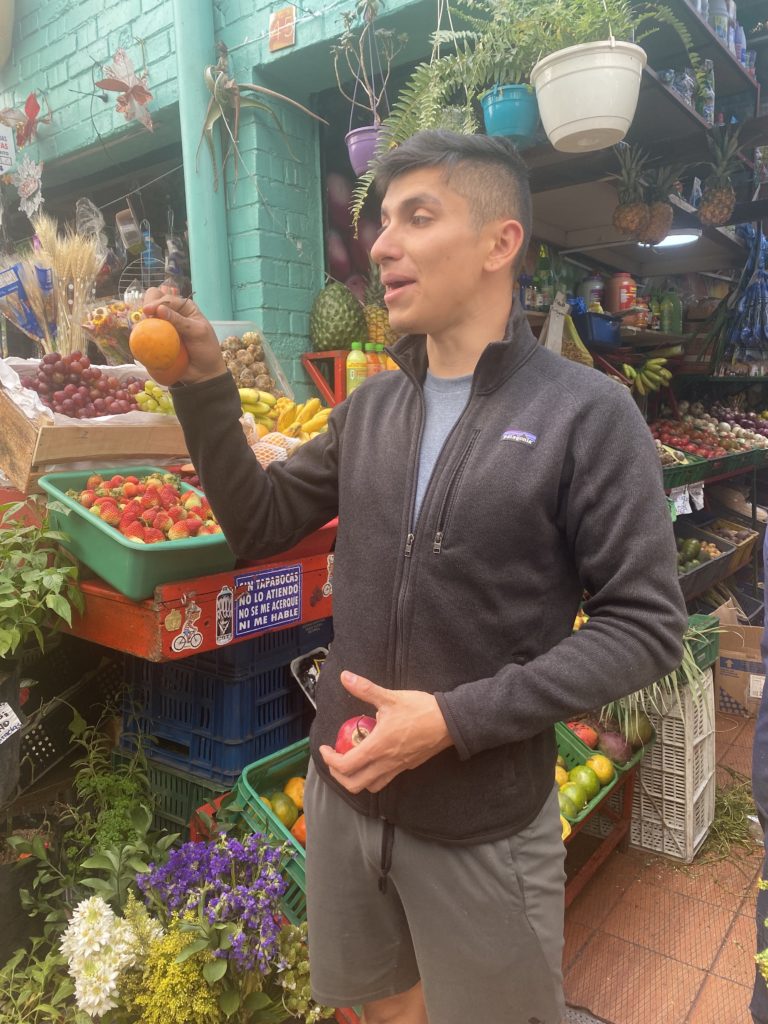

After the passionfruit came a string of fun fruits and veg. Tree tomatoes of three different varieties including ones crossed with mangoes and blackberries, a purple cucumber that tastes like a crisp melon, a sweet potato you can eat raw that has the texture of Nashi pear, and some bizarre fruit that smelled like date and is apparently an aphrodisiac. After about the tenth fruit sample we were staring to worry we wouldn’t make it the rest of the 3 hour bike tour without the need of a clean baño.
And of course there were the avocados the size of a small puppy, that the locals eat with lemon and salt. The Colombians’ answer to improving the flavour of almost anything is to add lime juice and salt: add it to avocadoes, fruit ice cream, beer,… the list goes on.
We decided on a bike tour of Bogotá as something a little different to the usual walking tour of a city and we were so glad we did. The tour started in the narrow, cobblestoned streets of La Candelaria lined with white washed row houses adorned with brightly coloured designs.

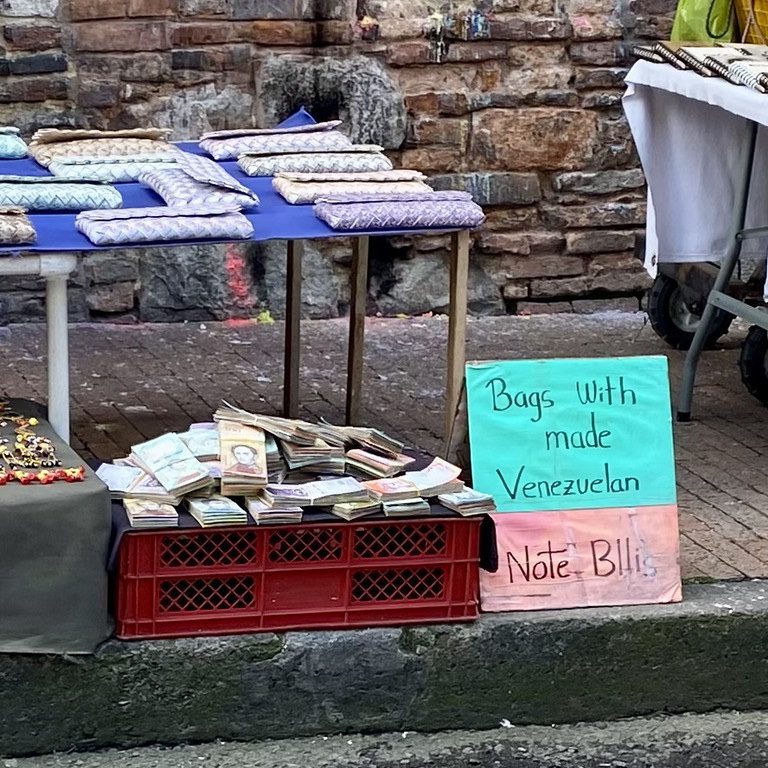
Closer to the main square of the old town people have set up makeshift stalls to sell the usual tourist trinkets: key chains, magnets, t-shirts, wallets and bags made with Venezuelan cash…. wait, what?
With the crisis in neighbouring Venezuelan continuing, hundreds of thousands of Venezuelans have walked into Colombia and to Bogotá to start a new life. As inflation is out of control in Venezuela, a bag literally made out of Venezuelan currency is worth more to sell than the cash itself.
As we entered the main square the small streets gave way to a huge plaza surrounded on each side with the grand limestone buildings of the parliament, the Supreme Court, one of the most prestigious universities in the country and a large basilica. As soon as we entered, a policeman stopped our guide and took him aside. With no explanation to us, Daniel followed the police officer and stood talking to him for about 10 minutes. We weren’t entirely convinced the tour was going to continue or if he was going to be dragged off. Luckily he did return and explained that given the increasing number of tour operators, some with less scruples than others, every individual leading a tour must carry a registration card.
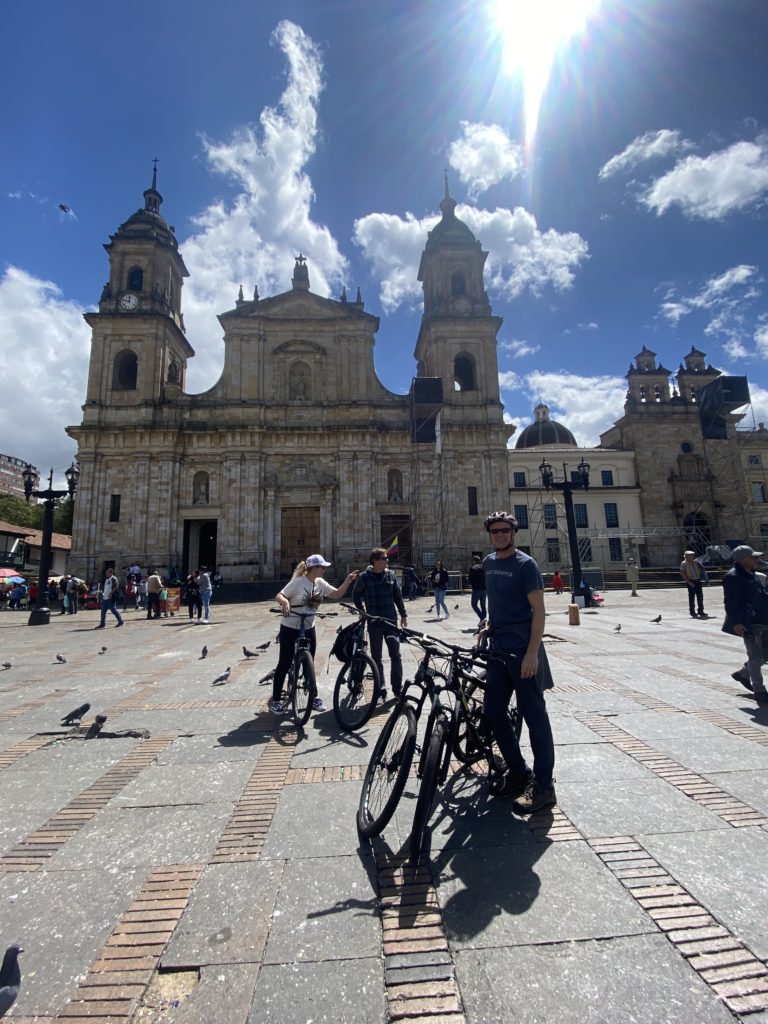
With that small taste of Colombian government control out of the way Daniel led us out of La Candelaria, down the main market street (a pedestrian mall lined with people selling all kinds of stuff from sugar cane to shoes), and we headed north through the financial centre to the more affluent areas of Northern Bogotá. We traveled through a ‘safe’ (aka relatively affluent) suburb before cycling through one of the poorest areas. All the while Daniel told us about the city’s history and issues. It helped us put the neighbourhood that we’re staying in into perspective. We had been a little nervous about spending much time in Bogotá. We had been warned to not walk around at night where we were staying, and other warnings like not standing on the edge of a street with you brand new phone. We’d decided to only spend two days here. After this tour however, we felt more comfortable in our neighbourhood and realized how much the city has to offer.
A Troubled History
Biking is hugely popular in Colombia, with the Andes mountains making great training grounds for professional cyclists. Thankfully we were sticking to the city’s many (reasonably flat) bike paths and not heading up into the mountains. Again, not an image we had in mind: a city with a whole network of bike lanes separated from the traffic Our guide, Daniel, was a local University student who was very knowledgeable about the history and politics of the city and Colombia.
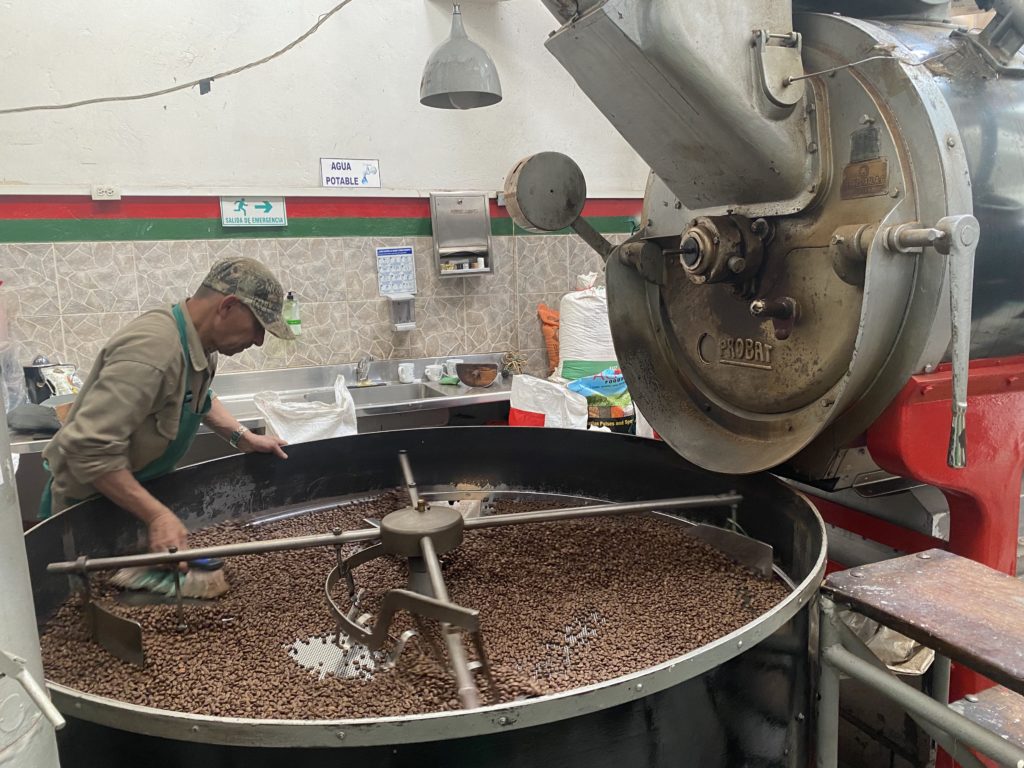
Our tour included visiting a cafe with a coffee bean facility in the back.
As we sat drinking espressos of Colombian coffee picked in the local countryside with the smell of the beans roasting in the next room, the 5 of us sat around a map of Colombia and Daniel told us how his grandmother had been forced to leave her home in the countryside when guerillas arrived. The land is too valuable, and the guerillas forcibly ‘remove’ existing populations so that they can use it for growing coca or bananas.
This is a common story, and one that we would hear again and again. As a result, the city of Bogotá has grown from one million to 11 million in the last 100 years, with more than half the population working in the ‘informal’ economy like selling drinks or snacks on the side of the road. There are so many stalls on the streets that the government has set up stands for them to use.
Sin Olvido (Never Forget)
At this point in our bike tour we got our first taste of the complexity of Colombia’s political history and how Colombians are dealing with the conflict that has haunted the country for so many years. On the walls of the building next to the coffee roasters, in a small semi industrial area, there is a striking pink and purple wall of art. Like so much of the street art here in Bogotá it has a political message. The three striking parts of this artwork are the number 6402, the words Sin Olvido (Never Forget) and Nada Mas (No More) along with a portrait of a young man: Fabian Margas. At just 26 years old Fabian was one of the 6,402 innocent people the Colombian government killed and then falsely presented to the media as guerrilla fighters.
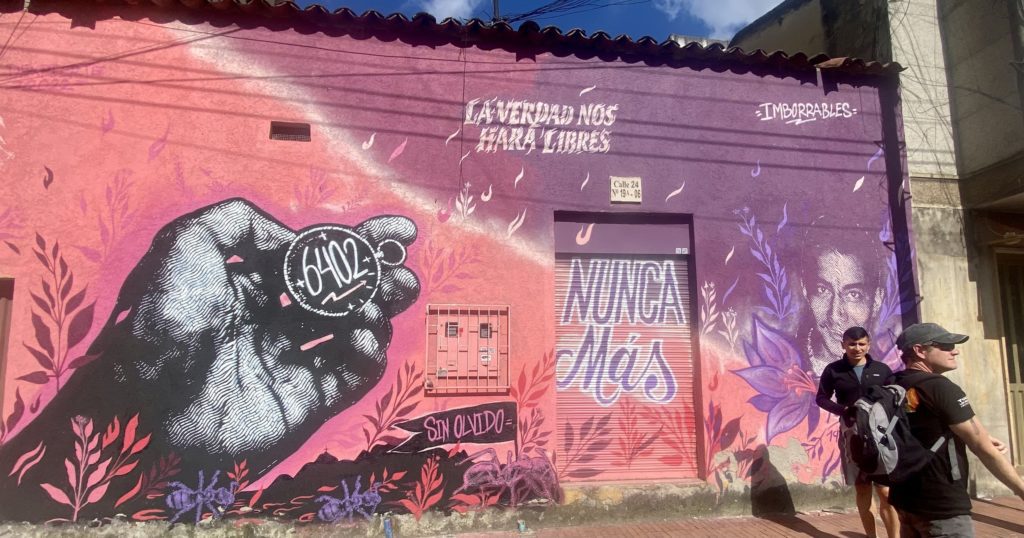
What captured us about this artwork, and what would continue to strike us as we travelled in Colombia is the sense of hope. The focus is not on the negative but on the future and not repeating the past. This was just the start of our discovery of Colombia’s recent past, how it’s affected people here and what they are doing to move on. It’s a fascinating and uplifting story.
Museo del Oro
On our bike tour our guide Daniel made reference to the Poporo Quimbaya, saying that of course we would have seen this when we visited the Gold Museum the day before. The Poporo Quimbaya is one of the most famous culturally important items in Colombia. We were too embarrassed to admit we must have breezed right past it. To be honest there are so many fabulous pieces in the museum it’s not hard to miss some of them. In fact, it houses one of the largest collections of gold pieces in the world: 34,000 in total.
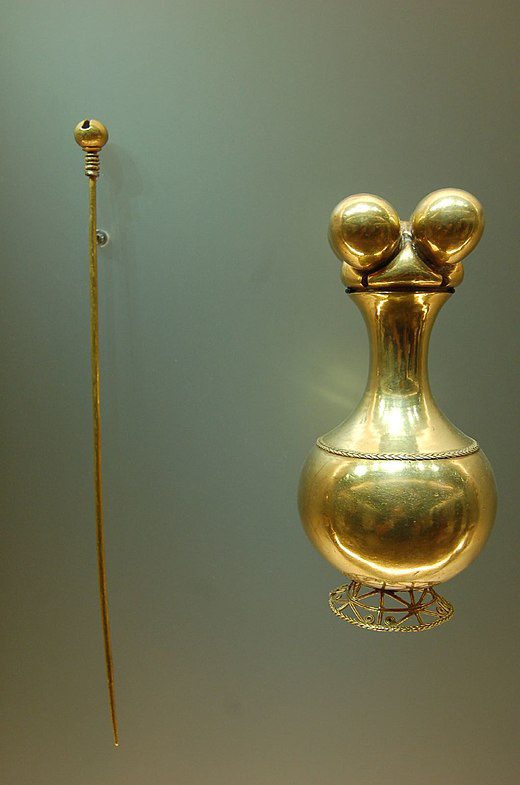
The world-famous Poporo Quimbaya. So famous, we didn’t even take a picture of it (Thanks, wikipedia!)
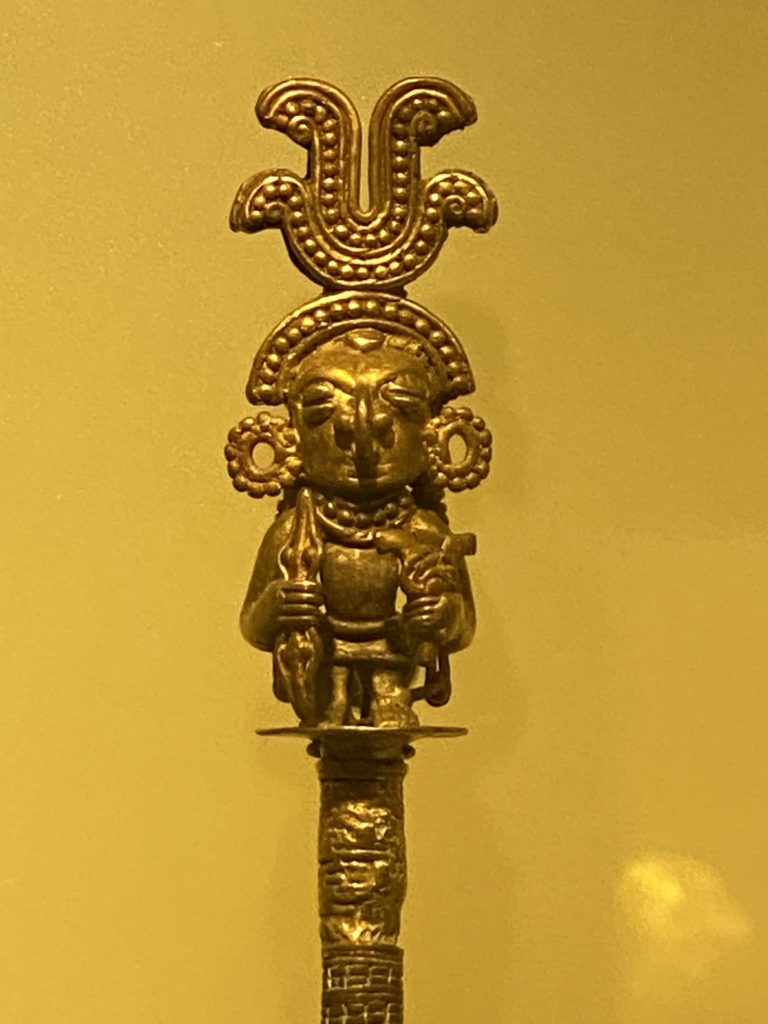
The Museo del Oro (gold museum) in Bogota is quite austere as you walk in, and most of the rooms are quite dark to protect the precious works. Despite this, the exhibition of gold pieces is used to introduce visitors to the sophistication of the indigenous societies of Colombia prior to the Spanish invading and taking over the country. Apparently National Geographic agrees, as they have named it one of the best historical museums in the world.
The chemistry graduate in Michelle was fascinated by the first part of the exhibition which takes you through the different techniques the indigenous people were using to collect, shape, join, cast and adorn gold pieces (as well as silver, platinum and copper). What was unexpected was the connection made in the exhibition with how metallurgy related to the various indigenous societies in the area.
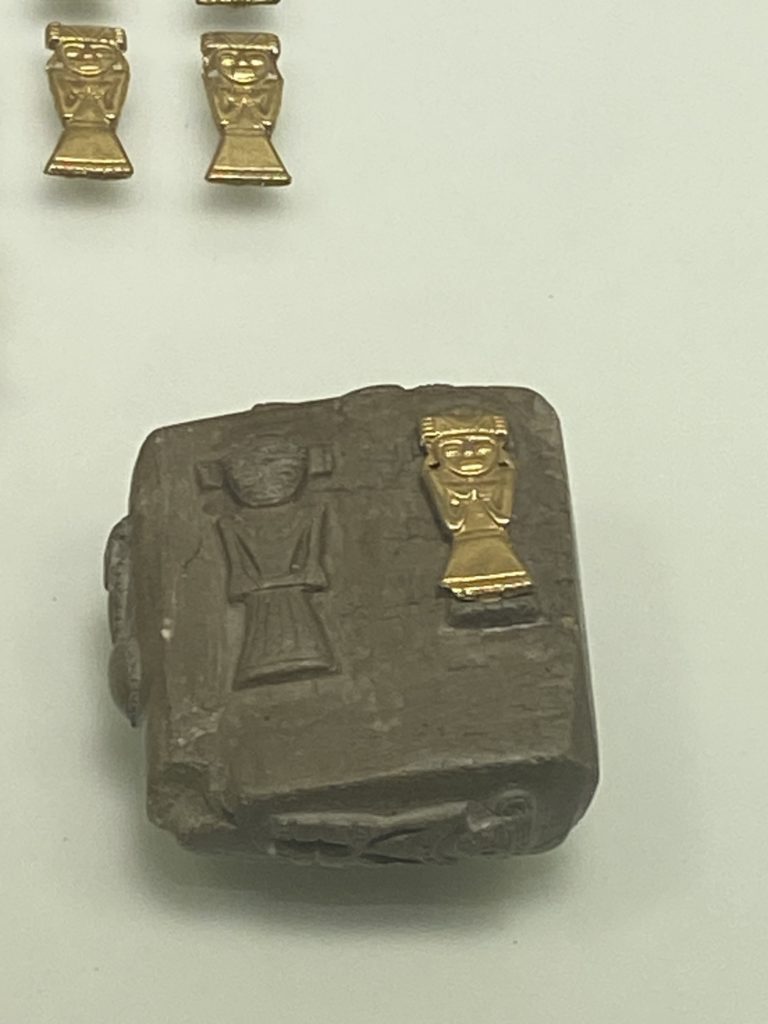
Metallurgy was part of indigenous cultures in South America from over 4,000 years ago, and pieces over 2,500 years old have been found in Colombia. The societies in this region lived in villages based on farming corn and cassava and fishing in some cases. With a surplus in food, they were able to devote some people to the art of metallurgy. The metal pieces were used mainly to display wealth and authority. Many of these were the poporo quimbaya, a vessel used to store lime and ornate sticks used by the Shamans to mix the coca leaves with lime, so they could exact the chemicals that allowed them to ‘think, renew and transmit sacred knowledge’. In fact there were a range of plants they used to ‘immerse themselves in the spiritual dimension of reality and visit other levels of the cosmos’. Sadly, many of these cultures were wiped out when the Spanish arrived (along with their diseases) and decided to take the land as their own.
El Dorado
As we made our way through the rooms, we came to a very dark room with just one piece, the El Dorado raft. It’s an incredibly intricate piece about the size of two playing cards housed in a glass huge cabinet that makes it look like it’s floating on a lake. But it’s the myth as much as the work itself that warrants a room of its own. The story of this piece has led to legend across the world and all kinds of plundering expeditions. The piece represents the raft used by local chieftains to float out to the centre of sacred lakes to gift gold pieces to the gods by throwing them into the lake.
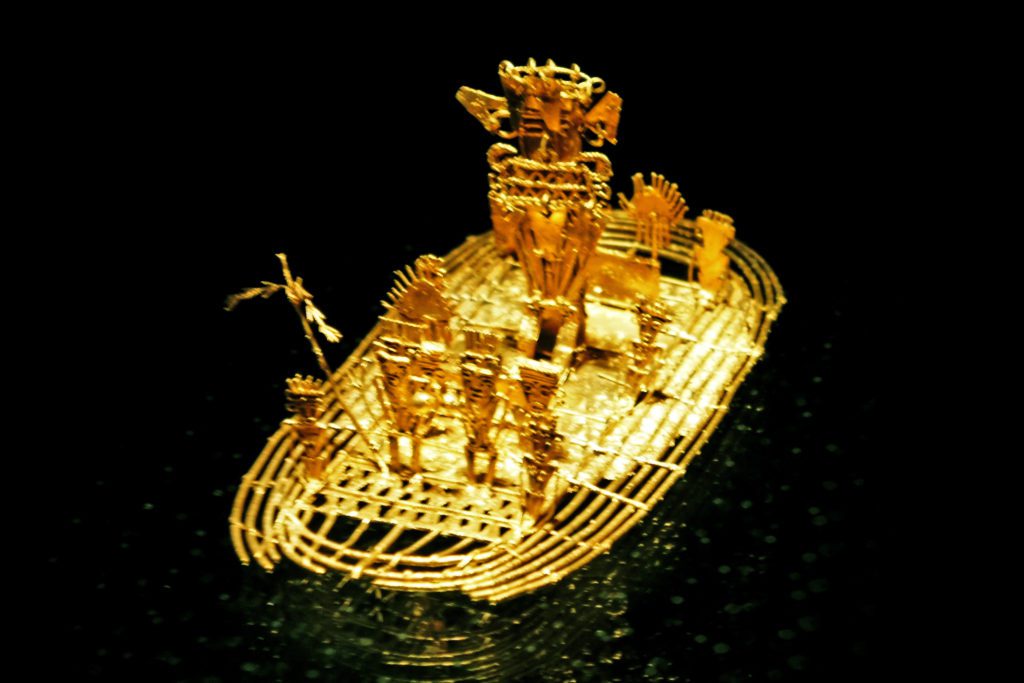
As you can imagine, when the Europeans caught wind of this story, the possibility of a pile of gold hidden on the bottom of a lake piqued their interest. As time went on, El Dorado changed from the name of the ceremony, to an empire of riches that led to various people trying to find this holy grail (all to no avail).
Beyond Bogotá
As we flew out of Bogota just 48 hours later, we were left feeling like there was waaay more to this city, and we’re so very excited to learn more about Colombia beyond our simplistic initial ideas. This place seems incredible already!!
Bogotá In a Nutshell
We stayed near La Candeleria (the main tourist area) but we’d suggest you try Chapinero, because it’s safe to walk around in day and night, and it’s easy enough to get to all the tourist areas without being in gringo-central.
For our Bike Tour, we used Bogotá Bike Tours, which we can highly recommend. Just show up about 15 minutes before the tour time (ours started at 10am).
We went to a great restaurant called Sazerak, which was sort of Cajun-cum-Louisiana style food. Really nice space, really nice food.
Closer to La Candeleria on the market street of Carrera 7, we stumbled across Compañía Casa de Rey. The coffee here was great, and if you follow your nose through the cafe you’ll discover an atrium area where there are a few other restaurants tucked away in a beautiful open area. Everyone seemed super friendly and the food looked amazing. (We ran out of time – too many great places!!)
3 thoughts on “Bogotá: A Warm Welcome to Colombia”
Comments are closed.