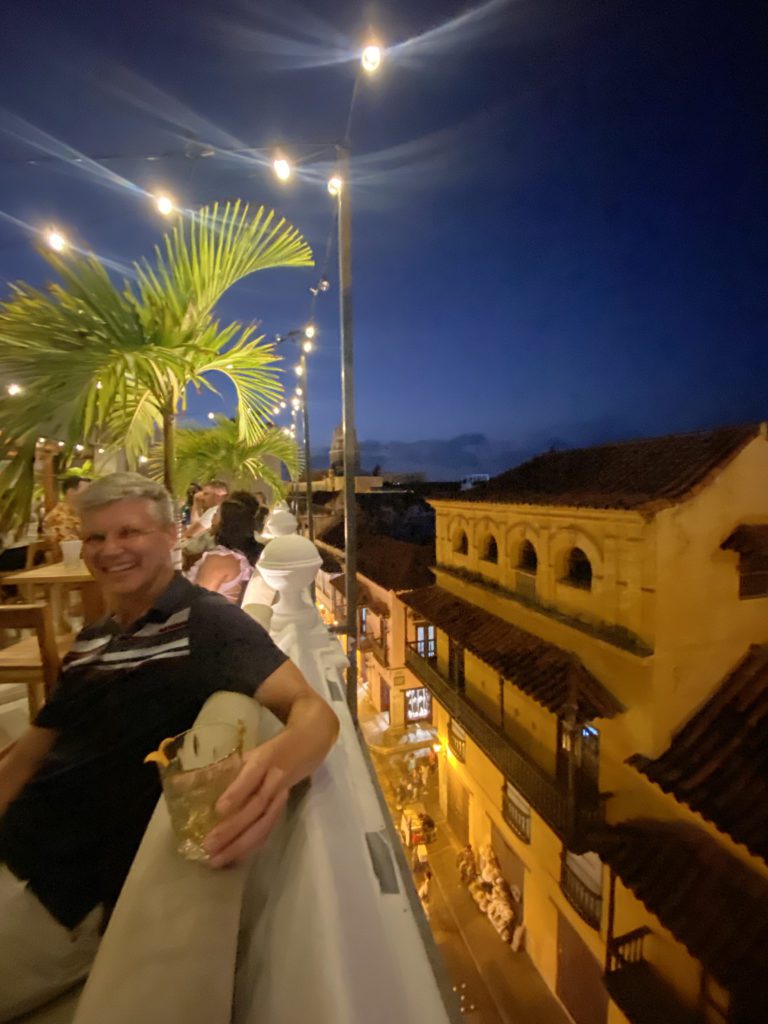
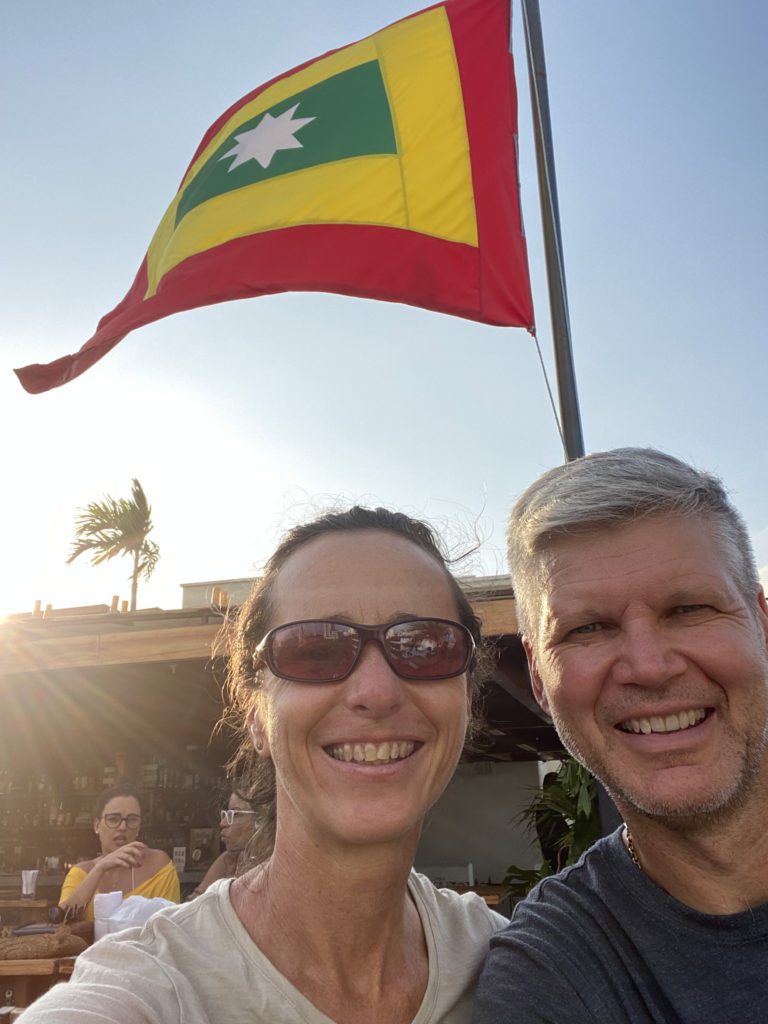
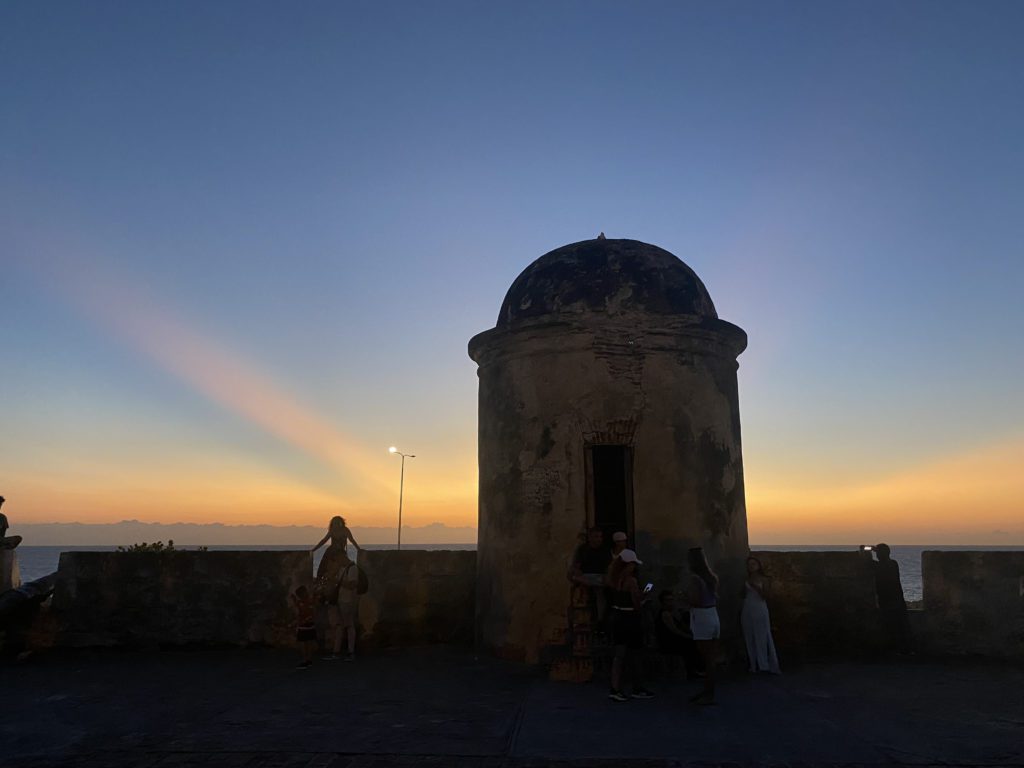
Sitting on Cartagena’s historic wall at sunset and looking out over the Caribbean Sea, we buy a cervesa from a local street seller. She doesn’t have change so leaves us with her cart of sweets and chips, and her 7 year old son. He’s teaching us the mantra of the cart seller, much to the amusement of both him and passers-by: “AGUACERVESACOCACOLAGATOR-AA-ADE”. This phrase, or a variation, is one we’ll hear muttered or shouted repeatedly by the hundreds of men and women plying the streets and laneways of this wonderful coastal city.
Cartagena de Indias is a city with a big personality. From the reggaeton and salsa music blasting from houses and cafes, to the jovial fresh lemonade seller sporting an Emperor of Japan T-shirt stretched over his broad belly, to the giant iguanas that randomly pop up around the place and the tropical trees and fruit everywhere you turn, it’s a city bursting with life. We spent a week exploring the different faces of this fascinating city.
The Different Faces of Cartagena
The Caribbean Coast of Columbia has such an interestingly diverse population, food culture and attitude to life that closely reflects its varied history. It’s a mix of indigenous people who came from Asia via North America over 4,000 years ago along with Spanish colonists and people who were brought here from Africa as slaves.
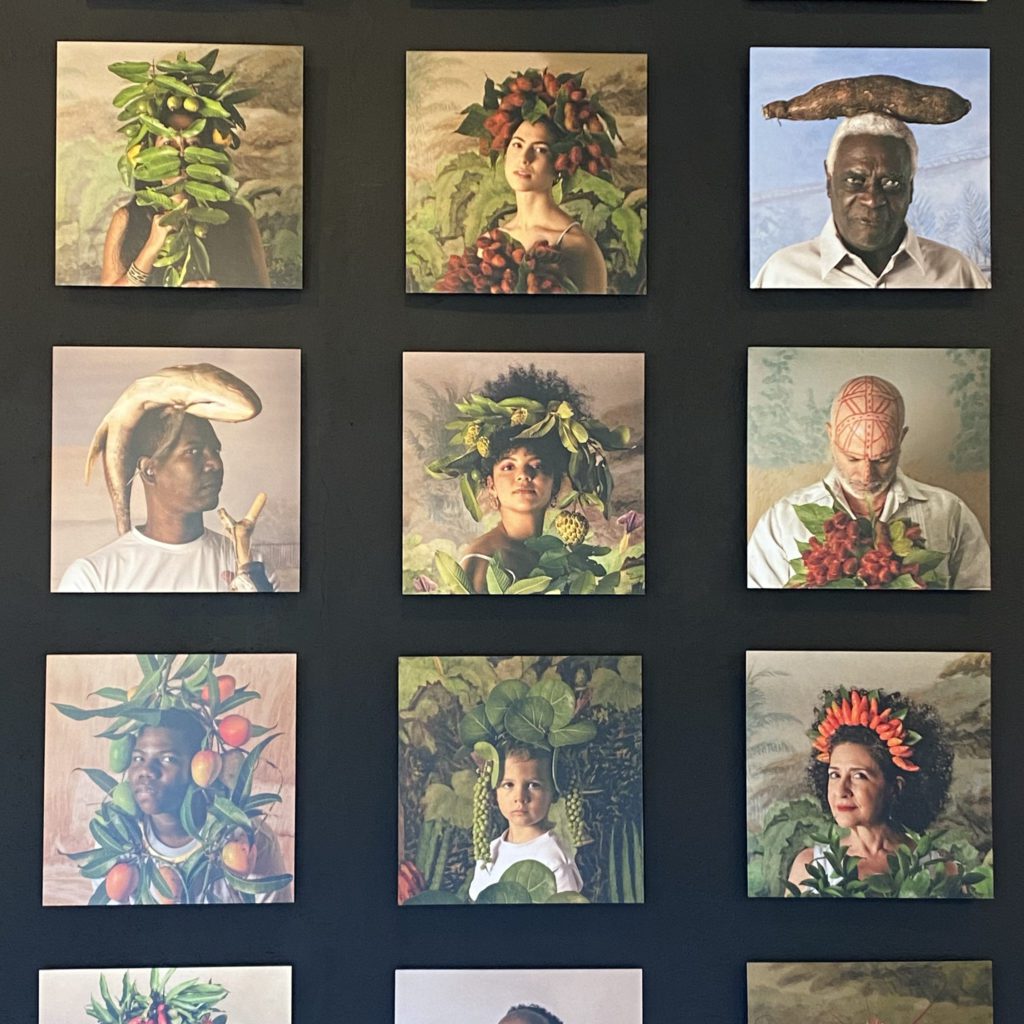
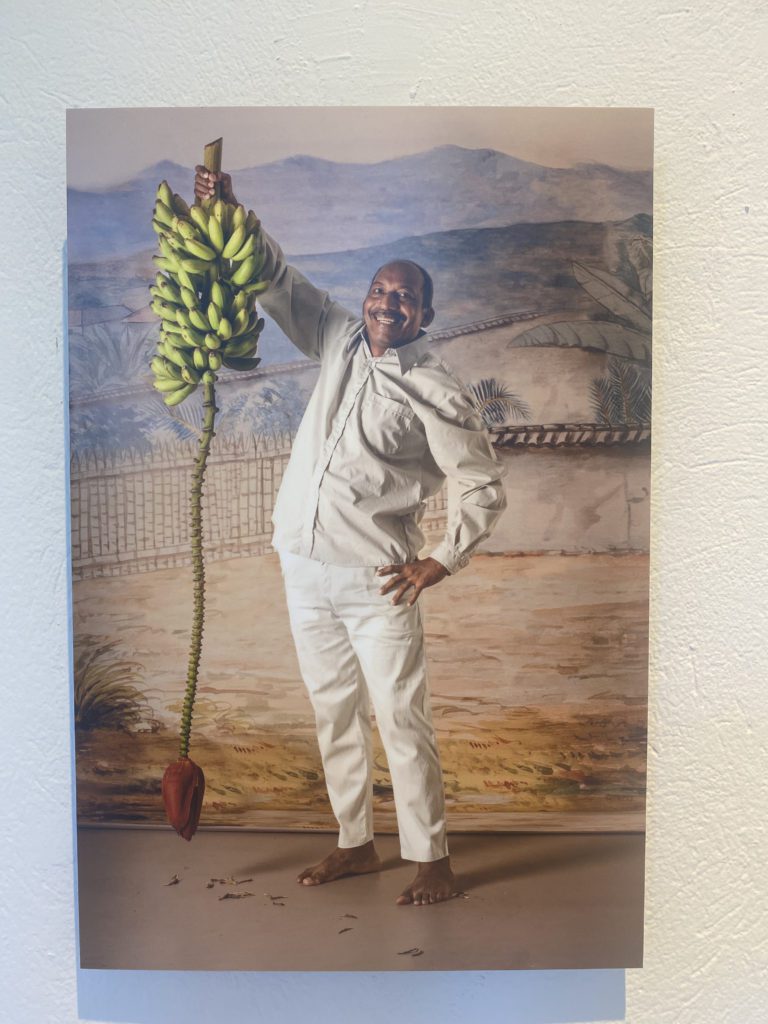
There’s an eye-caching photography exhibition we happened to stumble on in a tiny art gallery on the edge of the old town called ‘The Caribbean, 172 Years Later’. It’s an exhibition by local artist Ruby Rumie. Rumie has photographed 100 local people with their favourite local foods: everything from mangoes to crabs. It’s a wonderful display of the diversity of the region.
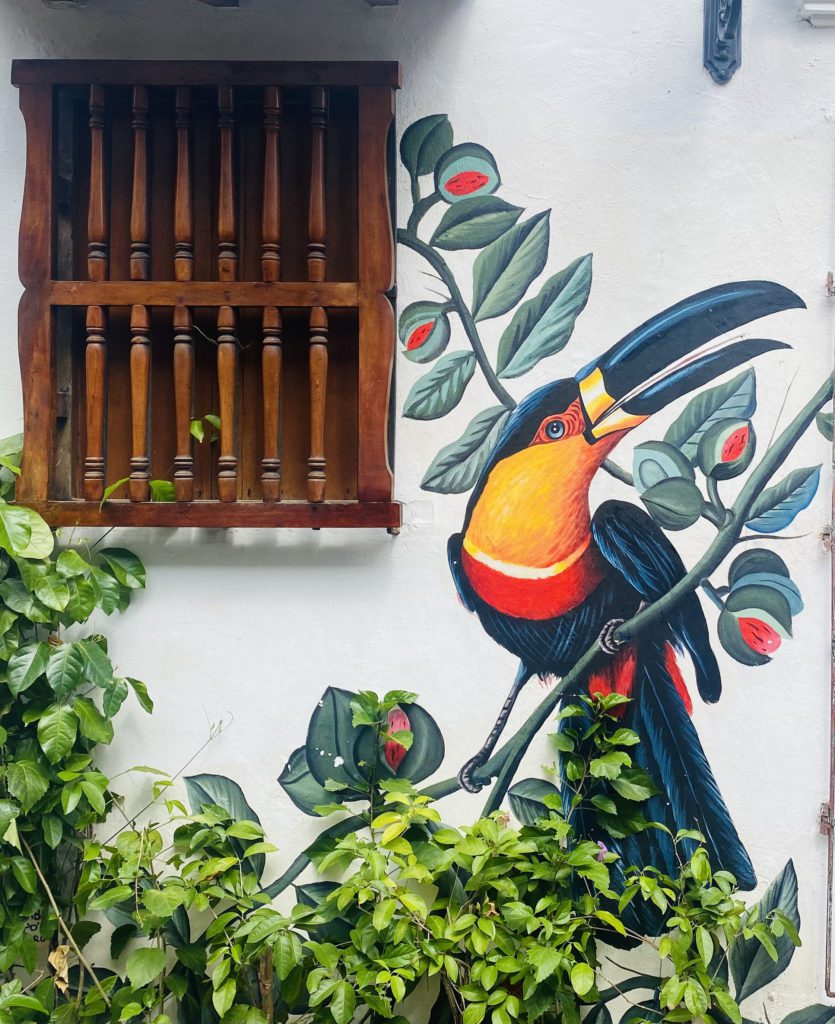
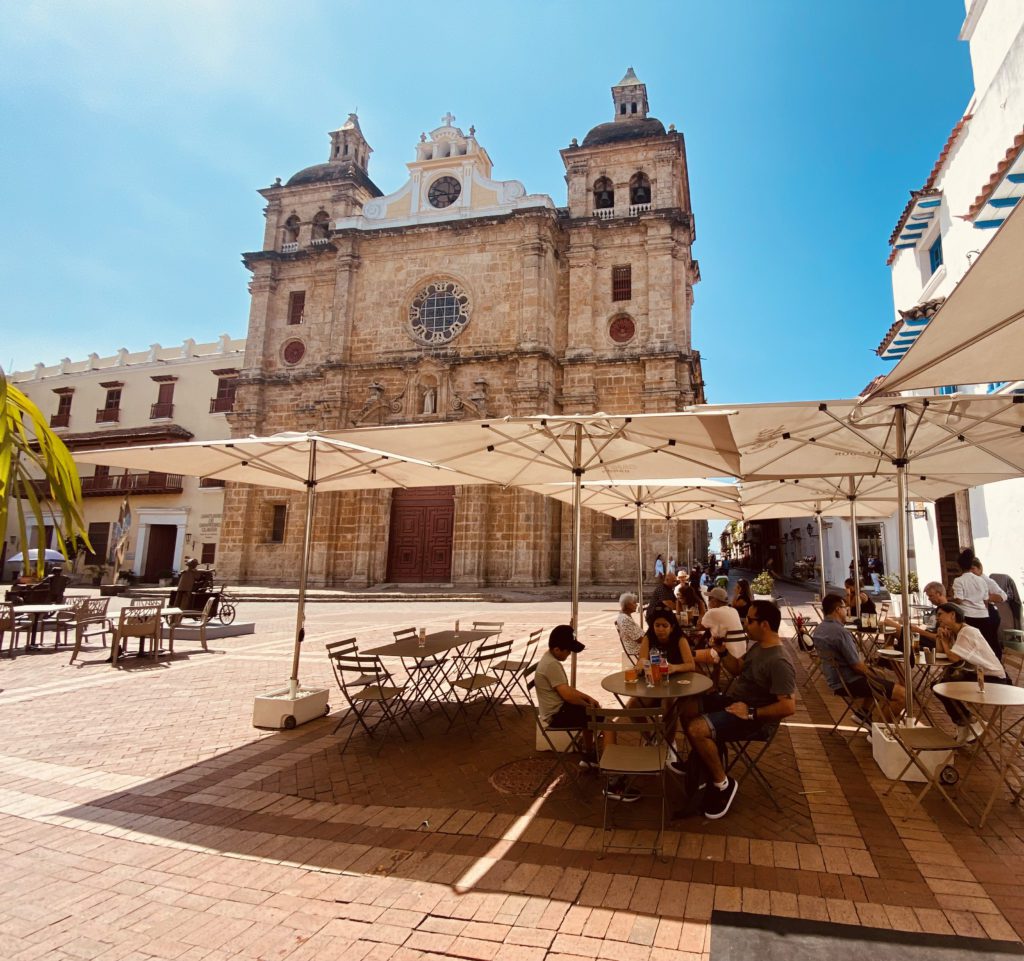
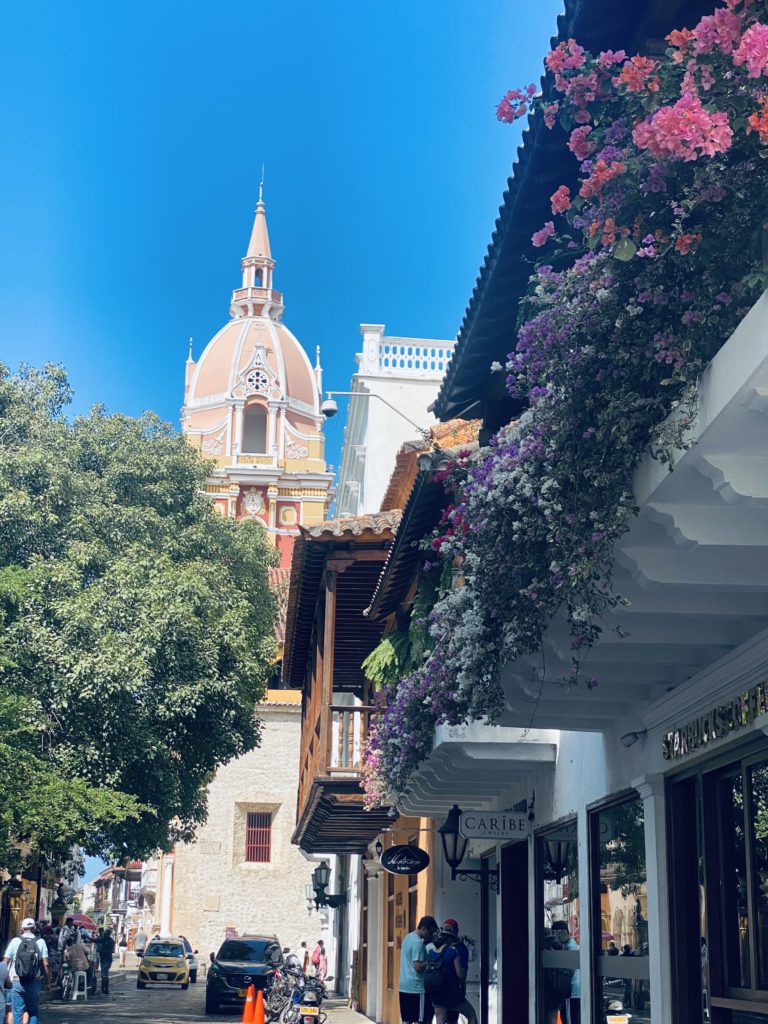
Today the old town is a ridiculously photogenic area of narrow streets lined with colourful houses adorned with ornate wooden balconies and large wooden doors, many of which are framed by masses of bougainvilleas that wind along the walls. It’s easy to get turned around in the maze of colourful streets filled with equally colourful people. It’s not hard to lose an afternoon wandering the streets and lounging in the many cafes.
The Spanish Face
At first glance the Cartagena Maritime Museum looks like something from primary school memories, complete with aging dummies of pirates and sea captains that have seen better days, a slightly musty smell and dusty cabinets holding dioramas. None of that matters once we’re bustled inside by Miguel, our personal guide who takes us on a swashbuckling tale through 300 years of colonial Cartagena history. In fact, the dummies turn out to be quite useful in helping us remember the various characters of the adventures.
In Coles notes form, the Spanish take control of the area not long after Columbus happens upon the continent of the Americas. They quickly realize how useful this beautiful protected harbour can be. For almost three hundred years it serves as a hub to store and ship Spanish gold and other precious metals they have ‘traded’ wth the indigenous peoples from all over Latin America back to Spain.
Over the course of three centuries, it comes under attack a number of times. Most notably in 1586 by the pirate, cum English knight Sir Francis Drake, who effectively holds the city to ransom for some gold doubloons. He wanders off satisfied with the bounty, but leaves a legacy that results in the Spanish increasing fortifications around the harbour many of which can still be seen today, including 11km of stone wall all around the city. They also built one of the largest forts in any Spanish colony, known as Castillo San Felipe de Barajas and it still dominates an entire section of Cartagena’s cityscape.
Just over 100 years later the French Baron de Pointis took the city for the French in 1697. According to our guide (who may have been using some poetic license), after a couple of months the Baron decided it was far too hot in Cartagena, so he upped sticks and retreated to the far more pleasant climes of France. This left Cartagena without a formal colonial power in place for over 40 years.
At some point someone in Spain remembered the place, and put one of their sea captains, Admiral Blas de Lezo, in place as the governor. De Lezo was an interesting character because in various battles with the English he’d lost his left leg, his left hand, use of his right arm and his left eye. Somewhat battle scarred, he retreated to the safety of a land-based posting in Cartagena. As you can imagine, his museum look-alike was quite memorable.
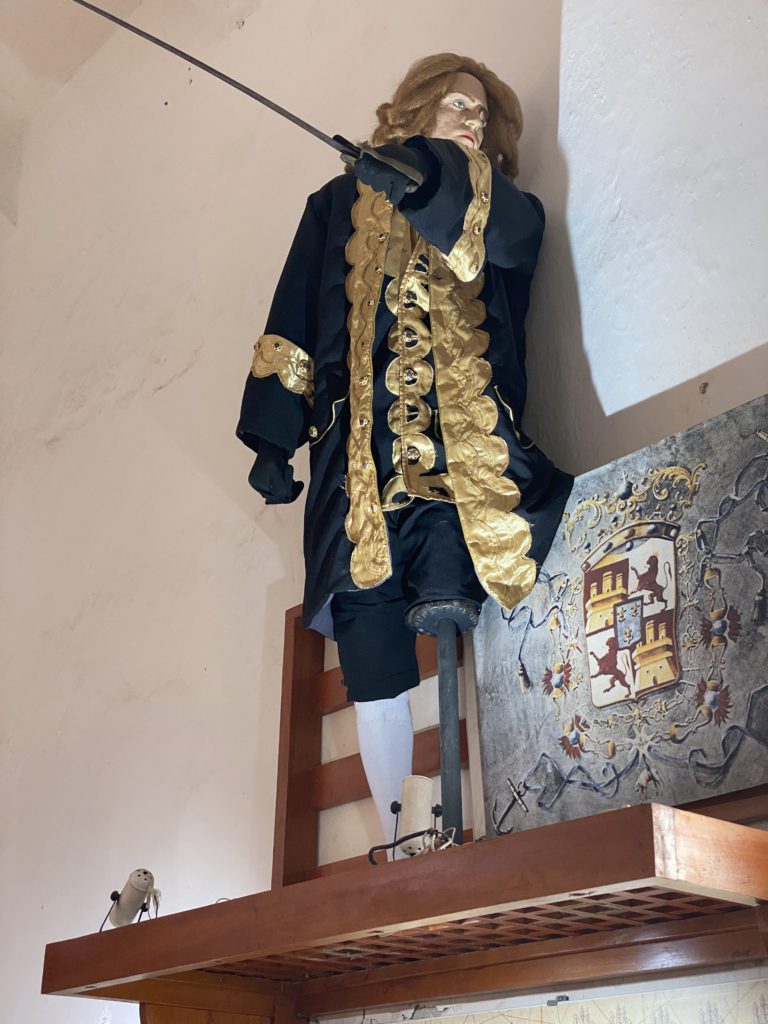
De Lezo’s arrival evidently got the English curious, and they figured it might be an easy target. So they sent a chap by the name of Vernon (of the same fame of various mountains in the US) across to take over the place. He amassed a total of 23,000 troops in 180 ships, hugely outnumbering the local Spanish by a factor of almost 100:1. After winning an initial battle, Vernon was so confident of victory that he fired off a note to England to say he’d taken the city, But, he was a little hasty. Through a series of both unfortunate incidents and clever planning by de Lezo, Vernon lost. Our guide Miguel, and it seems Cartagenans in general, seem very proud that Vernon lost and he gleefully pointed out that the loss appears not to have made it into many English history books.
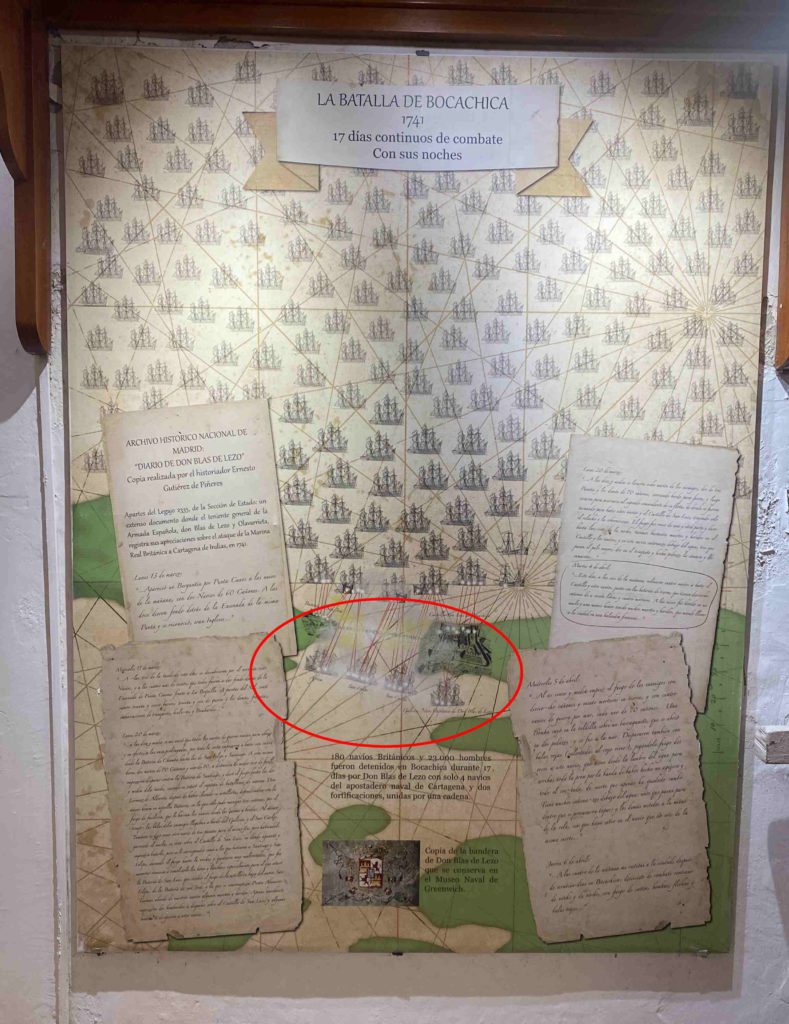
I’ve circled the Spanish ships. All the other ones are British
The Spanish go on to rule until the country gains independence, first briefly in 1811, and then for good in 1826 with the help of Simón Bolívar. At this point, the small city of Cartagena is filled with colonial buildings heavily influenced by the Spanish. The fact so many of the colonial buildings remain today is a key reason it has been designated a UNESCO World Heritage site.
It’s near the end of our tour of the Maritime Museum, and Miguel can’t resist taking us to the modern area of the museum and getting us to act out some highly realistic scenes.

As we emerge from the museum and back into the thick humidity and hot tropical sunshine, pale cruise ship tourists wander the streets in search of the next stunning photo op or tropical juice. It seems like a world away from the city it once was.
The African Influence
Many of the buildings in the old Cartagena are coated in stucco, whitewashed and painted bright colours. But when our tour guide encourages us to take a closer look at some of the walls and buildings that haven’t had this treatment we start to see the myriad of intertwined curves that can only be coral.
It’s quite amazing to see whole pieces of coral embedded in the walls and for a moment we have images of people ripping the coral right out of the surrounding reef. But we’re reassured to hear that this rock is in abundance in the nearby hills. You might think it would be soft but apparently it’s one of the most dense and hardest building materials. Huh.
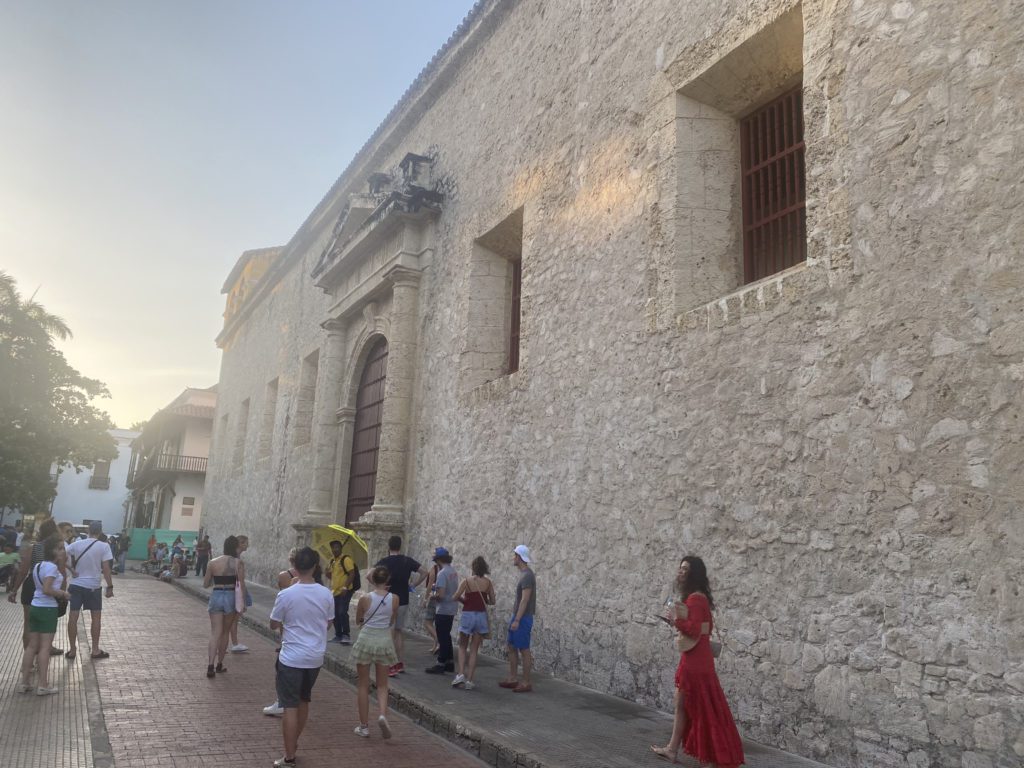
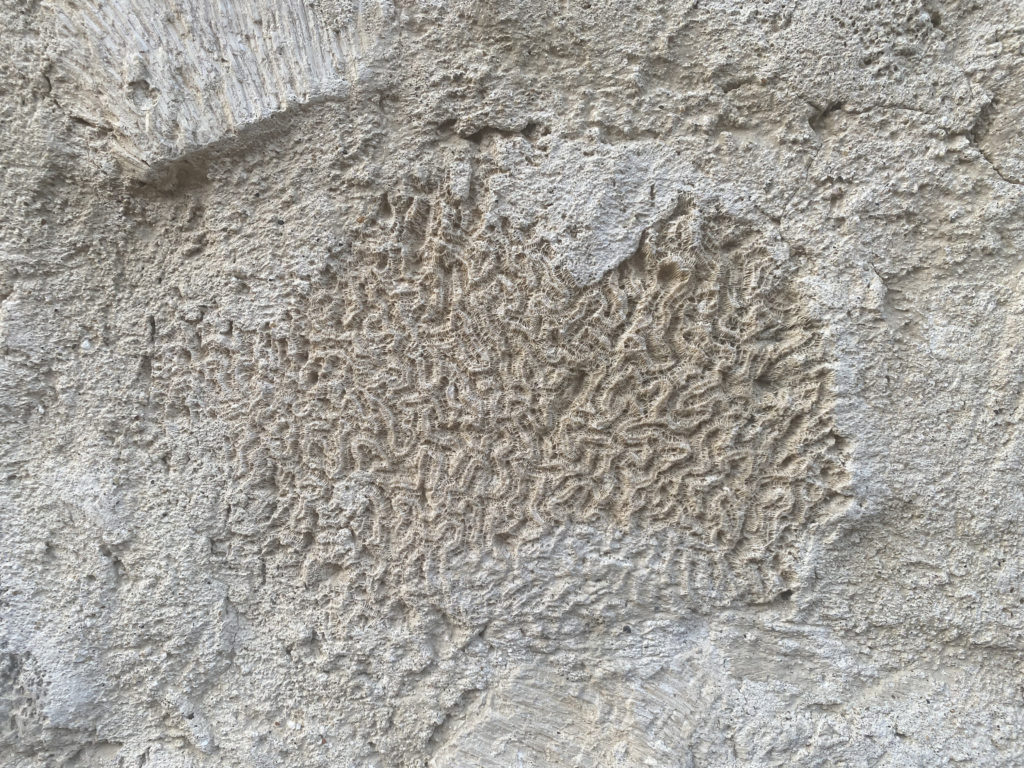
Along with gold and silver, the other trade that made Cartagena the most important port in the Americas was the slave trade. In the 16th and 17th century more than a million people were brought here from Africa as slaves across South America. Today this African heritage can be seen in the people, the food and the music.
Cartagena’s slave history does have one bright point: the town of Palenque, about two hours away. In 1599 a slave by the name of Benekes Botho, who was a king in his African home, escaped and fled to the swamps outside of Cartagena. He was able to orchestrate the escape of many others and form an army. This was so disruptive to the ‘highly lucrative’ slave trade, that the governor of Cartagena signed a peace treaty with Botho in 1605. But true freedom was harder to secure. It would be a long time before the escaped slaves gained freedom, and not before Botho was hanged. But in 1691, for the first time in the whole of the Americas the town of Palenque became the first free town of people who had formerly been slaves.
Today, the women from this town, called palenqueras, can be seen in the old town dressed in eye catching bright dresses the colours and carrying bowls of fruit on their heads. Palenque is a proud township, that among other claims to fame is also known as the birthplace of Champeta music – more on that in a moment.
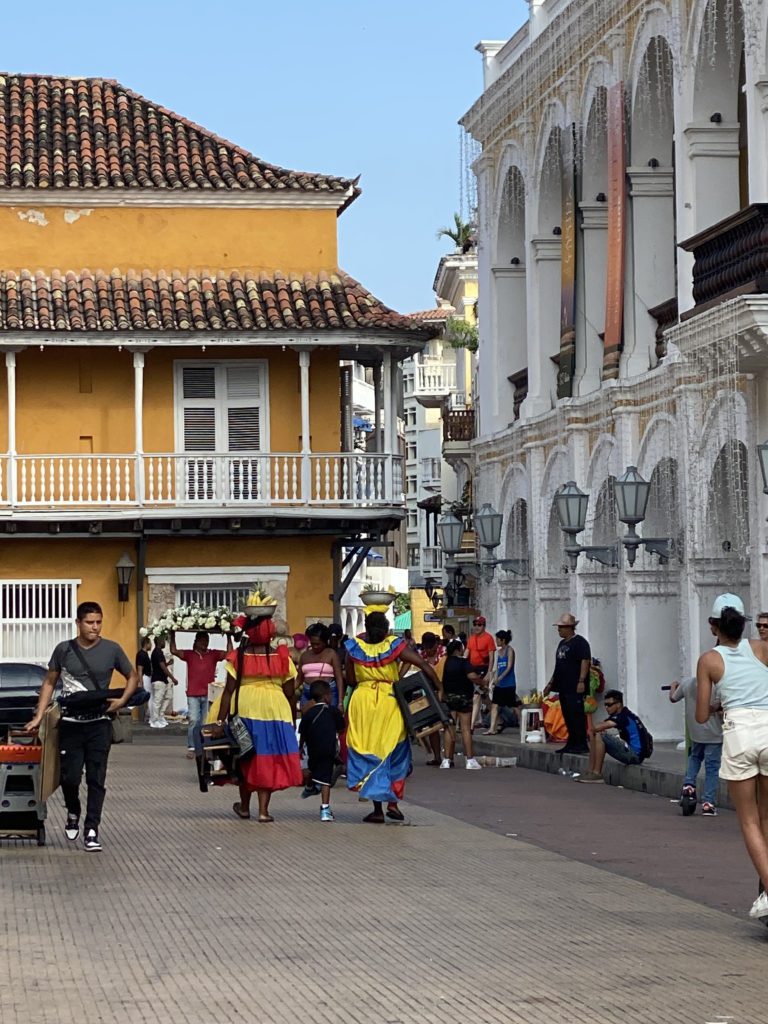
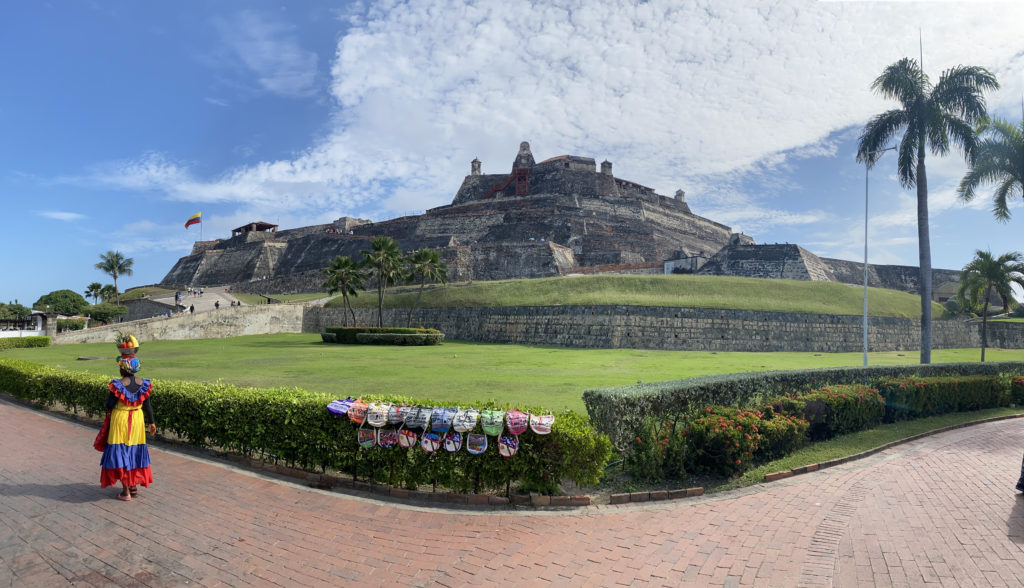
A palenquera in front of the Castillo San Felipe Fortress
A Tale of Two Cities
The old port of Cartagena was originally divided in two by the geography of the harbour islands. The gentrified area now known as ‘Old Town’ was an island to itself and the area where the slaves lived was known as Getsmani. The two were separated by a narrow channel of water (long since concreted over) and each night at 6pm a bridge was lifted so no-one could pass between the two. These days it’s more a separation of the more well heeled visitors and the backpackers. Getsmani has a great, edgy feel with narrow streets and lots of street art. Once we discovered this wonderful area, we ate most of our evening meals there.
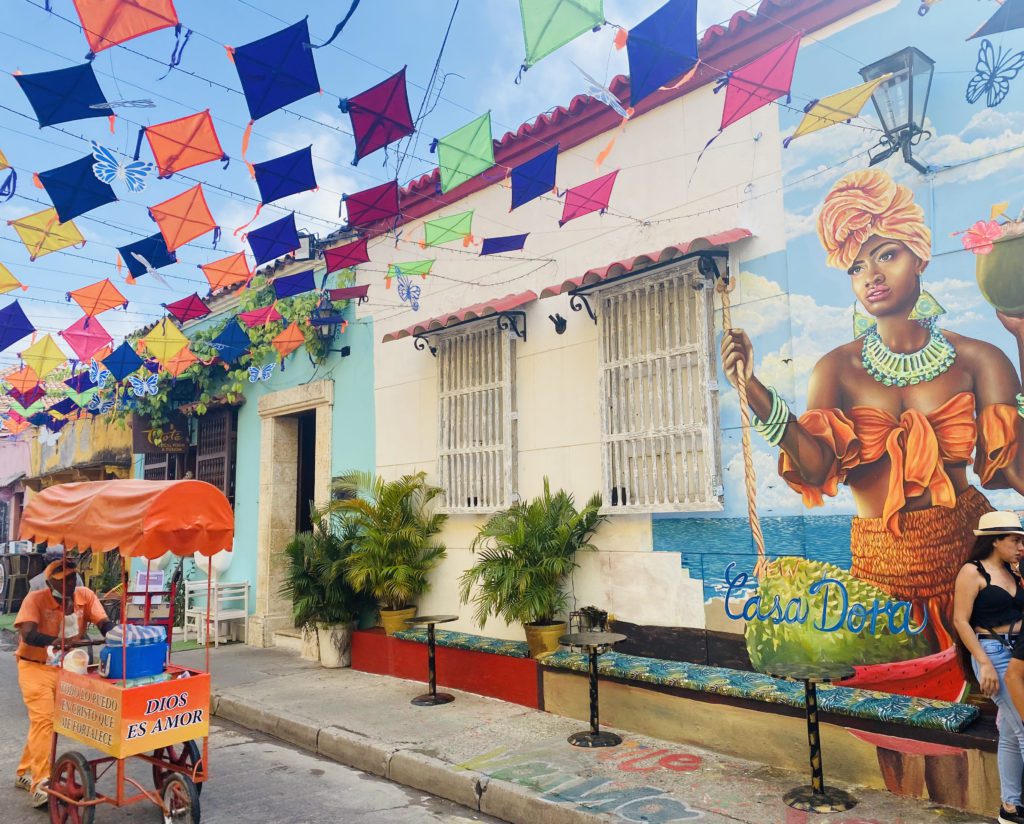
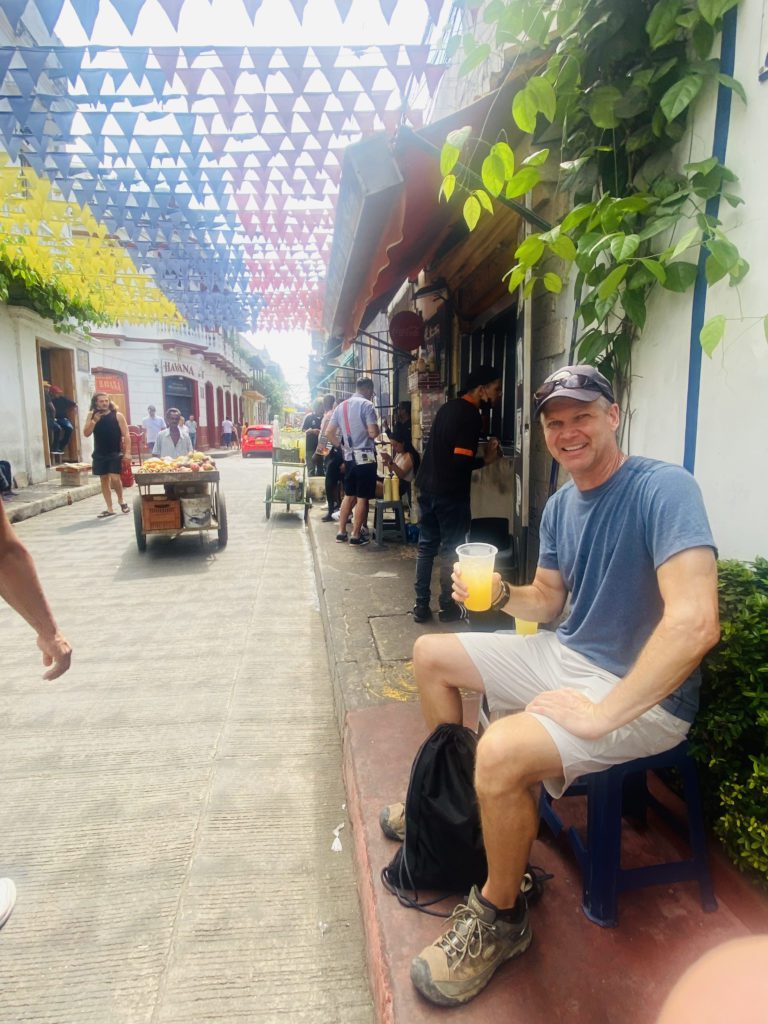
Just as the city of Cartagena was two cities in one, the city today has two very distinct faces on show.
Cartagena is a gem of city with a fascinating history and true old world charm on one hand, and on the other it’s party central for all the people streaming off the cruise ships or staying in nearby beach resorts. Its old town is filled with high end restaurants, classy cocktail bars and rooftop bars filled with bright young things.
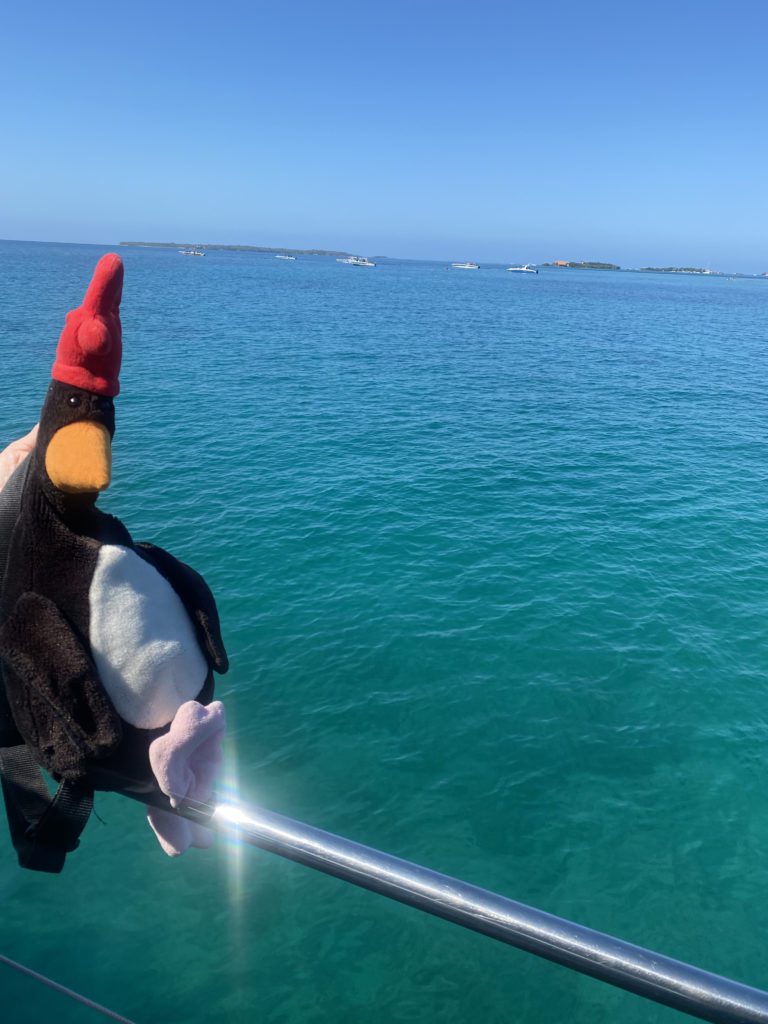
We had a taste of both sides of the city, with our fair share of cocktails on rooftops, limonadas in plazas and arepas on the street. We even took a day trip out to the Rosario Islands to snorkel in the warm tropical waters and laze around on a catamaran drinking cocktails in the sun.
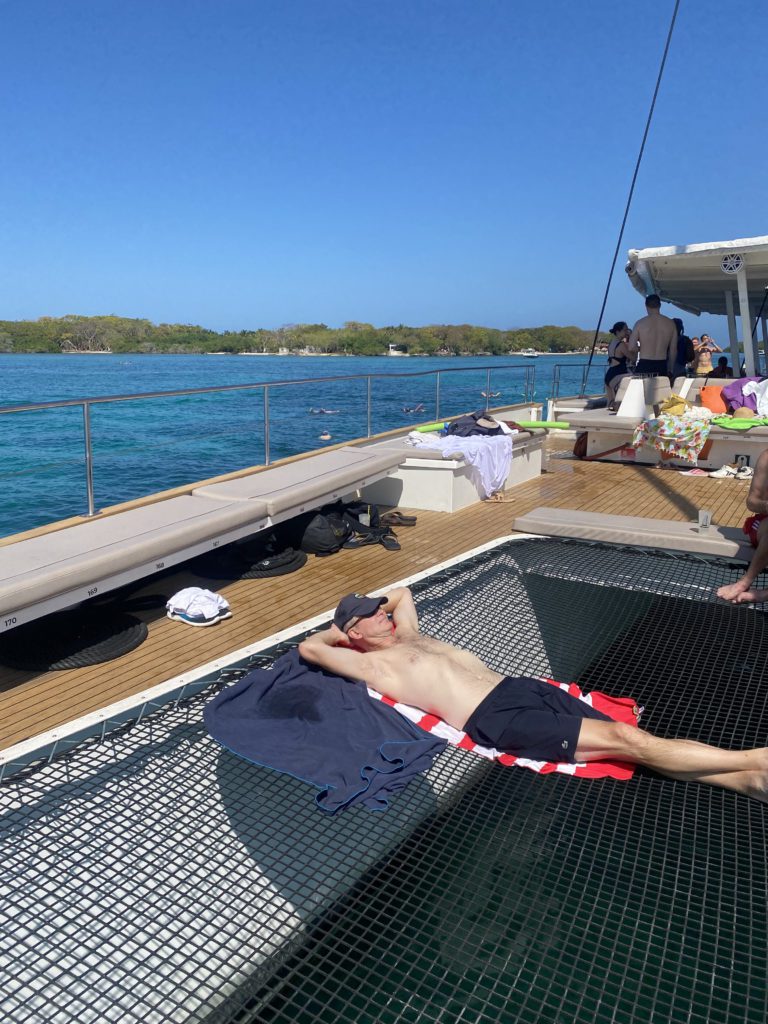
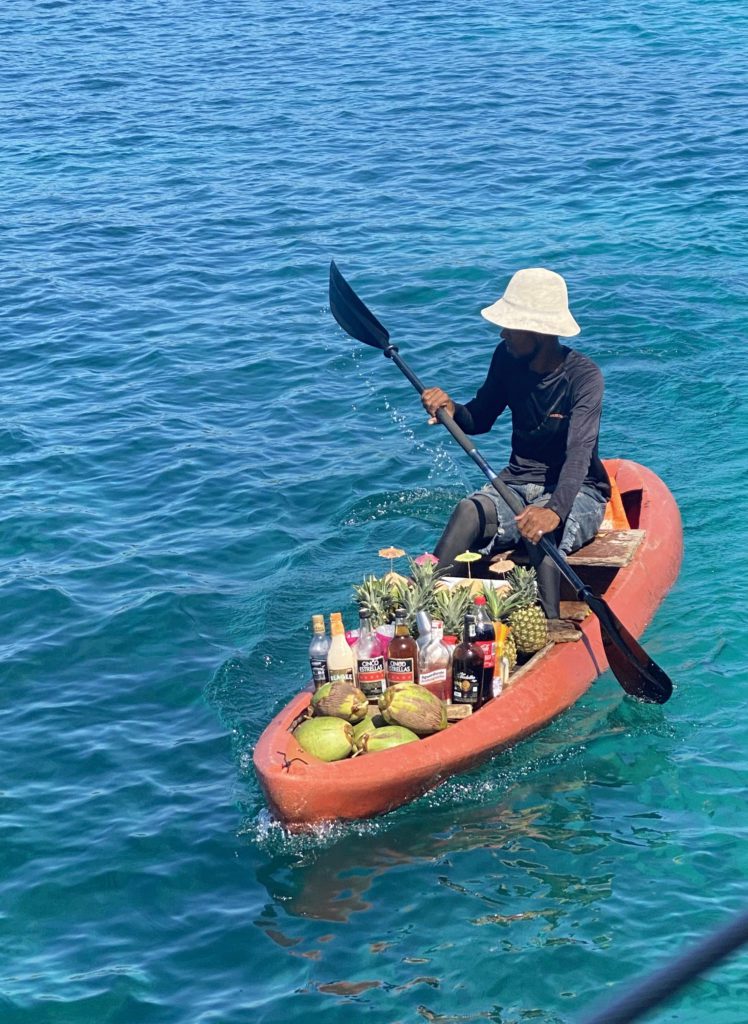
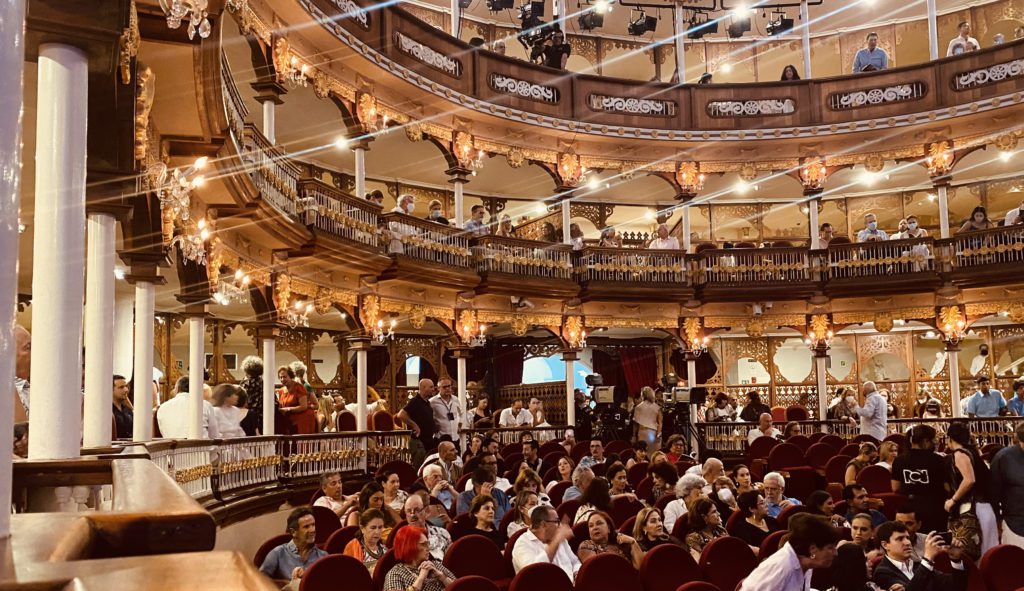
Back on land we switched again to the more sophisticated side of town. Just as the elite of the colony era may have done, we even had a chance to see a concert in the gorgeous, very intimate Teatro Adolfo Mejia. As part of the Cartagena Music Festival we saw the Prague Chamber Orchestra and a very talented Colombian cellist, Santiago Cañón Valencia. Not our usual choice for entertainment but we really enjoyed it. Maybe it was the beautiful venue, the novelty of being on holiday or just seeing a live performance for the first time in a long time.
Caribbean Beats
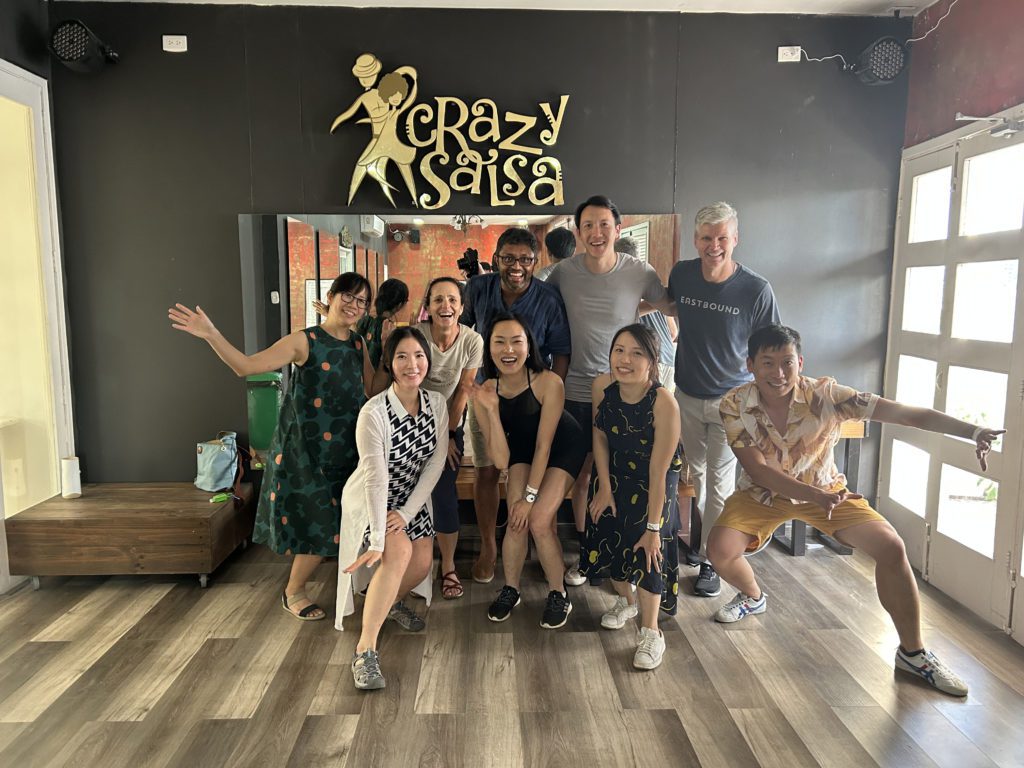
Nothing happens in a hurry in Cartagena, possibly with the exception of the most popular dance: Champeta. Our friends from the Ciudad Perdida trek, the Avocadoes, have invited us along to an introductory class to learn the basics of this high energy dance. Like so much in the region, this is a mixture of cultures. The musical heritage is a mix of African beats with Haitian and indigenous Colombian music.
As the class starts the first few steps are reminiscent of a 1990’s aerobics class with some classic ‘box step’ and cross step moves. It then evolves into a forward moon walk and some backwards cross country skiing moves. This is all fine until the music seems to quadruple in beat count so we can barely keep up and some kind of weird movement is brought in involving waving your torso in a way we’re not sure anyone other than a local is able to pull off. The result is a lot of laughter and a few steps we will be able to show off should a very specific song get played in the bar (Catalina, Catalina, Catalina…)
See if you can count how many times Al stuffs up in less than a minute
A Little Piece of Wildlife in the City
The diversity in Colombia is not only limited to its people. Apparently it’s one of the most ecologically diverse places on earth. We had expected to see some of this diversity when we were trekking in the jungle but found mostly cows, chickens, dogs and cats with the occasional butterfly (and of course Paola the parakeet). Oddly it was in a small city park that we saw the most unusual wildlife.
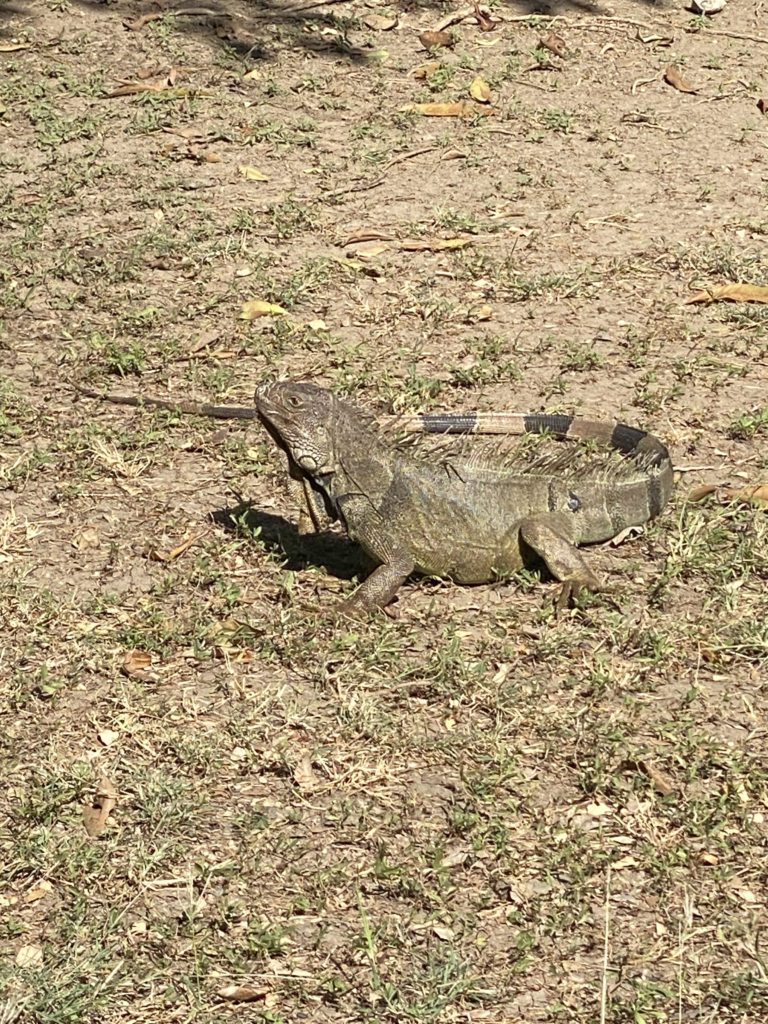
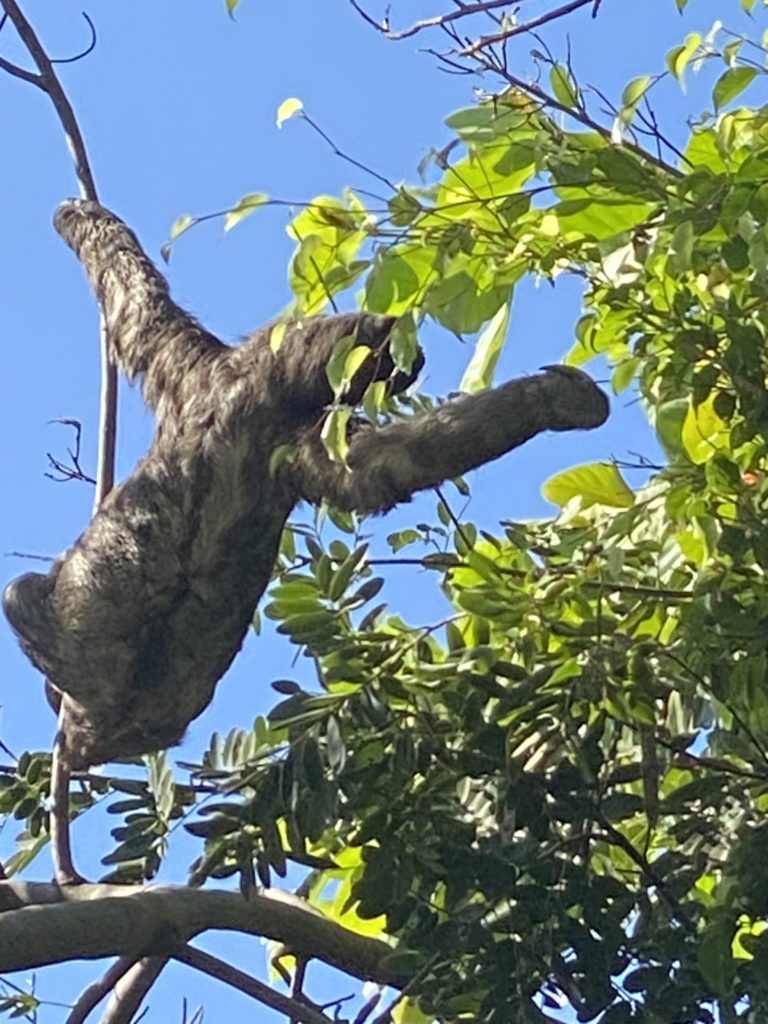
As we walk back from Michelle’s cooking class, we pass through the park and in the space of three minutes we’ve seen two giant iguanas, a bunch of tiny tamarind monkeys, and a giant black bird that is kind of terrifying, but no sloths yet.
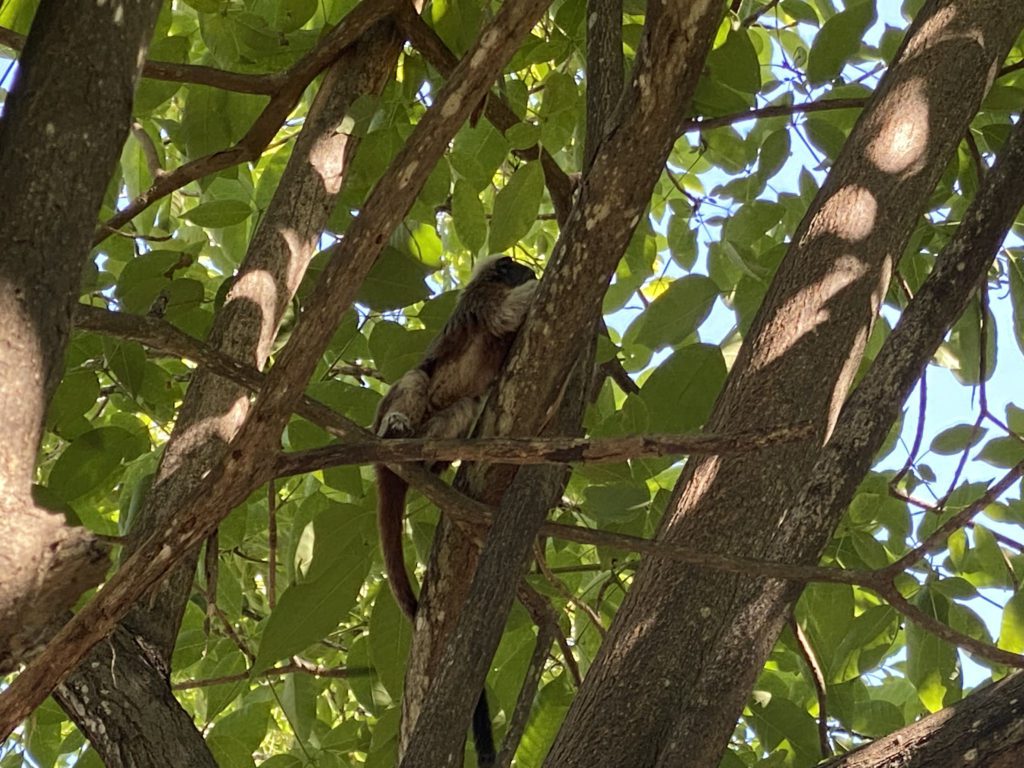
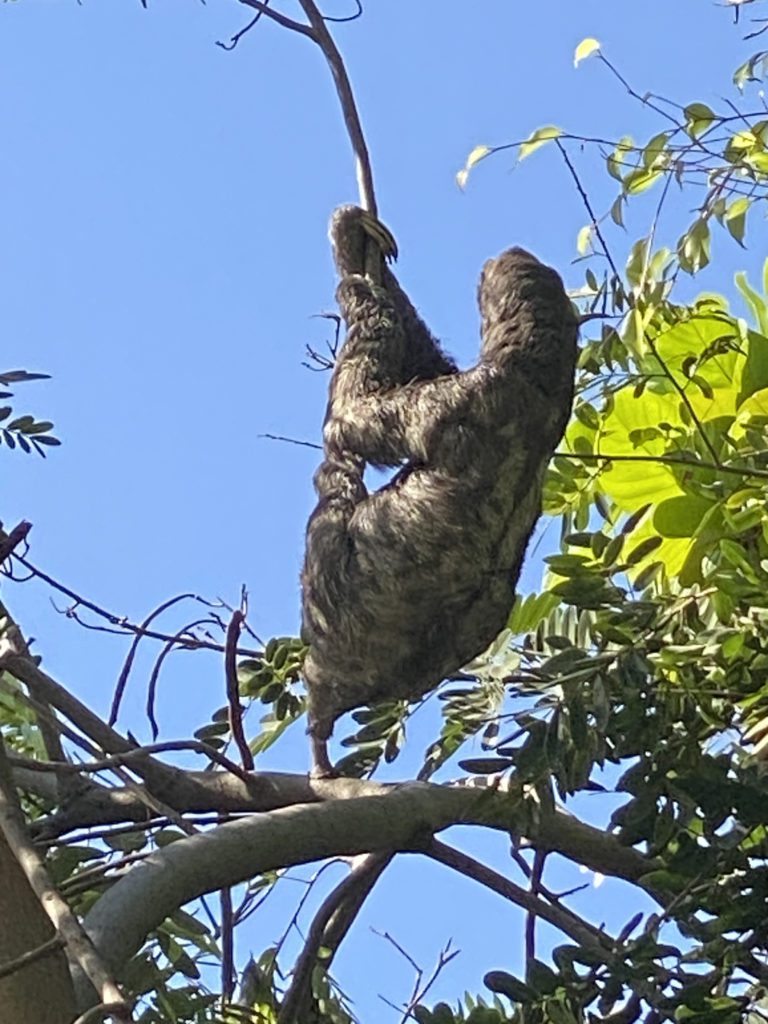
Just as we’re leaving the park and about to give up, we spot something high up in a tree. He’s a bit shy at first but then a long arm reaches out to grab a nearby branch with its long claws, then we see the classic sloth upside down pose. Finally he shows his face much to the glee of the small crowd that’s gathered, including our friends the Avocadoes who happen to be sloth seeking as well.
Moving On
After 5 weeks, our adventures in Colombia are coming to an end. As we sit in a rooftop bar watching the setting sun make the colonial buildings glow vivid orange, we talk about our trip so far. We realize how much we’ve enjoyed travelling once more in a culture that we know so little about. We can’t wait to see what Chile has in store. We have one last plate of ceviche, before we head south to the land of red meat.