
Colombia In a Nutshell: Travellers’ Tips
Money In Colombia
The Colombian currency is the peso. The largest bill is $100,000, and the smallest is $1,000.
You’ll sometimes see menus in restaurants drop the thousands, so it might say “$30” for a main (about $10 CAD). You’ll also hear ’30 mil’ for 30,000. (Mil means thousand in Spanish).
There are also coins – $1,000 is the largest (1 mil) down to 100 pesos (a couple of pennies – small enough that some places round up or down when giving you change). You’ll mostly be dealing with $1,000 and 500 peso coins.
Cash is king for street vendors and smaller stores. Credit cards are quite widely accepted, especially in the larger cities, but will attract a surcharge (usually around 3%). This may still make sense for you if you don’t want to carry tons of cash or have to keep going to the ATM.
Tipping in Colombia
Restaurants will either ask you if you’d like to include a tip or automatically add in a 10% tip to the bill. We usually clarify that there is a tip already included by asking ‘Servicio Inclusivo?’ and if the answer is ‘Si’, then we know we should take all of our change back.
Grocery Shopping
If you go to a supermarket, expect to be asked way too many questions at the checkout. You will certainly be asked if you want bags (bolsas), but you may also be asked about collecting points (puntos). But the most confusing question we found was if you wanted to divide your purchase into multiple payments (cuartas). And there’s usually one more question that we’ve never been able to figure out. Something about a national identity number and signing the receipt. Good luck!
Exchanging money in Colombia: Using ATMs
There are many different banks in Colombia that will accept foreign cards, and there are ATMs at all of the airports we’ve been to (Bogota, Medellin, Cartagena).
However, almost all of them charge you a fixed fee to take out cash, regardless of how much you’re taking out. This was usually around $8USD. Other blogs had said that there were banks that didn’t charge this fee (e.g. BBVA), but our experience was that they actually did. And, quite often you were limited to a fairly small amount to withdraw ($600,000 COP – less than $200 USD).
So we kept trying different banks until we found one that gave us what we were looking for – No fees, and a high withdrawal amount.
The only ATM we found that doesn’t charge any fee was Davivienda (which also happens to be one of the biggest banks in the country). And, it allows you to withdraw at least $2M COP ($500 USD) – and maybe more, we didn’t try taking out any higher.
The process is a little tricky to avoid the fee. Follow along below to find out how.
- All of the ATMs that we tried have an ‘English’ option, including Davivienda. Once you’ve put in your card and your PIN and chosen your account (we used our Canadian debit card and chequing account), you can choose a preset amount(up to $2M COP) or put in your own custom amount to withdraw.
- Then, it will show you a summary screen where it shows you what the exchange rate is, and the fee that they want to charge you (7.5%).
- At this point, press ‘DECLINE’.
- This doesn’t cancel the transaction – it just avoids Davivienda performing the foreign exchange before sending the request to your bank (and avoids the fee).
- Once you’ve pressed ‘Decline’, it will whirr for a few seconds before spitting out your money and a receipt, if you asked for one.
- Don’t forget to wait and retrieve your card!! In Canada and Australia, ATMs give you your card before you get your money – here, the very last thing it will do is give you your card back.
FYI Aussies: We also tried using our Australian debit/credit card. (Our Australian bank only gives us one card, which we can access all of our accounts with). No matter which account we chose – Savings, Chequing, or Credit – it always came out of our Credit Card. Something to keep in mind…

Getting Around
From Bogota Airport to the City
Once you’ve collected your bags and approach the exit, you will start getting accosted by taxi people trying to get you into their cars. Ignore these guys. Just before you go outside, on the right side of the exit doors, there is a small booth where you can prepay for a taxi to take you to your hotel, hostel or Airbnb. We wrote down the address to our Airbnb on a separate piece of paper and handed it to them so that they could find it on their laptop (Google Maps). Once they find the address, they’ll ask for your passport and payment (we paid cash, but I believe they take card), and then they’ll assign you a driver.
From Medellin Airport to the City
The Medellin Airport is quite a long way from the city, and includes a toll for a tunnel through the mountains. The trip via taxi or Uber will cost you around $25 USD.
If you choose to use an Uber for this journey (which we did) be aware that they cannot come right down the main street through the terminal to pick you up, because Uber is technically illegal in Colombia. (Even though it’s widely used, and locals keep telling us it’s one of the best and safest options). So you will likely have to meet them in one of the airport parking lots. This was our experience – the driver ended up walking down and finding us and taking us back to his car.
Taxis are a fixed price from the Medellin airport (about the same as an Uber) but you’ll need cash as most don’t have card facilities in their cars. Everywhere else in Medellin they will use their meter, it’s just at the airport that it’s a fixed price.
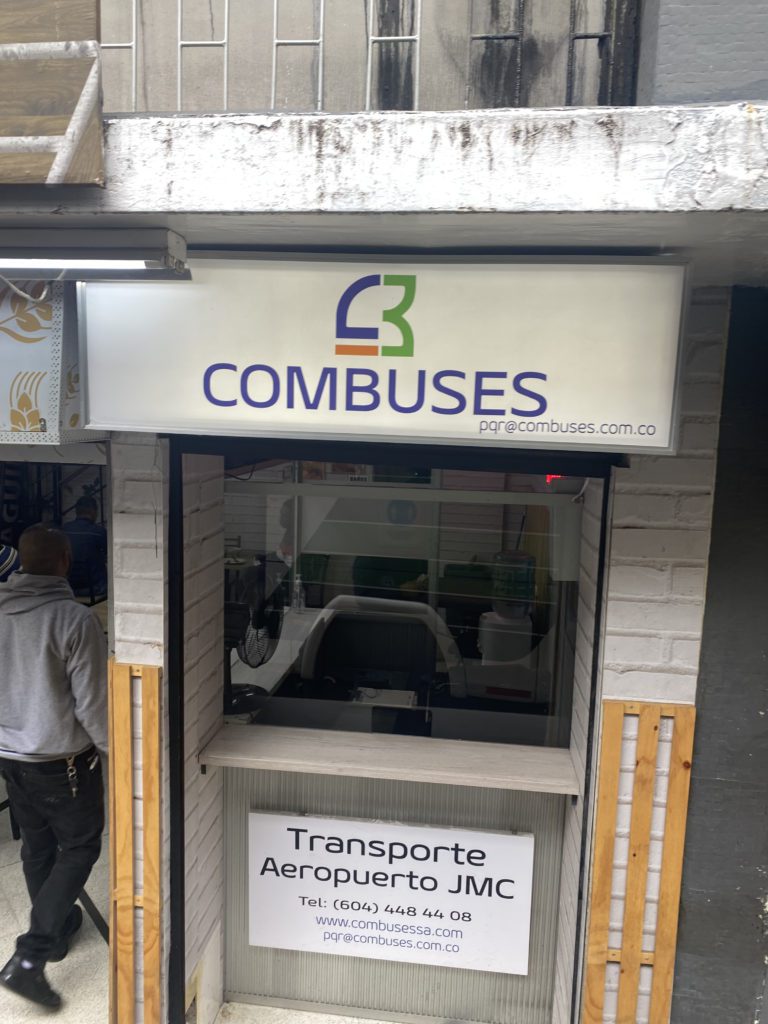
If you’re looking for a cheaper option, there is an Airport bus to and from the city. It’s very inexpensive (about $20,000 COP) and takes about 45 minutes. You can pay onboard, and it stops near the Arrivals exit. Look for the ‘Combus’ signs. This is their website:
Renting a Car in Colombia
We rented a car to drive from Medellin to Jardin. We ended up going back out to the airport to get a car, but it was a very easy experience. (We took the Combus, above).
We used Localiza and can highly recommend them.

https://www.localiza.com/colombia/es-co
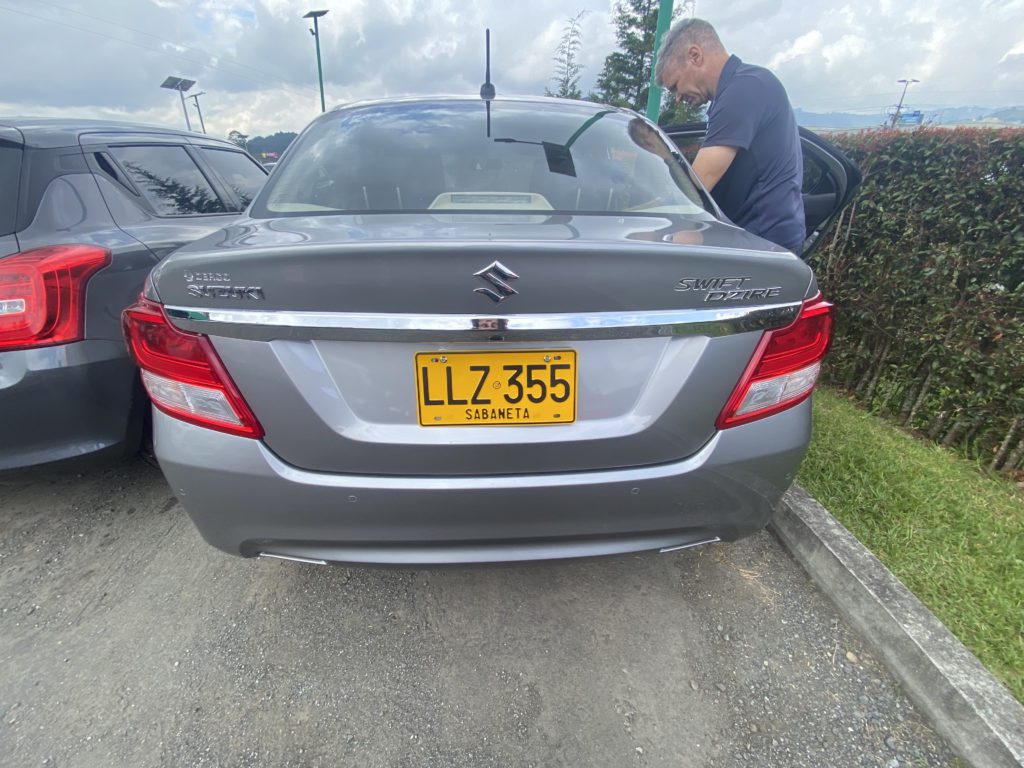
With full insurance, it was about $30 CAD per day. When we decided to extend, we just called them and told them, and they ended up charging us just a few extra hours rather than a whole extra day. The car was a brand new Suzuki Swift sedan, and there’s a shuttle bus to and from the airport terminal.
Filling Up With Petrol
All of the service stations are full serve, meaning someone will come to you to fill ‘er up. (Usually several people!). ‘Lleno’ (Je-no) means ‘Full’.
Getting on the Internet
You have two or three choices for getting on the internet in Colombia:
Use an eSim like Airalo
This is actually what we did when we first arrived in the country, but not one I’d really recommend. We’ve used Airalo elsewhere with great success (e.g. Spain), but here in Colombia it’s waaay more expensive.
I chose the cheapest option that Airalo had, which was 7 days/1GB for $8USD. This was literally just to act as a bridge until we could get a local SIM, and in retrospect probably wasn’t really necessary. It’s a LOT more expensive to use an eSIM in Colombia than a local prepaid SIM, so I’d only suggest this route if you’re only in the country for a few days. For a week or longer, it’s worth the extra effort of getting a local SIM.
Getting a Local SIM
There are several national carriers that you can use (Tigo, Claro, WOM). We used Claro, and the experience has been great. It’s super cheap – less than $10 USD for the SIM card and 30 days of more data than you can use.
To complete this exercise is a 2-step process. The first step MUST be done in an official Claro shop, the second step can be done ‘anywhere’.
First step: get a SIM card. This needs to be done at an official Claro store. Just go in and ask them for a pre-paid card (prepago). Being a foreigner, they’ll know what you’re after. You will need to provide your passport so that they can register it with the government (This is why you don’t want to buy a SIM off the street). The SIM card costs about $4,000 COP – just over $1 USD.
Second step: Buy a data/minutes package. Depending on the Claro shop, they may or may not be able to do this for you. For Michelle’s card everything was done for her in the shop. For Al, they couldn’t do it in the store, but sent us down to the Claro stand at the grocery store nearby. (No idea why). In any case, you will see Claro ‘stands’ all over every city or town you’re in in Colombia. You can recharge your plan at any of them. The clerk will usually have a catalog which they’ll pull out, and you can point to the package you want. E.g. – for about $40,000 COP, you can have 18GB of data and unlimited calls/texts for 30 days. Just give them your new Colombian phone number, and they will type it into their magic machine. You will get a text a minute or so later saying your package has been applied. That’s it! (You can also go to the claro.com.co website to look at the different prepaid packages available, but you won’t be able to recharge online without a Colombian credit card)
https://www.claro.com.co/personas/
Language Schools and Exchanges
We did a week of Spanish classes in Medellin with Mr Fox, and we had a great experience with them. There are plenty of places that offer classes: our advice would be to know what you want to get out of the classes, and make sure you’re clear with the school about your expectations. We wanted 90% conversation and 10% grammar, and that’s what we ended up getting.
Language Exchanges
To help you get more real-world experience with your Spanish in a ‘safe’ environment, consider doing a language exchange, where you go to a bar and talk with native Spanish speakers (who want to practice their English).
Medellin language exchanges
There’s a Facebook page called Language Exchanges Medellin where people post about group events happening in the city. Here’s some we heard about:
Thursday 8pm the wandering paisa hostel Laureles
Wednesday and Sunday 8pm Flora Black Coffee El Poblado Tuesday bilingual trivia
Tuesday, Thursday, Friday 8pm Dulce Poison Laureles
Wednesday 7pm Salsa class and language exchange Galeria LaFond (also Tuesday 7pm bilingual trivia)

…or follow us on Instagram…