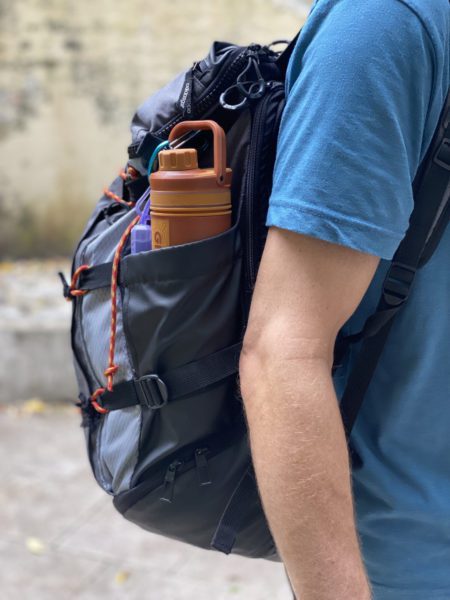
A short (ha!) review of the Grayl Ultrapress water purifier. (An awesome piece of kit)
(PS – we’re not paid or reimbursed in any way for these reviews. Sigh. Maybe one day)
Getting Clear on Drinking Water
In the lead up to our trip to South America, various travellers have recommended that you either filter or boil your drinking water, or use bottled water. (Although a lot of the tap water is drinkable, sometimes it’s…not).
So rather than leave a trail of plastic across the continent, we opted to pick up a portable water filter to carry with us.
At least, I thought we wanted a water filter. It turns out what we really wanted was a water purifier.
What’s the difference between a Water Filter and a Water Purifier, you might ask?
In a word: viruses.
And by that, I mean the nasty ones – Giardia, E Coli, Hep A, and a few other icky beasties
It turns out that a lot of systems (including the one we’d been using for years and years camping, the MSR MiniWorks EX Microfilter), doesn’t actually trap these suckers. Although it does a great job of filtering out things like bacteria and protozoas (as well as sediment and dirt), the filter was simply too ‘big’ to catch viruses.
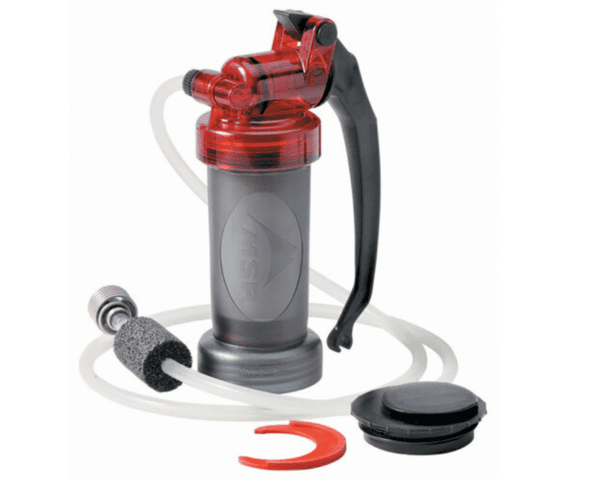
(Picture courtesy MSR)
Of course, bigness is relative. The MiniWorks uses an activated carbon filter with pore size of 2 microns. Which to a layman might seem pretty small. But to a virus, it’s like Steph Curry hitting a 3-pointer from beyond the arc. Swoosh. Straight through. Nuthin’ but net. You see, even the biggest virus is no more than 0.5 microns at its fattest point. So a 2 micron filter leaves them quoting MC Hammer*.
Enter the water purifier
Technology has improved significantly over the last decade or so. Today, filters using ultrapowdered activated carbon and electroabsorption can stop particles down to 0.2 microns across. Which is like putting Shaq on a ladder in front of the hoop. (Sorry to those of you who don’t follow the NBA!) Anyway, let’s just say that these filters are very very small.
So once I got over my shock that actually, for the past few decades we haven’t actually been as protected as I thought we were when we were camping in the back country, I zeroed in on the products out there using these new whiz bang filters.
(I also briefly considered purifiers that use LED to ‘zap’ all the nasties out of the water. But I discounted these because a) they generally don’t actually filter the water first, meaning any dirt or particulates in the water will still be there after being zapped, and b) I didn’t want to be reliant on batteries – rechargeable or otherwise – while we were out on the trail)
So who were the competitors, what were my criteria, and why did I settle on the Grayl Ultrapress?
The competition
Although there were quite a few choices out there, including plenty of ‘bargains’ on Amazon and eBay, I opted to limit my choices to name brands, and specifically those that had been reviewed by other fellow travellers and/or gear review sites. Because this wasn’t something that I’d be able to test beforehand, I was pretty reliant on other people’s hands-on experiences. Here’s the shortlist:
LifeStraw
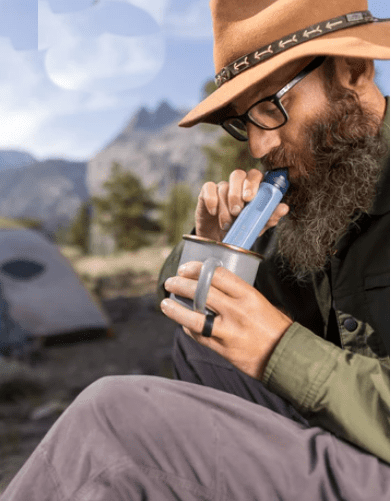
There was an initial appeal with the LifeStraw, mainly driven by size. This thing is super small and pretty versatile. Not only can you drink right out of a lake or stream (or just a glass or other small container), you can also attach it inline with your camelbak/water hydration system. So you can stick 2L of dirty water in your knapsack, and sip out clean purified water on the other end. That is super cool.
So why didn’t it get the nod? Two reasons. First, if you do go the camelbak route, it means that you’re basically committing to filtering every single dsip of water you take, because a) you;resplicing in the LifeStraw into your hose, and b) as soon as you dump dirty water in the bag, it’s kinda dirty ‘forever’. (Or at least until you can give it a good thorough washing).
But there’s an even more compelling eeason why I didn’t like this one, and it’s right there in the name. STRAW. Drinking no longer is a somewhat passive exercise; you, and specifically your mouth, need to be active participants in pulling the water through that filter. By sucking. And as the filter gets progressively more clogged over time (which is normal), you’re gonna be sucking harder and harder. Not to put too fine a point on it, but that isn’t my idea of having a nice relaxing glass of water. So the LifeStraw was out. (Picture courtesy Lifestraw)
Gravity feed
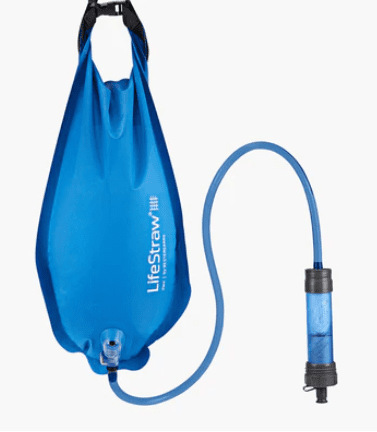 Ironically enough, my original plan had been to take our MSR gravity feed filter (that we’d recently replaced our MiniWorks with). It has been super convenient in the back country – no more pumping a handle for twenty minutes to get your water – just dip the ‘dirty’ bag in the lake, attach it to a tree with the ‘clean’ bag below it, and go and do something else. Come back a few minutes later and voila, you have clean water. (There are a few different systems out there. The one pictured is courtesy Lifestraw).
The main reason I decided not to go this route was that it was pretty bulky to carry both the clean and dirty bags as well as the hose and filter. Add to that I wasn’t expecting to be regularly near any trees or lakes, so… the bag system’s out.
Grayl Geopress
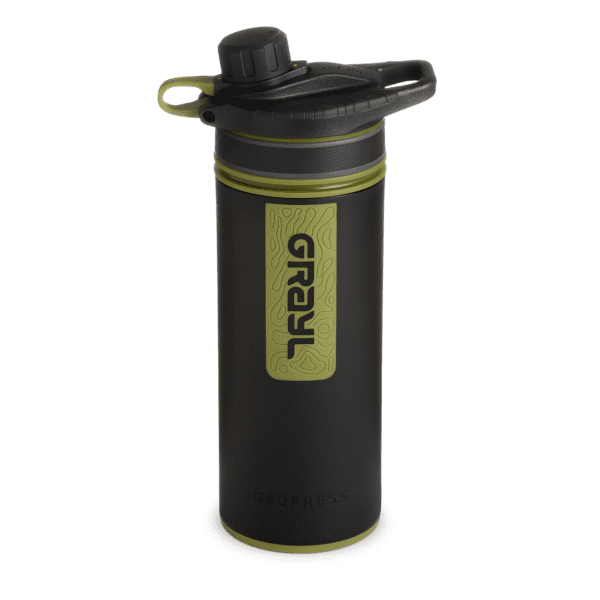
(Picture courtesy Grayl)
One of the things that I loved about both of the Grayl offerings was that they look like and act like regular old reusable water bottles, like the ones you take to the gym or carry around with you on a hot day (or at least like we do).
To be honest, the Geopress was the one that I thought I was going to buy. When I saw the reviews of how the Grayl system works, I was like – wow – this is super cool, Pull the outer and inner containers apart, fill the larger outer one with dirty water, put the inner one back in and push down with your hands and… 10 seconds later, you have just under a litre of clean, purified water. It’s a miracle! (It’s actually science)
I actually had the Geopress in my hand, walking around REI. I was cruising around browsing/looking for other cool stuff, but didn’t want to get distracted and forget why I was there, which was to buy the Geopress, so I kept it in my hand. And…it’s giant. It’s like the Super Big Gulp of drink bottles. I mentioned Shaq earlier, and this thing would probably be perfectly sized for his giant mitts. But for normal sized humans, this thing is uncomfortably large. Forget about putting it in cup holders, forget about sliding it in your bag’s side pocket. This thing is monstrous. And carrying it around by the top handle is no more pleasant. The handle is at an awkward angle, and I just couldn’t find a comfortable way of carrying it. To the poinjt that after ten minutes lugging it around REI, I couldn’t wait to put it down and pick up…
Grayl Ultrapress
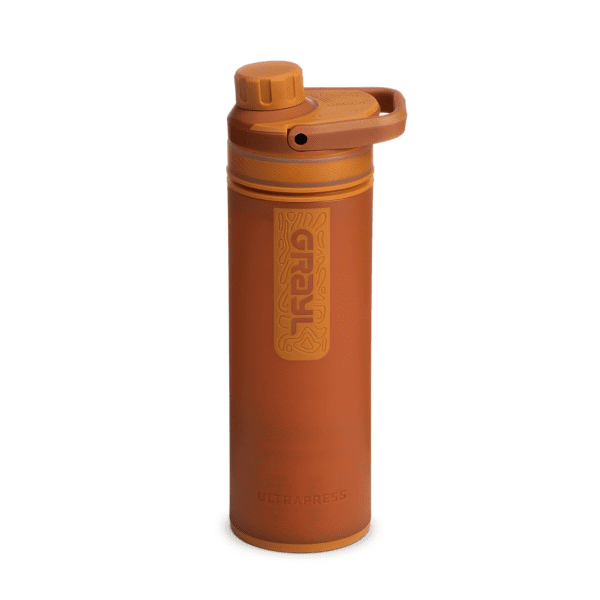
If I’m honest I didn’t think that I would be buying this one. Before I held it in my hand, I thought there were two design flaws that were deal breakers.
Firstly, it only holds about 500ml of water, but the bottle itself is more like the size of a 750ml with the filter in the bottom of it. I didn’t think that 500ml would be enough when you’re out hiking, or even when you’re out walking.
Secondly, while the Ultrapress’ larger brother has a cap that is secured to the lid so you can’t lose it, this guy’s cap is not. So it’s reasonable to imagine accidentally dropping that cap somewhere where you may not want to pick it up again…. And, you can’t take the cap off and have a drink with one hand (at least, I can’t). Add to that, the threads are not the same as, say, a disposable water bottle so if you lose it, you are in some trouble.
With those negatives in mind, I had pretty much discounted the Ultrapress. Right up until I realized i didn’t have giant pancake hands to hold the Geopress, and was forced to dismiss it. And… from the first time I held the Ultrapress in my hand it just felt… right. They’ve done an amazing job with the aesthetics; it’s shaped just right, with rubbery bits in all the right places. The carry handle is comfortable for… carrying it, and you very quickly get used to the bit of extra weight compared to a non-purifying water bottle.
Over the last month or two I’ve used it as my primary water bottle, and the terror of losing the lid has gone away, as has my urge to try to open it one-handed. (I think when I mainly look for a one-handed option is when I’m driving, which I haven’t been doing much of lately. When I’m out walking using both hands feels normal).
And, if you don’t want or need to purify the water, you can just use it like a regular water bottle. Just pour the clean water straight into the main container. It’s only when you need to purify and/or you want to dazzle your friends, that you separate the two halves and press them back together like some ancient water-alchemist. (Again, science).
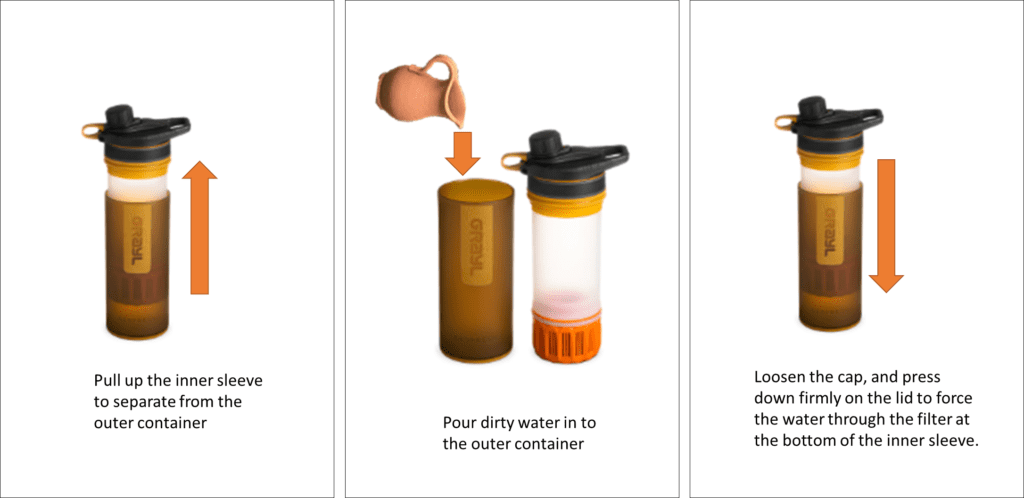
The 500ml capacity is still a concern. But, our plan when we’re out on the trail is to use the Grayl to purify water and then transfer into our other containers (camelbak, water bottle, etc). So it’s really only when you’re doing some urban adventuring that the capacity is an issue. And I can live with that.
Now, this is not a cheap device. It’s over $100 CAD/AUD, and the filter doesn’t last forever and will need to be replaced regularly (and also not inexpensive). I’ve packed a spare in case we can’t find them in South America / when we need one.
But, for our purposes it ticked the right boxes. And given the number of countries/environments we plan on visiting in the next six months where we just can’t be sure of the water quality, we felt it was worth the expense.
*Can’t touch this.