
The one where we spend a week or two driving around Scotland, starting with the Highlands and ending in Glasgow.
This is part two of our Scottish Highland Fling series. To read the first part, click here!
We rejoin our intrepid travellers at Inverness, at the top of the Great Glen and Loch Ness:
Journey Down the Great Glen
With a long drive (for Scotland, anyway) ahead of us we thought we’d opt for an audio book. Michelle was thinking something along the lines of Bill Bryson’s hilarious anecdotes of his walk through the UK, but Al had other ideas. So as we drive out of Brora the car fills with the BBC 2000 audiobook adaptation of Macbeth, replete with a rich Scottish brogue.
At the end of the last ice age about 400 million years ago, two tectonic plates came together to form the Great Glen that today stretches all the way from Fort William in the southwest of Scotland to Inverness in the northeast. (Fun fact 3 – this is the same fault line that caused the remarkable geological features found in Newfoundland’s Gros Morne National Park, before the plates separated and formed the Atlantic Ocean. We loved that place.)
Glaciers scraped through the glen, and the resulting string of lochs had for centuries taunted the locals who just knew that they should be able to be connected together, if only someone could just figure out how to do it. It wasn’t until 1803, when the combination of economic and political conditions (mass unemployment following the Highland Clearances) and the reputation and lobbying strength of that famous Scottish engineer Thomas Telford, was enough to finally kick off the massive engineering effort required to build the canals and realise the dream of an ‘inland passage’ across Scotland.

The canal literally slices Scotland in half, allowing steamships to avoid the treacherous North Sea route
Construction of the canal and lock system took 19 years to complete and by the time it was finally completed in 1822, (wait for it…) steam-powered iron hulled ships were too big to travel through the canals, and the threat from Napoleon’s France was gone so the Navy didn’t want to use it either. Like many other canal systems around the world built at this time (see: Rideau Canal, Erie Canal, Göta Canal, etc etc), railways and steam-powered ships looked to be the death-knell of the Caledonian Canal, but luck would provide a different path. Queen Victoria’s trip up the canal in 1873 and the resulting publicity saw a huge upsurge in tourist traffic. That traffic continues to grow, with upwards of half a million visitors each year. Add three more to the total, as our own journey begins at the top of the loch system, in Inverness.
(Fun fact 4: the ‘Inver’ in Inverness means ‘mouth of the river’ in Gaelic, in this case the River Ness. The Celtic equivalent is ‘Aber’, as in Aberdeen – mouth of the River Deen. Nope, the River Don.)
We head off from Inverness, following the length of Loch Ness on the northern shore. This is a very picturesque drive, as it winds through the forests and we catch glimpses of the mighty beast loch as we make our way along the northwest edge. Midway down we foolishly try to stop at Urquhart Castle without a reservation HA! It appears we’ve come within the radius of city day-trippers, and – big surprise – Urquhart Castle is in Outlander. It’s a half hour wait just to get into the car park. We drive on.

This pic is straight from Wikipedia, because we didn’t get to see the castle.
By the time we reach Fort Augustus at the bottom of Loch Ness, King Duncan is long dead and Banquo is next. We get out to stretch our legs and see if Nessie is going to poke her head above water – alas, not today. There’s a great little museum here (where, full disclosure we ‘lifted’ many facts about the locks and the canal (see what I did there)) and we grab a few things for a picnic lunch. Sitting along the edge of the canal, we watch a few boats make their way up the ladder of five locks through the village.


Mystery solved!
Lochs and Locks
Now, there are a lot of lochs here in Scotland, and it seems that either they started to run out of names at some point, or they foolishly held some sort of ancient gaelic equivalent of a twitter poll to come up with the name of one of the lochs; how else to explain ‘Loch Lochy’. In the finest tradition of Boaty McBoatface, Planey McPlaneface and Ferry McFerryface. (Wanna go down the rabbit hole? You’re welcome.) (Later we’ll come across Loch Drunkie, but I think we’ve got a pretty good idea where that name came from)
Next stop on our lock (loch?) tour is Neptune’s Staircase, just north of Fort William and in the shadow of Ben Nevis. (Ah Ben, perhaps next time we will scale your cloudy heights). By this time Lady Macbeth is scrubbing her hands non-stop, Malcolm’s family is dead and Birnam Wood is on the march towards Dunsinane Castle.
With nine locks, Neptune’s Staircase is quite the engineering marvel, and the friendly lockmasters are happy to tell us a little bit about how it all works as they shepherd a few boats through.


We jump back in the car (Macbeth learns that Macduff is a child of caesarean birth – plot twist! Macbeth’s dead, Malcolm’s king, play’s over) and dash over to Ben Nevis Distillery (which randomly was owned for a short time by a Canadian) for a whisky tasting. These are healthy shots and there are five of them. Tough trip, this. Then it’s off to our hotel and on to dinner. We walk into town and to a promising looking pub. Fort William is known as a bit of an action adventure hub, but you wouldn’t know it from the high percentage of Q-tips in town. (Michelle loves this name and doesn’t seem to understand that she’s married to one). We can’t resist the ridiculous suggestion of haggis nachos with tattie scones. Actually not too bad – when in Caledonia, as they say.

Water shmawtter
Let’s all go to Glencoe
This corner of Scotland is absolutely stunning, and if you’re a hiker (and even if you’re not) there are some fantastic places to visit, way more than we had time for this time. From Fort William you could easily continue following the winding coastline, exploring the villages, castles and lochs liberally sprinkled through the region, and eventually make your way across to the Isle of Islay for the peatiest of peat scotches. But for us this time, we’re continuing back towards Glasgow. We take a bit of a circuitous route to take in some highland scenery and see if we can spot a highland cow or two.

Fort William
Not far from Fort William is Glencoe, which has quite an unfortunate description in the guidebook as ‘grim’(?). I guess it depends on the weather and the season (and maybe because of its sordid part in Scottish history – i.e. the Glencoe Massacre) but on our drive through the glen it is spectacular. We stop at the Three Sisters Viewpoint for a – I keep saying this – spectacular view. There are some great hiking trails through here too – well worth spending a day or two exploring, if you have time. But we loop back and drive back the way we came, through this (you guessed it) spectacular glen, hit the coast and turn south.

Glencoe

The weather was seriously good while we were here
Trossachs Trail
Like I said, there’s really no wrong way to go to get from Fort William to Glasgow – everything is beautiful, the driving is easy and the distances aren’t long. We could have easily carried on east along the A82, but instead we double back, meander down the coast (best scones so far at the Racer Café!) and then head inland on the A85, eventually meeting back up with the A82 at Clifton and continuing in a generally easterly direction.
Our target today is the Trossachs Trail; this is a roughly 40 mile (60km) loopy-road-slash-hiking-biking-walking trail that makes its way through the northern reaches of Loch Lomond & The Trossachs National Park. It’s just a beautiful drive, with lots of hiking and biking trails to explore. The highlight of the drive for us, though, is lunch at the Venachar Lochside, with sparkling sunshine and Al’s best meal to date (cabbage no less!).


After lunch we continue with a beautiful winding drive through the hills but ‘no a caw’ to be seen sadly. Eventually the idyllic countryside gradually gives way to houses, which give way to the outer suburbs of Glasgow, until we eventually find ourselves in the middle of the hustle and bustle of the largest city in Scotland.
All hail the Glaswegians
It’s worth mentioning that today we’ve crossed the line between the Highlands (mountainous) and the Lowlands (flatter, rolling hills). The boundary runs diagonally across the country, like so:
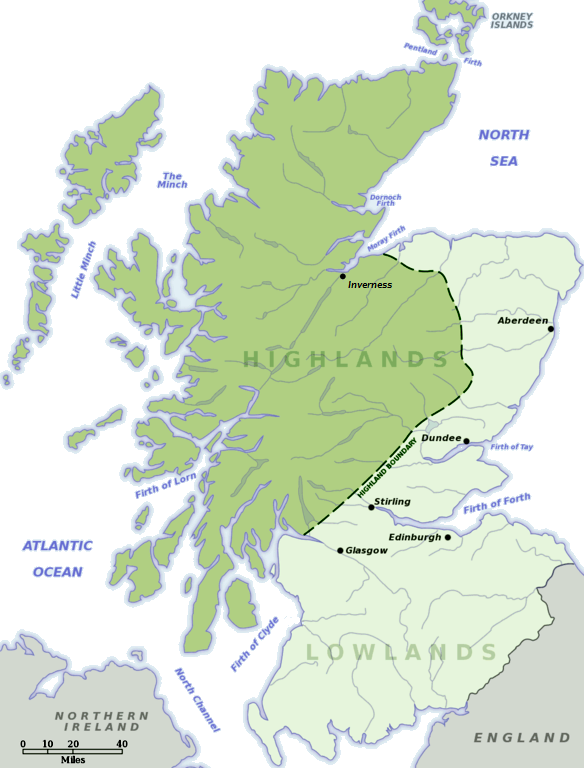
Anyway, before this trip our knowledge of Glasgow was limited to music (Simple Minds, Franz Ferdinand, Belle and Sebastian….) and the scar of the memory from our road trip 20 years ago when we’d not been able to find anywhere to stay in Glasgow and had to drive out after just a few hours. At the time, we had no idea we’d stumbled onto a design centre and foodie heaven.

Unusually for Glasgow, this statue isn’t wearing a traffic cone
In search of Charles Rennie Mackintosh
Thanks to Marj, our Glasgow visit has a distinct Charles Rennie Mackintosh theme. We’d never heard of this Glaswegian who is one of the ‘Legendary Four’ that helped shape Scottish design and architecture in the early 20th century.
A controversial figure while he was working, his talent and effect on design was never really celebrated in his lifetime. We started at the Hunterian gallery with the Mackintosh Apartment at the University of Glasgow where the apartment Charles and Margaret designed has been completely recreated. It’s a bit of a surreal experience walking into a 1920’s house completely contained within the walls of a modern museum. Everything from the fireplace to the furniture to the rugs to the art on the walls was designed and created by Charles or Margaret, and despite it being over 100 years old much of it looks amazingly modern. Everything old is new again, indeed.


Mackintosh and the Willow Tea Rooms
Over the years Scottish governments have tried to control the situations that arose from ingesting large amounts of very strong home-distilled whisky. Opening breweries as an alternative, or setting up distilleries that controlled the alcohol content were both tried. In the early 20th century tea rooms were in vogue as a place to socialise that didn’t involve copious amounts of very strong whisky. Whether or not this was actually effective is open for debate, but what isn’t is that the scones in this place are magnificent and opulent.

High tea at the Willow Tea Rooms

More Mackintosh
Next we visit the Kelvingrove Museum, which has a (less impressive, but still good) installation of the Mackintoshes’ furniture and art.

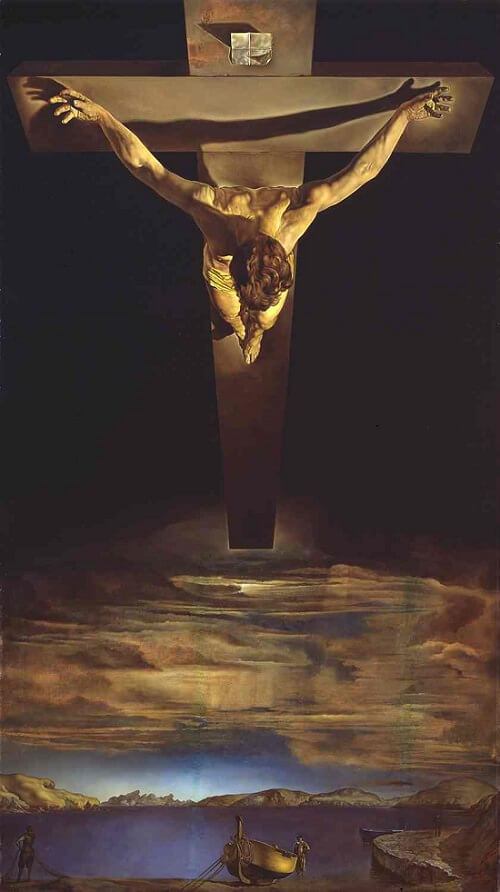
This museum is interesting, in that it seems to have a little of everything. (Though if you really want to experience a hoarder’s paradise of bric-a-brac in joyous disorder, try the Hunterian Art Gallery just across the River Kelvin!) But the star of this museum is without doubt Dali’s Christ of Saint John of the Cross. For those of us who only know Dali for his melting clocks and camel-legged elephants, this piece demonstrates Dali’s brilliance as an artist, not to mention his ability to generate a ruckus of controversy.
The Hill House
We round out our Mackintosh trail with a visit to a house designed by Charles Rennie Mackintosh for a book publisher, in the town of Helensbourgh about 40 minutes outside of Glasgow, called the Hill House.

This house, built early in Charles’ career, was revolutionary and daring when built, using groundbreaking materials and techniques at the forefront of their time. The Blackie family, who commissioned the building, lived there for nearly 50 years so it was also an extremely livable home. ‘Everything’ in the house has been lovingly retained and restored by the National Trust to allow visitors to experience the house as the Blackies would have lived in it.
Unfortunately some of the materials chosen by Charles haven’t fared as well as others, including (crucially) the Portland cement exterior. 100 years of Scottish sun lashing rain and damp have ravaged the walls, which have become saturated and crumbling. Somewhat controversially, in an effort to prevent the house from literally disintegrating, the National Trust has built a ‘cage’ around it made up of very fine chainmail fencing which keeps the rain off but allows the wind to gradually dry out the walls over the next decade or so. They’ve done quite a good job of making the cage a feature by building stairs all around that allow you to walk around the building and enjoy the sweeping view of the bay at roof level. It’s a really cool building and worth the trip out of Glasgow to see it.


Burrell Collection
Another day, another magnificent museum. Today is the Burrell Collection, about a twenty minute drive south of Glasgow. The history of this museum is crazy. Back in the late 1800’s, Sir William Burrell made his fortune in the family shipping business, and then spent the next 75 years pursuing his real passion, which was collecting art and antiquities from all over the world. He was the major donor of art to the 1901 Glasgow International Exhibition, the proceeds of which enabled the creation of the Kelvingrove Art Gallery which we visited a few days ago. Then in 1944 he donated his entire 9,000+ art collection to the city of Glasgow, providing all people of the city free access to his collection in a beautiful countryside setting. The importance of the eventual opening of the gallery in 1983 cannot be overstated – to quote the website, “it sparked the regeneration of Glasgow as a major cultural city, following decades of post-industrial decline. In its first year of opening, the museum attracted more than one million visits.”
Add three more to the list of visitors. Visits continue to be free, and it’s well worth an afternoon.
The Auld Alliance
And with that, our not-quite-two-week adventure in Scotland draws to a close, and our eyes and stomachs turn towards Paris. What we didn’t realise when we’d paired Scotland and France together was that we were following in the footsteps of 700 years of history. Way back in 1295, the kingdoms of Scotland and France made an alliance against – who else – the English, which has endured to this day. (Rugby aficionados would be familiar with the Auld Alliance trophy, which Scotland and France play for as part of the Six Nations Championship. We were not). So, like Mary Queen of Scots and Bonnie Prince Charlie before us, we make the perilous journey across the North Sea. (We fly Easyjet). But that will have to wait for another post.


Glasgow in a Nutshell
- The west end of Glasgow is a great place to base yourself. The beautiful leafy Kelvingrove park is a great place for a walk and a people watch as locals enjoy the sunshine. It’s also close to the university, Kelvingrove Art Gallery and Museum and lots of great cafes and restaurants.
- The main sights are quite walkable from the west end.
- The city is quiet in the morning. Most of the city doesn’t open until 8am, with many galleries not open until 10 or 11am.
- The Hop-on-hop-off bus is a great way to get your feels for the city. Be aware that the first bus of the day leaves George Square at 9:30am, so it won’t get to you in the West End until about 10:15am.
Meals
Glasgow didn’t disappoint on delivering on the title of Foodie City. We had some amazing meals with a mostly Scottish seafood focus.
Finnieston – tapas style
The Bothy – Scottish but not heavy. Delicious – we went twice
Crab Shakk – delicious seafood. The tables upstairs are small and close which increases the chances you’ll end up chatting to the next table (who might be Swedish music journalists in town for the concert of a legend)
The Ben Nevis Bar is a great small pub that plays live music every night.
The Pot Still is a bar in the centre of the city with a huge range of whiskies to try and group tastings in the corner of the pub.



…or follow us on Instagram…