

Los Bonitos Barrios de Medellin
There are generally two barrios (neighborhoods) that gringos stay – La Poblado and Laurales. La Poblado is one of the oldest neighborhoods in Medellín, but you wouldn’t know it by looking at it. It’s filled with bars, restaurants, shops big and small, and the requisite Starbucks. In a word, it’s gringo-central.
We chose to stay in Laurales, which although appears to be slightly more expensive, it’s also slightly less filled with extranjeros (foreigners). While we don’t mind extranjeros – I mean, we’re extranjeros ourselves – we really do enjoy trying to immerse ourselves as best as we can in the local culture and language.
And indeed, that has been our experience so far. Although there is some English spoken in Laurales, it definitely defaults to Español primero. We really enjoy trying to stumble our way through conversations with the local shopkeepers and anyone else who will speak to us. They probably HATE what we’re doing to their language, but generally they’re pretty good natured about it. We’re taking 7 days of Spanish language classes while we’re here, so con un poco de suerte we’ll start to get better in the coming weeks.
A Word About Accents
While we’re both native English speakers, we’ve both studied French in the past, and so the use of accents on words isn’t totally foreign. (Even English throws in the occasional café or touché-type accent here and there.) In Spanish, we were gratified to learn that there’s only one type of accent used*, and – even better – it’s there to tell you how to pronounce words. Whenever you see an accent over a vowel, it’s telling you that’s where the stress on the word should be.
Take Medellín as an example. You’ll see there’s an accent over the last ‘i’. That tells you that the stress is on the final syllable in the word. (If there’s no accent at all on the word, it’s generally on the ‘middle’ syllable). Now, keep in mind that two L’s means it’s a ‘j’ or ‘y’ sound, and you have Med-eh-JINE. Easy, eh?
(* Technically there’s the ñ accent too, but we’re all familiar with that guy – remember el niño and la niña?)
‘Alumbrados Navideños’ (Christmas Lights)
OK, so I said we were staying in Laurales. And that’s what the Airbnb listing tells us. But a recent trip in a cab told us otherwise. We were sooo proud of having learned how to get in a cab, say hello and how are you, tell him our address and the nearest cross street, all in Spanish. But it started to fall apart when he went off script, and asked us something our Spanish teacher hadn’t prepped us for. After some rapid fire Spanish at us and blank looks all round, we finally figured out what he was saying. Turns out our apartment is actually in Conquistadores, which (although nice), isn’t nearly as… distinguished, shall we say, as Laurales. ‘Laurales-adjacent’, perhaps. We all had a good laugh about it and he got us home.
Anyway, one big advantage of staying in Conquistadores is that we are about a three minute walk from one of the biggest and most spectacular Christmas light displays in the southern hemisphere, known as ‘Los Alumbrados Navideños’ . Tens of thousands of people come from Colombia and around the continent, just to see these lights. There are actually two locations for the lights; we’re near the Rio Norte display.
This year’s theme was Disney’s ‘Encanto’. The world of Encanto is based in Colombia, and the story is heavily influenced by ‘magical realism’, which is in some ways a uniquely Colombian way of looking at the world and no better encapsulated than by the works of Gabriel García Márquez (100 Years Of Solitude, which Michelle read just before we arrived). Magical Realism can be described as what happens when magic mixes with the real world, and to many Colombians it’s not only limited to works of fiction. The idea of magic existing in everyday life is much more commonly accepted than perhaps anywhere; one might wonder if with all of the challenges that Colombians have faced over the last century, perhaps there’s also an element of a coping mechanism in it.

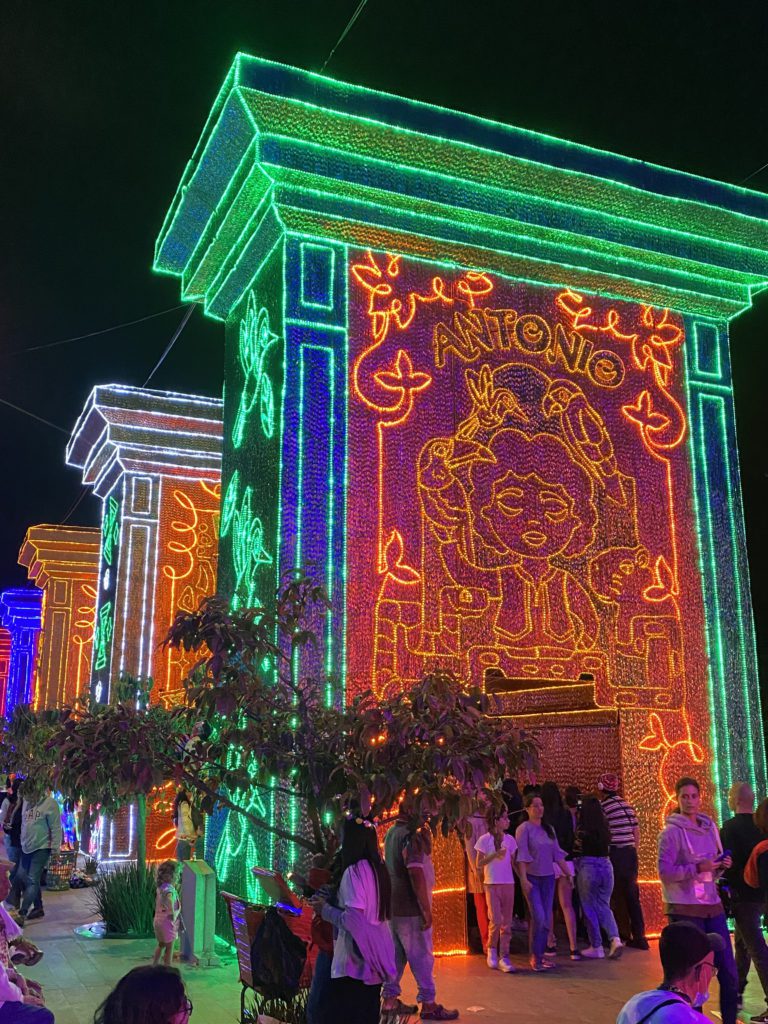

In any case, we wandered out a few evenings and enjoyed the spectacle and the crowds. The riverfront was packed full of families taking pictures with their favourite character (usually Mirabel) and people selling stuff (balloons, toys, apples on sticks, meat on sticks, etc). It felt warm and wonderful. It doesn’t hurt that the temperature never really drops below 17C here. The weather is gorgeous year-round.
Cabs and Uber: Our Experience
All of the various blogs that we’d read before we arrived in Colombia had put the fear of God into us about local cabs: they wouldn’t use a meter; they’d drive you around in circles to increase the price; they’d take you to a secluded part of town and hold you up. So, we called an Uber when we arrived in Medellín Airport. After quite a bit of messaging back and forth between us and the driver, we finally connected with him and he took us to his car…. out in the parking lot. It turns out that Uber is technically illegal in Colombia, so he’s not allowed to drive into the airport proper. Of course, like many things in Colombia, ‘illegal’ doesn’t mean ‘enforced’. Just about everyone we talked to suggested Uber. It was easier, it was safer. And our experience here with Uber has been great. We’ve actually had the same driver more than once, and had some really nice conversations with them.
That being said, unlike other countries we’ve visited, Uber is not a pre-agreed price: you still pay for the length of the journey, so if your driver gets lost it costs more (which happened). As we gained in confidence in our Spanish (yay classes), we started taking regular cabs instead of Uber. And – they were great. They always use a meter. They take you to where you want to go. They’re friendly. They’re actually probably cheaper than Uber. So, our advice would be don’t think that Uber is your only choice. (We didn’t venture into the world of grabbing a ride on the back of a scooter. Those guys are maniacs!)
Life in Laurales
There is something magical about life in the tropics, and although Medellín is high on a mountain plateau rather than on the Caribbean coast, the signs of life in the tropics are everywhere. From the fruit carts on the streets selling pineapples and mangoes, to the rainforest-like trees lining the many rivers criss-crossing the city, to the afternoon rainstorms that occasionally come to knock the humidity out of the air, there’s no forgetting that you are just a few degrees north of the equator.
We started taking language classes at a small school in Laurales (‘Mister Fox‘). Each afternoon we make the 15 minute walk into the barrio, and usually we’ll find somewhere to have a cappuchino (they do great coffee here) or a Limonada (more on Limanadas later). Occasionally we’ll go in a bit earlier to have a menu del dia (menu of the day) which is basically a big plate of local food for a few dollars.
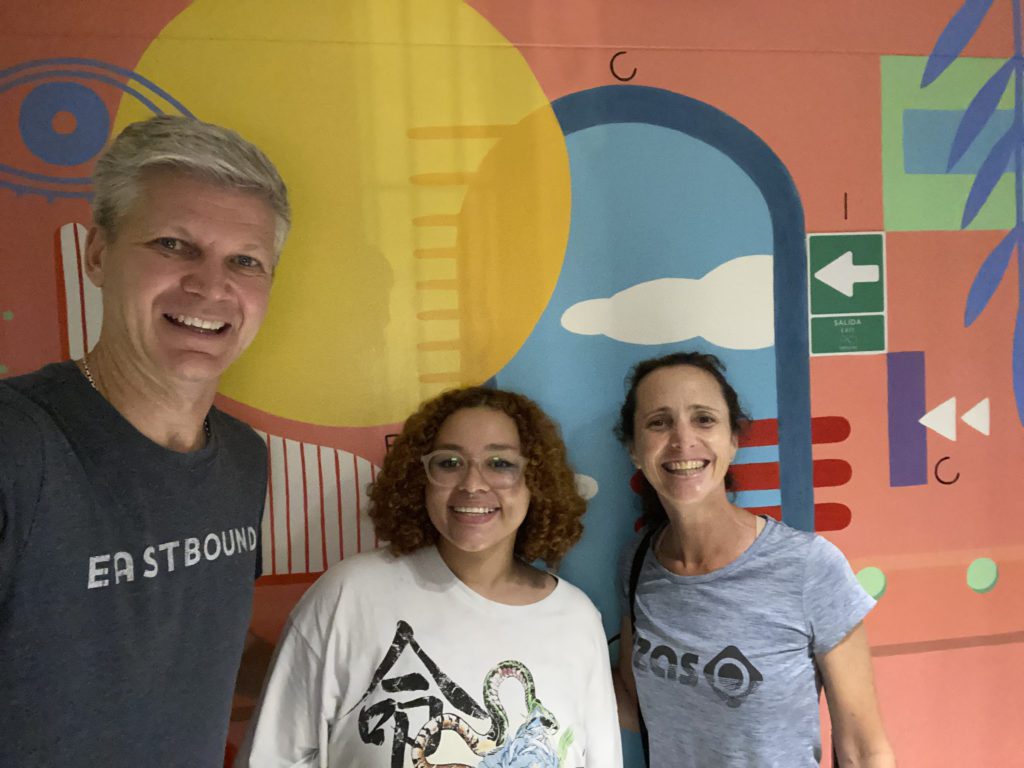
After class we’ll meander through Laurales and find a restaurant for dinner. While traditionally Colombians have their big meal at lunchtime and just have something small in the evening, there are plenty of food options here in the evening. Being the oldies that we are, once we’ve eaten we typically go home whereas every Colombian in the area seems to be getting ready to go out. Do these people not sleep?? Every night of the week, the bars are just starting to kick off at 10 or 11 at night, and we can hear the music playing well into the night from the comfort of our apartamento.
We did spend one very fun evening at a local bar doing a ‘Language Exchange’ followed by a dance class(!). The Language Exchange was really cool: there were about 15 people, a mix of Colombians and extranjeros, and the owner of a local language school facilitated the evening. The activities helped to spur the conversations; we’d speak in Spanish and the Colombians would reply in English, and we’d help each other with vocabulary and concepts. Of course Michelle and Al were speaking some of the most basic phrases you can imagine, but it was still really fun to be able to interact with real Spanish speakers in such an authentic and relaxed setting.
Then came the dancing. Of course Michelle was a natural, and Al was continually saying ‘Perdon’ and ‘Lo Siento’ (sorry) as he mashed on the girls’ feet with his big clodhoppers.
More up Al’s clodhoppers’ alley was the local pickleball sessions, which a small group of (mostly) expats organize four days a week at a sports facility near our apartment. We attended a couple of sessions but decided we’d rather spend the time we have exploring some of the hikes and other activities all around us.

Day Hikes Around Medellín
The way those last paragraphs read makes it sound like we’re living a life of leisure, wandering out sometime after lunch to make it to our Spanish class at 4. The truth is, most days we seem to be racing home from somewhere in a cab, hoping we have enough time for a shower before we have to run over to our class. This being the second biggest city in Colombia, there is plenty to see and do here, including some just incredible hikes.
Medellin is surrounded by 7 large hills that you can see from wherever you are in the city. To be fair they’re actually mountains; you’re already 1,500m above sea level, so these are around 2,000m. Higher than Whistler and similar to Australia’s highest mountain peak. They are green and inviting to the likes of us, although they do look… steep.
Cerro de Tres Cruses (The Three Crosses)
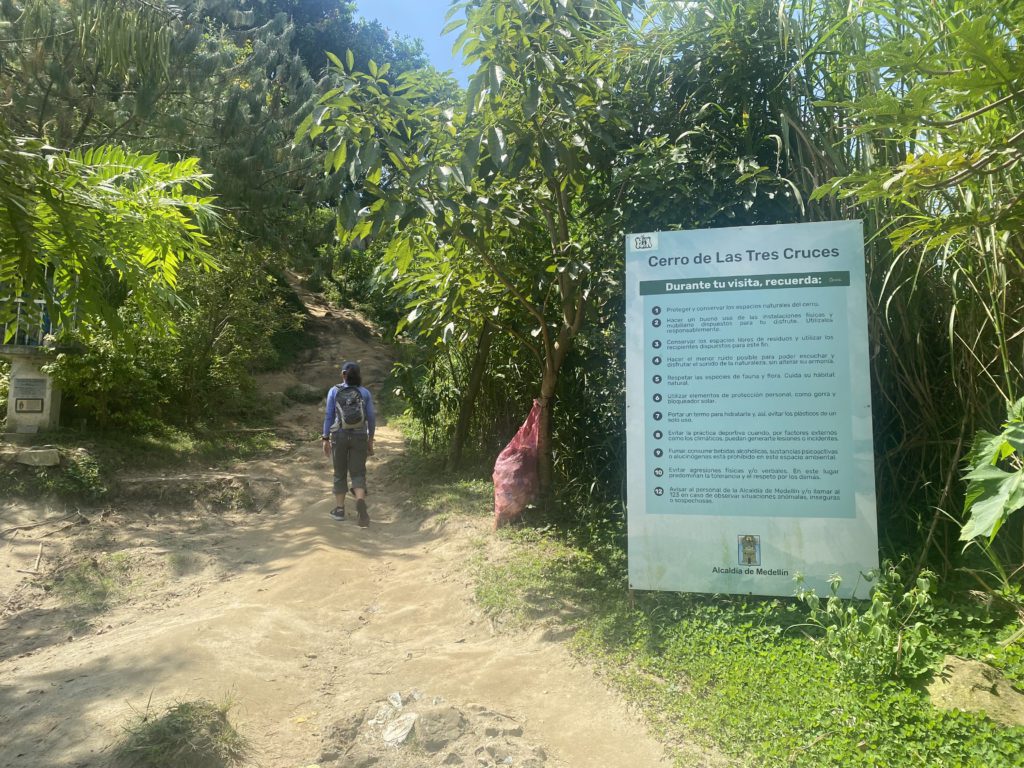
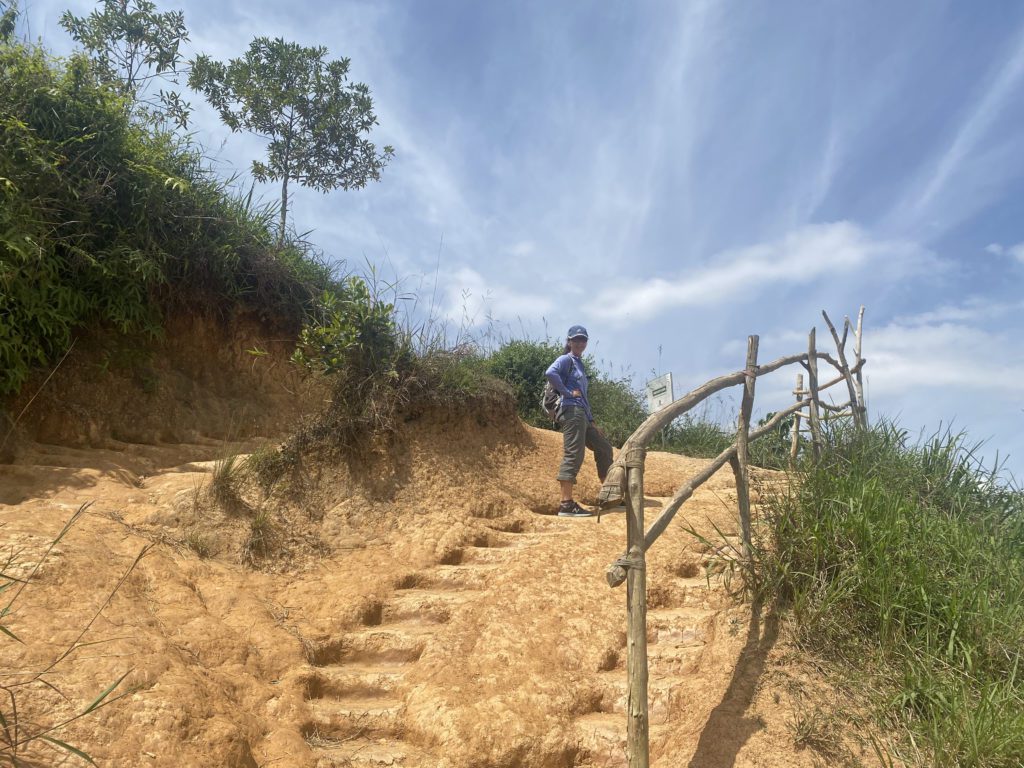
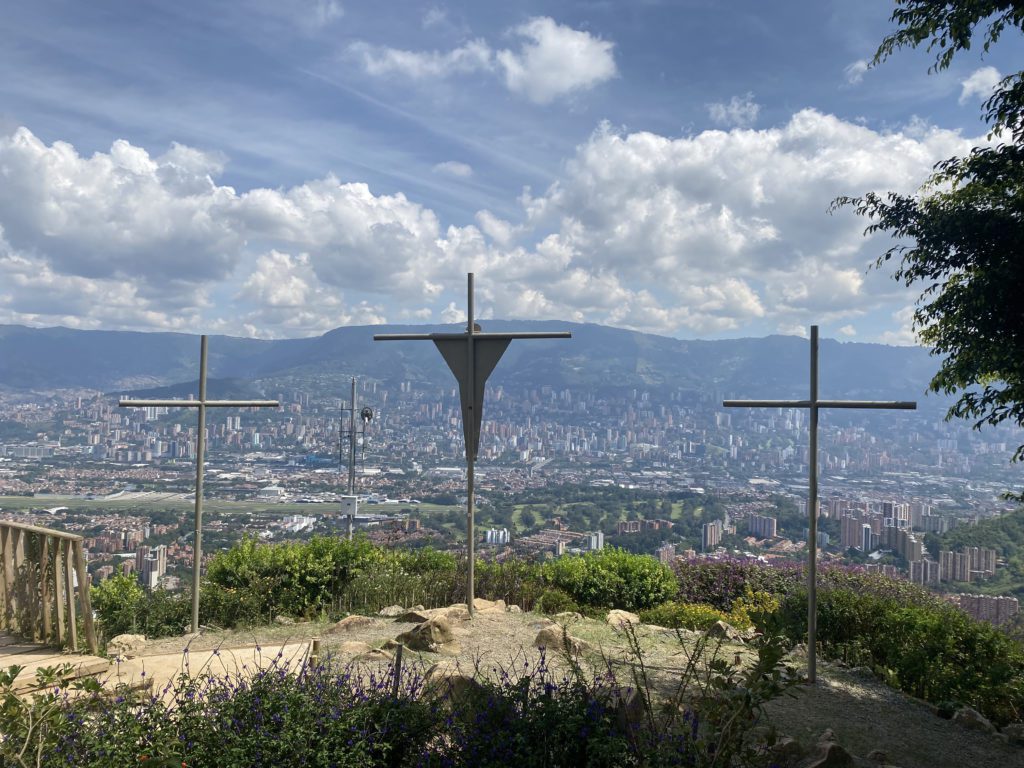
…And they are, in fact, steep. The first hike we did was called ‘Cerro de Tres Cruses’, or the Three Crosses. The start of the path is at the edge of one of the barrios on the western edge of Medellín, and appears to head straight up from the edge of the road. Someone has thoughtfully carved rough steps in the clay to help you keep your footing, but these are no doubt continually washed away by the rain which must gush through these gullies during storms.
Halfway to the top there’s a booth where you can buy some sliced piña (pineapple) and catch your breath, which by now is coming out in great gasping wheezes. It’s about a 45 minute climb to reach the top, where you’re treated to a panoramic view of the city below. If you’re up for it, there’s also a workout area where you can do some press-ups in the afternoon sun. No? Me neither.
La Catedral to Salto del Angel and Campanas Waterfalls to Arenales Viewpoint
When we arrived in Medellín, we started watching an old-ish Netflix series called ‘Narcos’. It tells the story of the narco-terrorists active in Colombia through the 80s and 90s, and much of the action takes place in Medellín. The most infamous of these criminals was born in Medellín, and when he eventually ‘surrendered’ to the authorities, one of the conditions of his surrender was that he would be able to build his own private prison overlooking the city, staffed by guards hired and paid for by him, and no police or army allowed within a 2-mile radius. (As the narrator of the series points out several times, ‘You couldn’t make this shit up’).
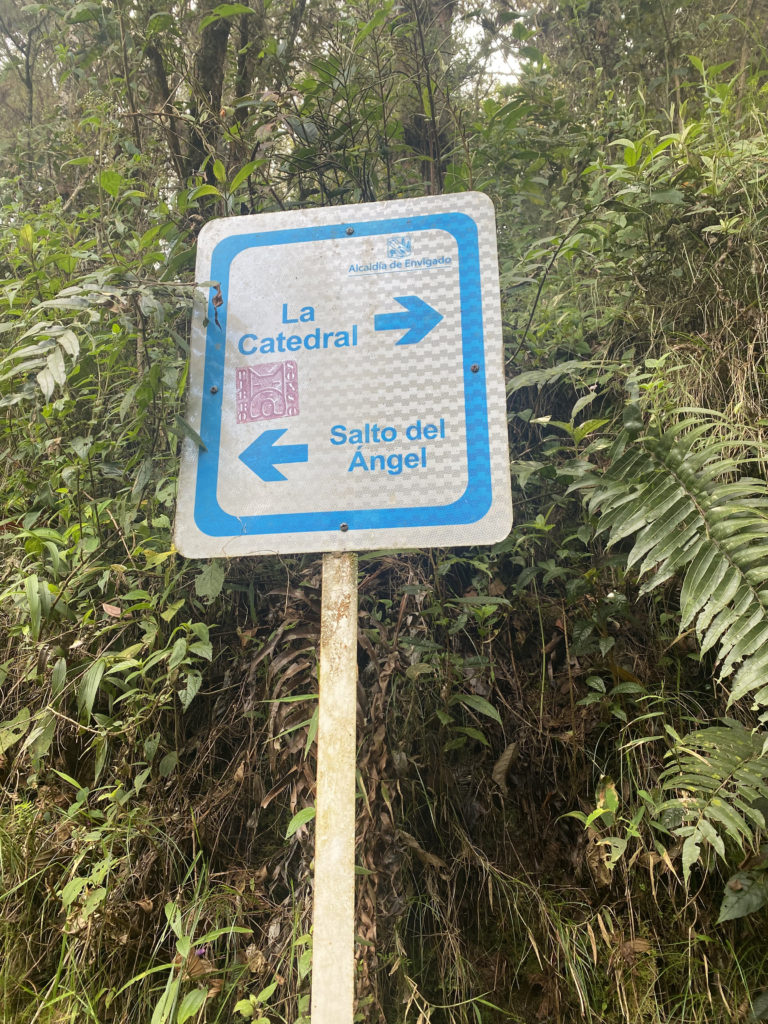
That ‘prison’ was called La Catedral. There is little to no evidence of the original structures there now, and there are several signs reminding visitors of that fact. It’s now the site of an old folks’ home and a church, and we didn’t choose to visit the site due to its history – we chose it because of the spectacular hike that starts from here.
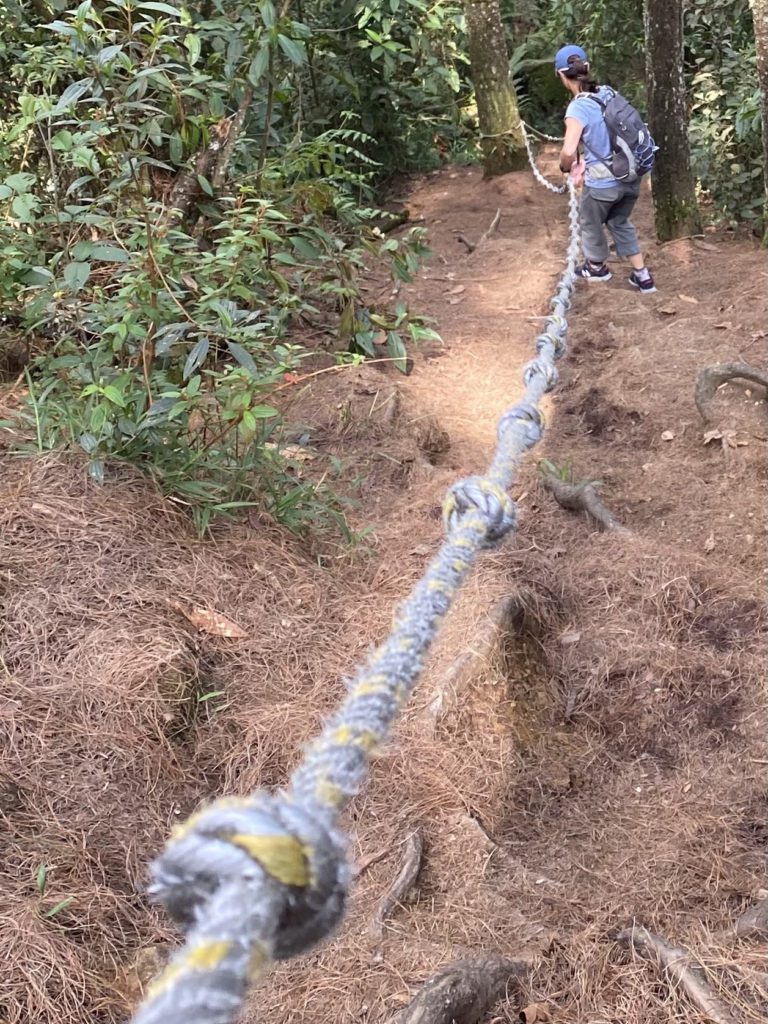
We took a cab up the hill to La Catedral, and from there we verified with a couple of kids (Shouldn’t you be in school??) exactly where the hike starts, and set off. The trail winds through the hills, alternating between thick jungle and deep forest, with some sections equipped with ropes (somehow always ending about 6 feet shy of the ideal spot) to help your descent. Along the way you pass two quite spectacular waterfalls, where you can go for a quick dip before continuing on to the next section.
The second half of the hike generally follows a river that winds its way down the mountain. And by ‘follows a river’, I really mean ‘is the river’. The easiest way down is to take off your shoes, put on your hiking sandals, grab your walking stick (this is almost a must to help you with your balance), and jump into the water. For the most part you’re in water up to your knees, but there are a few spots where the rapids force you onto the path onshore. The water is pretty cold, which means there’s no leeches or other nasties. There weren’t even any biting insects around; it was an ideal hike.
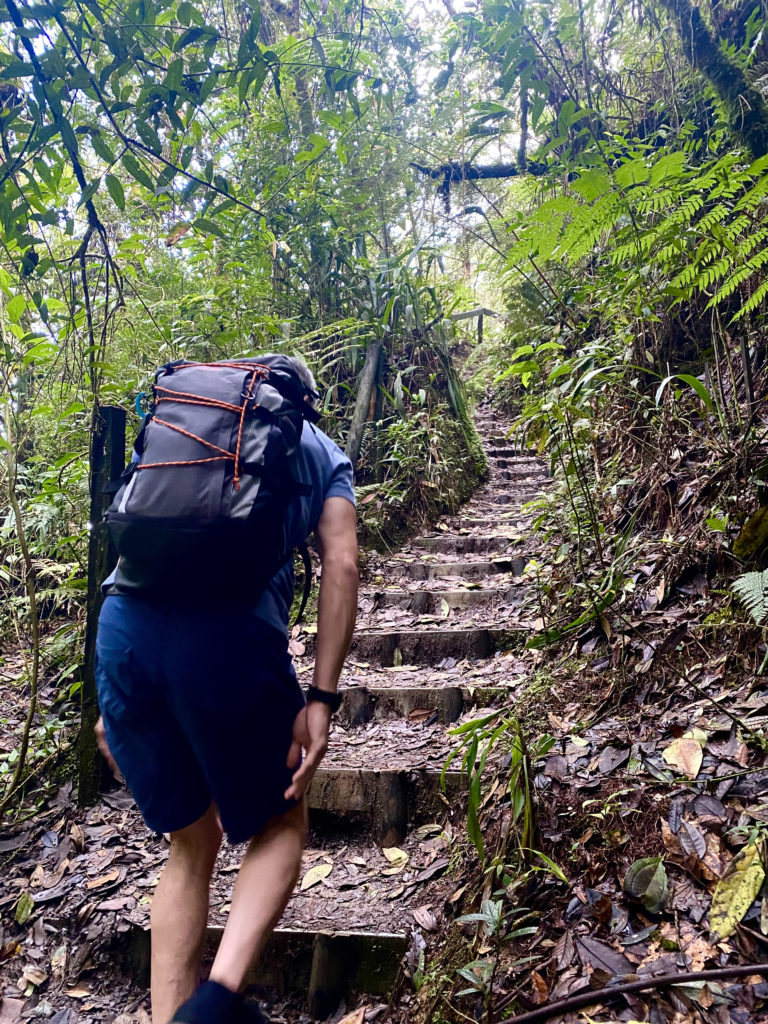
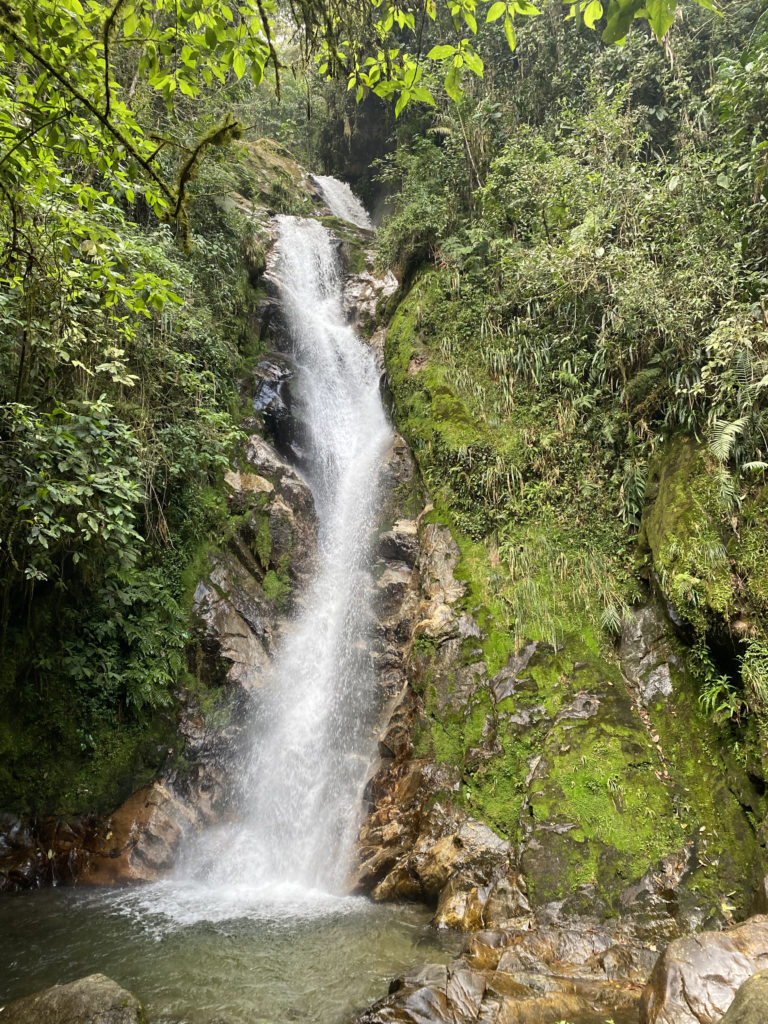
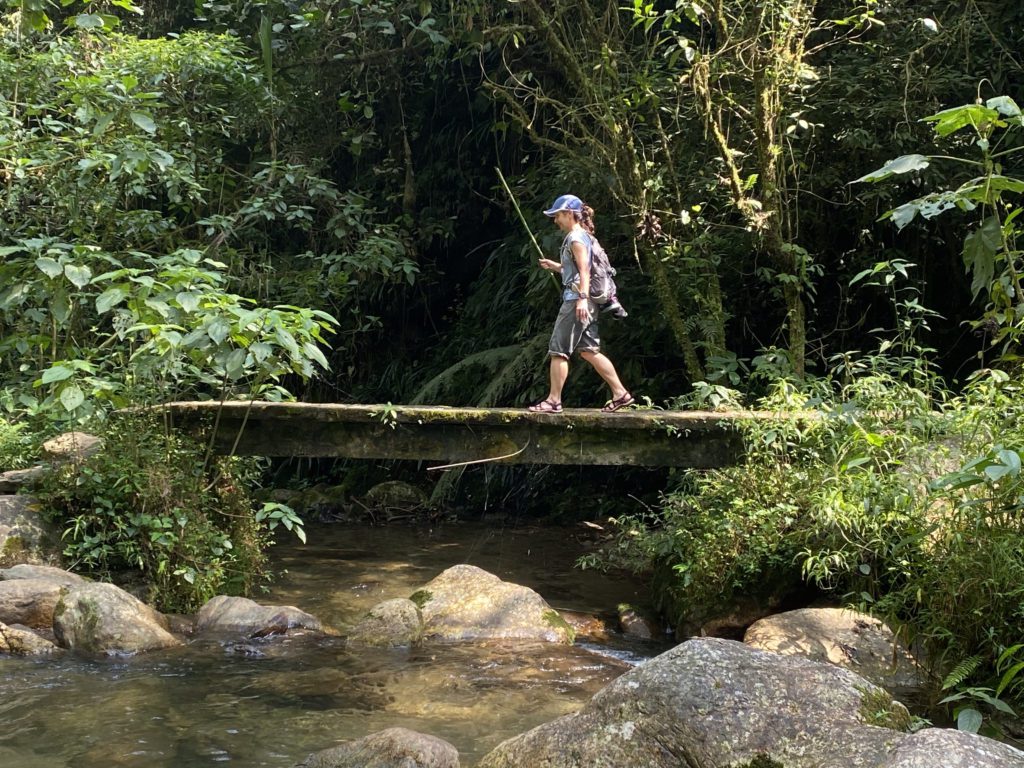
About 4 hours after we started, we emerged on a local road near a local bus stop. We sat with a neighbourhood dog who seemed convinced the bus would arrive soon and, sure enough, about ten minutes later it arrived with his owner on board. We clambered on and enjoyed the fifteen minute ride back down to Envigado, which is a charming part of Medellín that used to be a separate town. Definitely worth a look around if you have time following the hike or on another day. Sadly we had to race back to get to our Spanish class (see what we mean?)
Medellín’s Troubled History: Comuna 13 and the Modern Art Museum
There are two other places that we visited while we were in Medellín, both of which have a direct connection with the city’s violent past. Those were Comuna 13 and the Modern Art Museum. But we’re going to have to save those for a separate post, because there’s so much we have to say about them. Stay tuned! (And if you’d like to get an email when we do post it, sign up below!)